

Frustration Due To Failure In Love Affair: Madras High Court Commutes Death Sentence Of Man In Woman’s Murder Case
The Madras High Court noted that the principle of reformation has gained importance in the criminal jurisprudence and is a significant factor while awarding sentence to the accused.
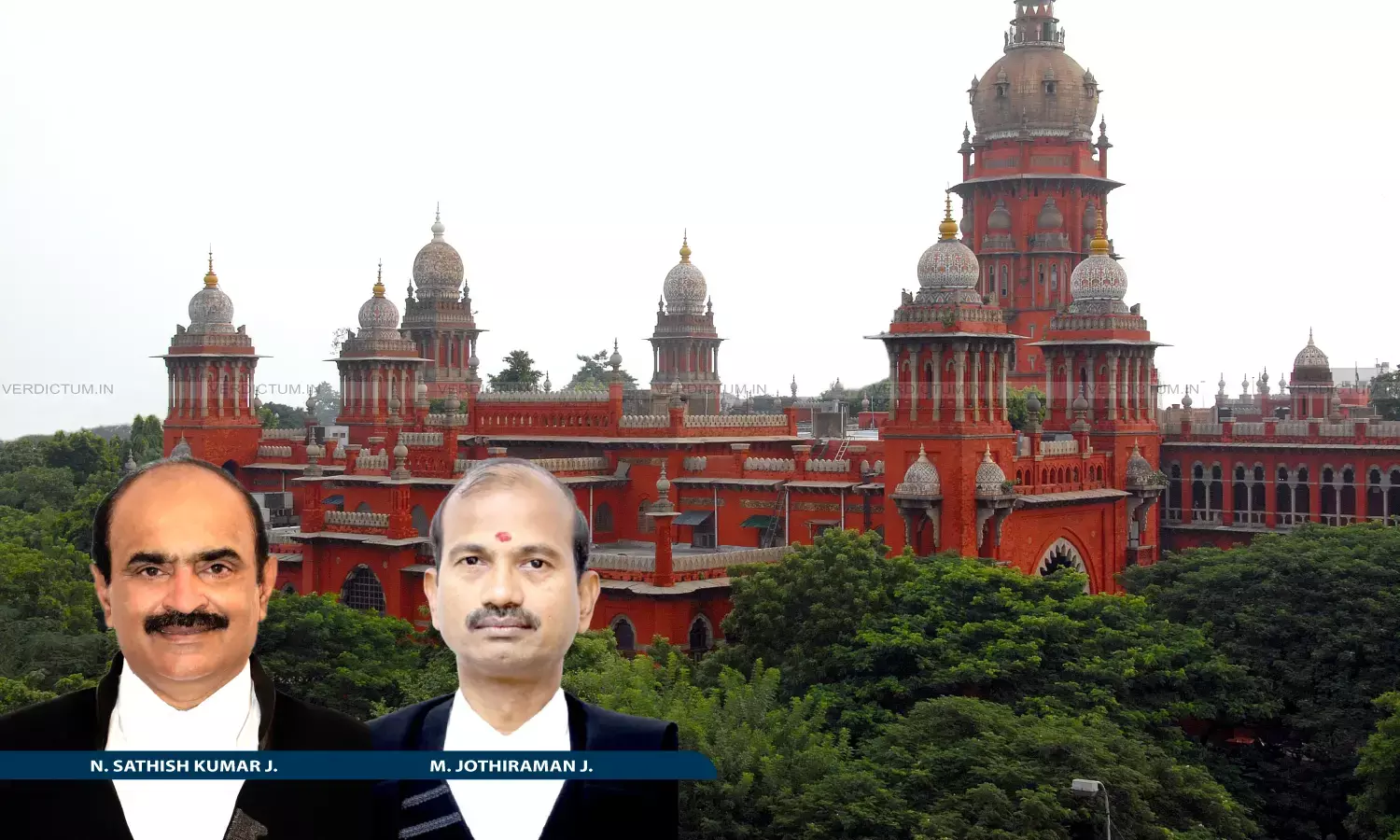
Justice N. Sathish Kumar, Justice M. Jothiraman, Madras High Court
The Madras High Court has commuted the death sentence of a man who was convicted for killing a woman with whom he was in a relationship.
A Reference was made by the Sessions Judge under Section 366 of the Criminal Procedure Code, 1973 (CrPC) for confirmation of the capital punishment of death sentence awarded to the accused and a Criminal Appeal was filed by the accused, challenging his conviction.
A Division Bench comprising Justice N. Sathish Kumar and Justice M. Jothiraman remarked, “Considering the reports of the Probation Officer and the Superintendent of Prisons and considering the entire occurrence which is due to frustration of the accused because of failure in the love affair and the family of the deceased disowned him, we are of the view that the death sentence is not warranted and if life imprisonment is awarded, that will meet the ends of justice.”
The Bench noted that the principle of reformation has gained importance in the criminal jurisprudence and is a significant factor while awarding sentence to the accused.
Senior Advocate R. John Sathyan appeared on behalf of the Appellant/Accused, while State Public Prosecutor (SPP) Hasan Mohamad Jinnah appeared on behalf of the Respondent/State.
Factual Background
The deceased and the Appellant-accused were in love affair for some period. The deceased was studying in a college and as per the witness (PW 1) i.e., her college mate, the accused used to come to the college to see the deceased. He used to call the deceased frequently over phone and involved in altercation with the deceased. The deceased informed PW 1 that the accused’s family members requested to marry him. However, the deceased’s family members did not agree for the same on the ground that the accused belonged to a different caste, besides he was also a drunkard and a drug addict and had no permanent job. That apart, he was also 10 years elder than the deceased. Therefore, the parents of the deceased did not agree for the marriage and they decided to marry the deceased to another man.
Thereafter, the deceased was not in talking terms with the accused and he used to allegedly follow her even after the relationship fell apart. PW 1 deposed that she and the deceased used to travel in suburban train. They used to board the train at St. Thomas Mount railway station and the accused used to visit the deceased over there. PW 1 also saw the accused beating the deceased. Allegedly, he was in the habit of coming to the railway station for many times and following the deceased. The accused also set up a DP in his phone indicating that “Sathish loves Sathya we are married”. Hence, a police complaint was given against him and after giving warning by the police, he gave an undertaking that he will not involve in such things. In October 2022, as usual, the deceased reached the railway station prior to the arrival of PW 1 and the deceased informed her that the accused came and stared at her and was standing in front of the college.
Next day, when PW 1 reached the railway station, the accused came near to the place where she and deceased were standing. It was alleged that the accused while pretending as if he was speaking to someone over the phone, came near to the deceased and pushed her on the track. The deceased fell down and before she got up, the train ran over her. The accused ran away from the place of occurrence and the deceased died on the spot and her body parts were scattered. Hence, an FIR was registered. The Trial Court convicted the accused for the offence under Section 302 of the Indian Penal Code, 1860 (IPC) and Section 4 of the Tamil Nadu Prohibition of Harassment of Women Act, 1998. He was sentenced to death along with a fine of Rs. 25,000/-. Resultantly, the case was before the High Court.
Reasoning
The High Court in view of the facts and circumstances of the case, observed, “The courts have to consider the possibility of reintegration of the accused offender into society particularly when the possibility of reformation of an accused is high considering the factors such as age, no previous criminal history and genuine remorse indicating a significant change of mind of the accused. The Courts should see the individual criminal not as irrevocably criminal but as capable of reformation when they are provided with sufficient rehabilitative opportunities.”
The Court emphasised that a balancing judicial approach is necessary while awarding punishment to an accused like the one in this case.
“While assessing the case as to whether it qualifies under the rarest of rare category, it is necessary for the courts to exercise a balancing approach. No doubt, the courts should look into the brutality of the offence, but at the same time, the factors such as the chances of reformation, the age of the accused, the socio economic background and prospects of rehabilitation must also be seen”, it added.
The Court said that the case on hand would not fall within the category of “rarest of rare” case and while the offence is grave in nature and very serious one and requires maximum punishment, the materials placed on record do not show that the accused is beyond redemption.
“The punishment to be awarded to the accused should be reformative in nature and the punishment is not solely retributive. The punishment should also serve as a deterrence as well as reformation. When there is a possibility of reformation, the aspect of reformation must be given primacy unless it is clearly ruled out by producing sufficient materials. The age of the accused must also be taken into account while considering the punishment”, it further remarked.
The Court elucidated that when there is likelihood of behavioural transformation, the Courts should see that during the younger years, the youth possess the capacity of introspection, reform and they can reintegrate into the society.
“In the absence of previous bad antecedents and further the accused is not a habitual offender but is a person who has acted under the influence of frustration, the said aspect must also be considered while modifying the sentence. Such a modification maintains a clear balancing approach that when there is a chance of reformation by the accused, the same shall not be closed or denied unless the possibility of reformation is clearly overruled”, it also noted.
Conclusion
The Court was of the view that the death sentence awarded to the accused is to be modified to life imprisonment and the same will meet the ends of justice.
“In the light of the above reasonings and decisions, the conviction imposed on the accused vide judgment dated 27.12.2024 in S.C.No.194 of 2023 under section 302 of IPC is confirmed but the death sentence awarded by the trial court with a direction to pay a fine of Rs.25,000/- and in default to undergo one year simple imprisonement is modified to life imprisonment with a direction that the appellant / accused shall not be entitled for any statutory remission or commutation until he serves incarceration for a period of twenty (20) years. This direction is issued considering the age of the accused and the possibility of his reformation is higher and also in the light of the judgment of Hon'ble Supreme Court in Sambhubhai Raisangbhai Padhiyar supra”, it directed and concluded.
Accordingly, the High Court partly allowed the Criminal Appeal and modified the death sentence to life imprisonment.
Cause Title- D. Sathish v. State (Neutral Citation: 2025:MHC:2712)
Appearance:
Appellant: Senior Advocate R. John Sathyan and Advocate J.B. Soloman Peter Kamal Dos.
Respondent: SPP Hasan Mohamad Jinnah and Addl. PP A. Damodaran.
