Process Of Law Must Not Be Misused To Target Individuals Who Have Fallen Out Of Favour With State Government: Madras High Court Grants Interim Bail To Savukku Shankar
Observing that criminal law cannot be deployed as a tool to target individuals who have fallen out of favour with the State, the High Court granted interim bail to Savukku Shankar, holding that repeated curtailment of personal liberty in such circumstances amounts to abuse of the process of law.
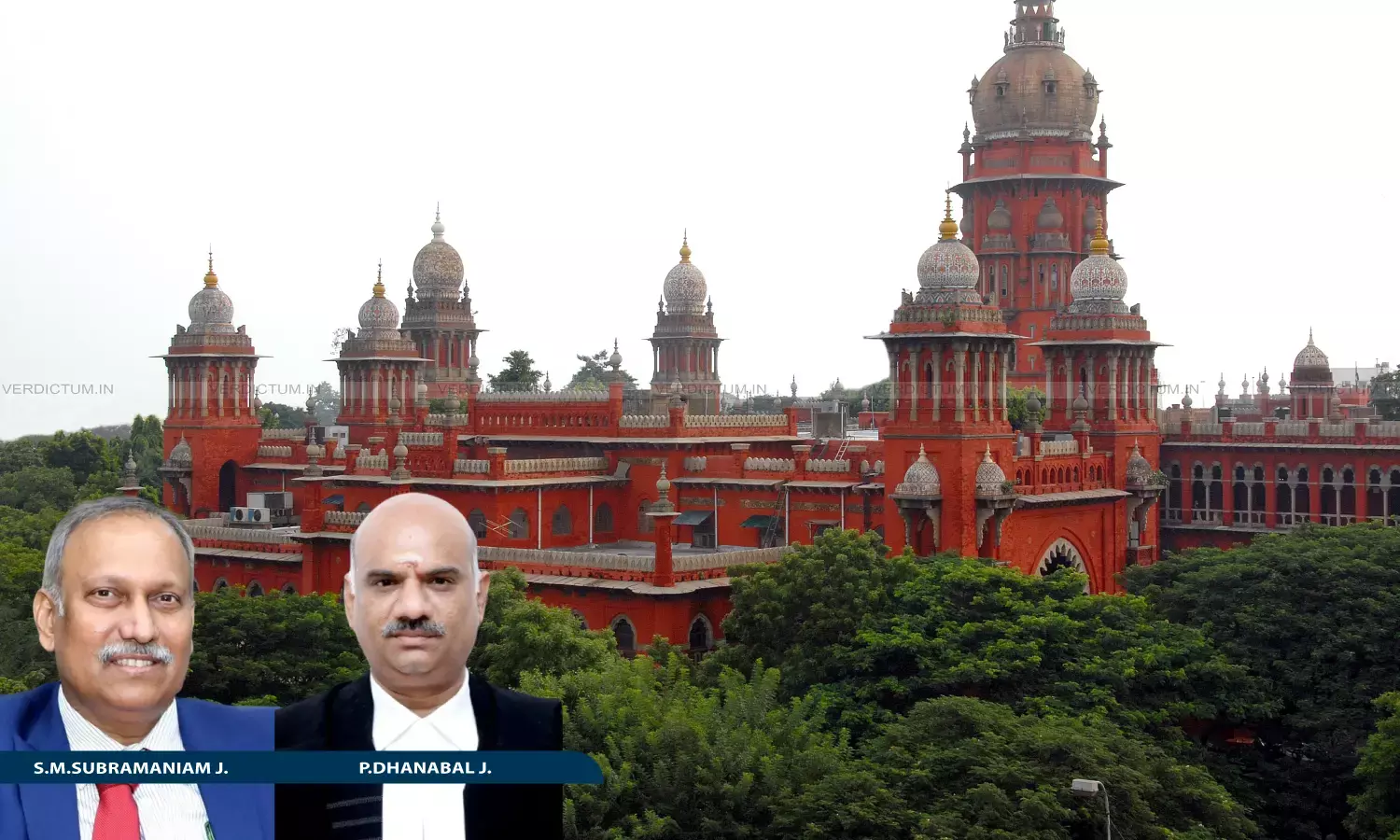
Justice S.M.Subramaniam, Justice P.Dhanabal, Madras High Court
The Madras High Court, while granting interim bail to Journalist A. Shankar, popularly known as Savukku Shankar, held that due process of law cannot be misused to target specific individuals who have fallen out of favour with the State Government, and that repeated curtailment of personal liberty in such circumstances amounts to abuse of the process of law.
The High Court observed that repeated incarceration of an individual for expressing dissenting views raises serious concerns regarding misuse of criminal law and unjustified curtailment of the fundamental rights guaranteed under Articles 19(1)(a) and 21 of the Constitution.
The Court was hearing a writ petition, a connected miscellaneous petition, and a habeas corpus petition filed by the mother of, seeking interim bail for medical treatment, protection against custodial harassment, and a direction against his alleged solitary confinement in Central Prison-II, Puzhal.
A Division Bench of Justice S.M. Subramaniam and Justice P. Dhanabal, while granting interim bail, observed: “This Court has time and again reiterated that due process of law shall not be misused to target specific individuals, who have fallen out of favour with the State Government. The professionalism and discipline of the uniformed personnel shall not be compromised under any circumstances by indulging in such forceful action unnecessarily”.
Advocate M. Ramamoorthy represented the petitioner, while M. Suresh Kumar, Additional Advocate General, represented the respondents.
Background
The petitioner, the mother of Savukku Shankar, approached the High Court alleging that her son, a YouTube journalist and CEO of Savukku Media, had been subjected to repeated harassment by law enforcement agencies due to his investigative journalism and criticism of governmental actions.
It was contended that multiple criminal cases had been foisted against him over time, including preventive detention orders under the Tamil Nadu Act 14 of 1982, both of which were subsequently set aside, one by the High Court and the other withdrawn before the Supreme Court.
In the present instance, the petitioner alleged that a purported unauthorised GPay transaction involving an employee of Savukku Media was used as a pretext to arrest her son. The timing of the alleged transaction, registration of the FIR, and the arrest were cited to contend that the criminal proceedings were orchestrated to falsely implicate him.
The petitioner further alleged that her son was subjected to custodial harassment, solitary confinement, and denial of adequate medical care, despite his serious cardiac condition and diabetes.
Court’s Observation
The Madras High Court expressed serious concern over the repeated incarceration of a single individual who was engaged in expressing dissenting views through digital media. The Bench noted that the history of successive detention orders and criminal cases raised suspicion as to whether the law enforcement machinery was being misused.
While stating that “this is highly unusual where the same individual has been slashed with two detention orders”, the Bench further remarked that “this raises serious questions as to whether there has been any abuse of process of law on the part of the State Government’s Law Enforcement Agency”.
The Court recalled its earlier judgment setting aside the preventive detention order against Savukku Shankar, wherein it had emphasised that freedom of speech and expression under Article 19(1)(a) cannot be stifled by indirect censorship through detention laws. The Court reiterated that dissent, criticism, and even unfair opinions cannot be met with forceful State action unless they result in public disorder.
Placing reliance on the Supreme Court’s decision in Arnab Manoranjan Goswami v. State of Maharashtra, the Bench underscored that courts must remain the first line of defence against deprivation of liberty and that incarceration, even for a single day, must be justified strictly in accordance with law.
The Court also examined the medical condition of the prisoner, noting that he had undergone major cardiac procedures involving stent implantation and was a chronic diabetic. The Bench found the prison medical report inadequate, observing that it failed to meaningfully account for his past medical history.
The Court further took note of allegations of solitary confinement and mental harassment, holding that repeated curtailment of personal liberty in such circumstances could only be construed as an abuse of the process of law.
Conclusion
Taking into account the medical condition of the prisoner, the repeated curtailment of his personal liberty, and the serious concerns regarding misuse of criminal process, the Madras High Court granted interim bail to Savukku Shankar for a period of twelve weeks, subject to conditions.
The Court clarified that the grant of interim bail would not be treated as an expression of opinion on the merits of the pending criminal cases and directed the prison authorities to release the prisoner forthwith upon compliance with the conditions imposed.
Cause Title: A. Kamala v. Inspector of Police & Ors.
Appearances
Petitioner: Advocate M. Ramamoorthy
Respondents: M. Suresh Kumar, Additional Advocate General, assisted by R. Muniyapparaj, Additional Public Prosecutor