

Prosecution Under Essential Commodities Act Doesn’t Bar Simultaneous Prosecution Under IPC For Criminal Breach Of Trust Arising From Same Transaction: Madhya Pradesh High Court
The Madhya Pradesh High Court was considering the five petitions filed under Section 482 of the CrPC against the order of the Chief Judicial Magistrate whereby charges were framed under the Indian Penal Code and Essential Commodities Act.

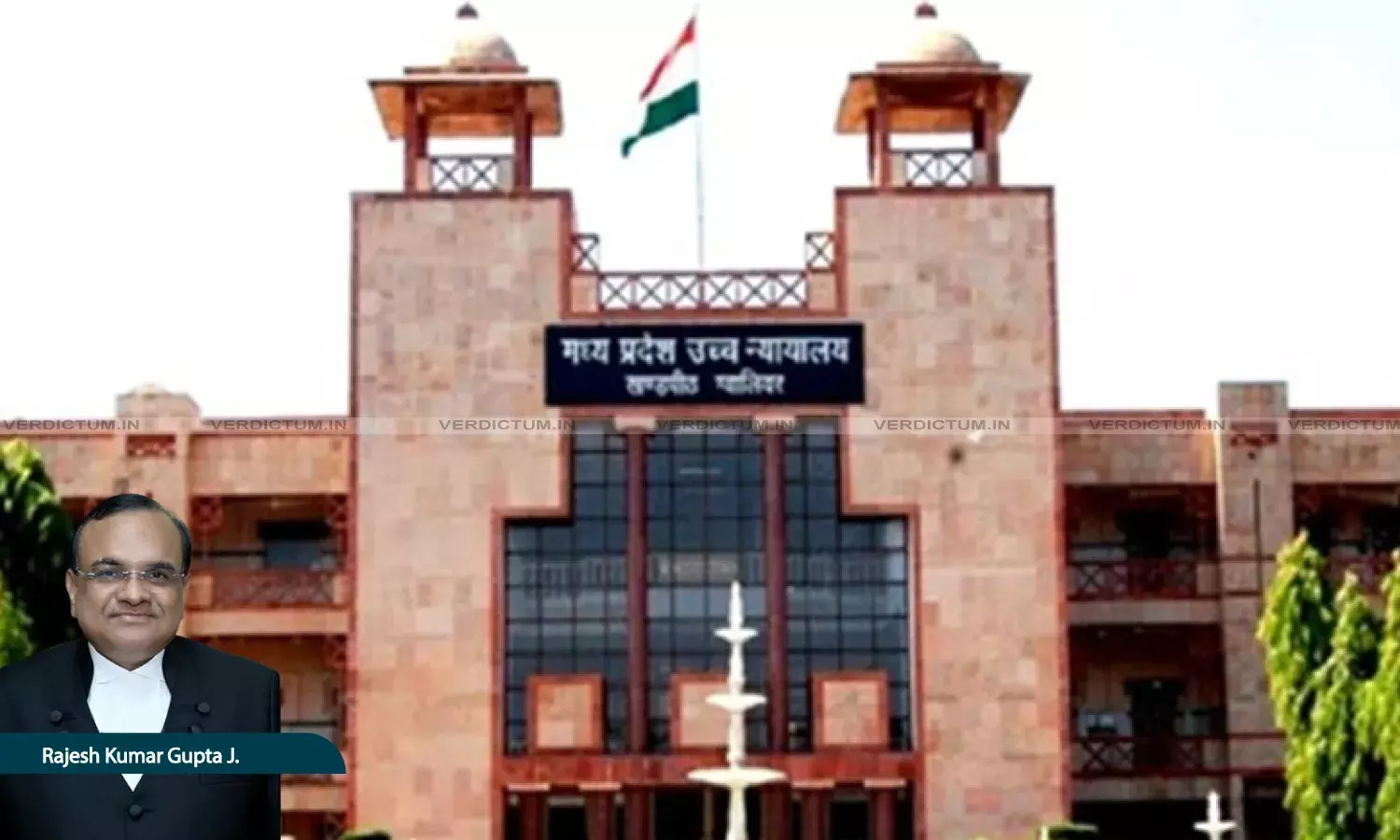
Justice Rajesh Kumar Gupta, Madhya Pradesh High Court
The Madhya Pradesh High Court has dismissed five quashing petitions filed by the accused persons in a case involving alleged diversion and unauthorized storage of wheat assigned for the Public Distribution System. The High Court held that the prosecution under the Essential Commodities Act Act does not bar simultaneous prosecution under the IPC for criminal breach of trust arising from the same transaction.
The High Court was considering the five petitions filed under Section 482 of the CrPC against the order of the Chief Judicial Magistrate whereby charges were framed against the petitioners for offences punishable under Sections 406 and 407 of the Indian Penal Code and Section 3, 7 of the Essential Commodities Act, 1955. All the petitions arose out of the same FIR.
The Single Bench of Justice Rajesh Kumar Gupta held, “Now, the question before this court is of Co-Existence of EC Act and IPC Offences. The prosecution under the EC Act does not bar simultaneous prosecution under IPC for criminal breach of trust arising from the same transaction.”
Advocate Sameer Kumar Shrivastava represented the petitioner while Public Prosecutor Dinesh Savita represented the State.
Factual Background
The case dates back to the year 2006, when the District Supply Officer along with a Junior Supply Officer and other revenue officials conducted a surprise inspection at Swastik Agro Mill. During inspection, large quantities of wheat packed in gunny bags not bearing FCI marking were found stored in the premises. Upon verification, it was found that the wheat was meant for distribution under the Public Distribution System (PDS) to BPL card holders, and had been diverted from the authorized route and destination. The inquiry revealed that wheat issued by the M.P. State Civil Supply Corporation for transportation and delivery to fair price shops was not delivered at the designated places, but was unloaded mid-way and stored in private godowns, allegedly with the intent to misuse and black-market the same. This was in violation of the Public Distribution System (Control) order.
On the basis of the inquiry report, an FIR was registered initially under Sections 3,7 of the Essential Commodities Act, and during investigation, Sections 406 and 407 IPC were added. After completion of the investigation, a charge sheet was filed against multiple accused, including the petitioners.
Reasoning
The Bench took note of the fact that the inquiry report, which was part of the charge-sheet, specifically recorded violation of Clause 6(4) of the Public Distribution System (Control) Order, related to unauthorised storage and diversion of PDS food grains. The Bench made it clear that whether the petitioner knowingly permitted or facilitated storage of PDS wheat in the godown was a matter of factual adjudication, which could not be examined under Section 482 CrPC.
“The material available on record, prima facie discloses entrustment of PDS wheat for a statutory purpose, and its alleged diversion and unauthorized storage. Whether such act was committed with or without the petitioner’s knowledge is a matter of evidence”, it added. Considering the ownership of premises, coupled with prima facie material showing storage of PDS wheat therein, the Bench held that the same gave rise to a triable issue. “Whether the petitioner had knowledge, consent or connivance cannot be adjudicated without trial”, it added.
As per the Bench, the charge-sheet prima facie disclosed that the wheat entrusted for delivery was unloaded mid-way and stored in private premises, which attracts Section 407 IPC relating to criminal breach of trust by carrier. The Bench also observed, “The Essential Commodities Act is a beneficial and regulatory legislation enacted to protect the common consumer from hoarding and black-marketing, and therefore courts must adopt an interpretation which advances the object of the Act. The technical pleas or hyper-technical objections should not be permitted to defeat prosecution at the threshold, particularly when prima facie material discloses unauthorized handling of essential commodities.”
The Bench further stated, “Unauthorized storage of foodgrains meant for public distribution constitutes a clear violation of Control Orders framed under Section 3 of the EC Act. Diversion of PDS commodities from the designated route or destination is sufficient to attract Section 7, irrespective of whether actual sale is proved.”
Explaining that Section 407 IPC is an aggravated form of criminal breach of trust applicable when the accused acts as a carrier or warehouse-keeper, the Bench mentioned that unloading entrusted goods at an unauthorised place amounts to conversion in violation of legal direction, attracting Section 407 IPC.“Explanations such as weather conditions, mechanical failure or instructions or superiors are pure questions of fact, to be examined during trial and at the charge stage, such defences cannot be accepted as gospel truth”, it added.
Noting that the inquiry report clearly recorded a violation of the Public Distribution System (Control) Order, particularly Clause 6(4), which governs storage and delivery of PDS food grains, the Bench dismissed all five petitions.
Cause Title: Sanjay Pancharatna v. The State of Madhya Pradesh (Neutral Citation: 2026:MPHC-GWL:2098)