

Reimbursement Request For Daughter’s Treatment At Non-Empanelled Private Hospital Ought To Have Been Sympathetically Considered: Kerala High Court Grants Relief To Govt. Teacher
The Kerala High Court held that his request for reimbursement as regards the treatment of his daughter ought to have been sympathetically considered.

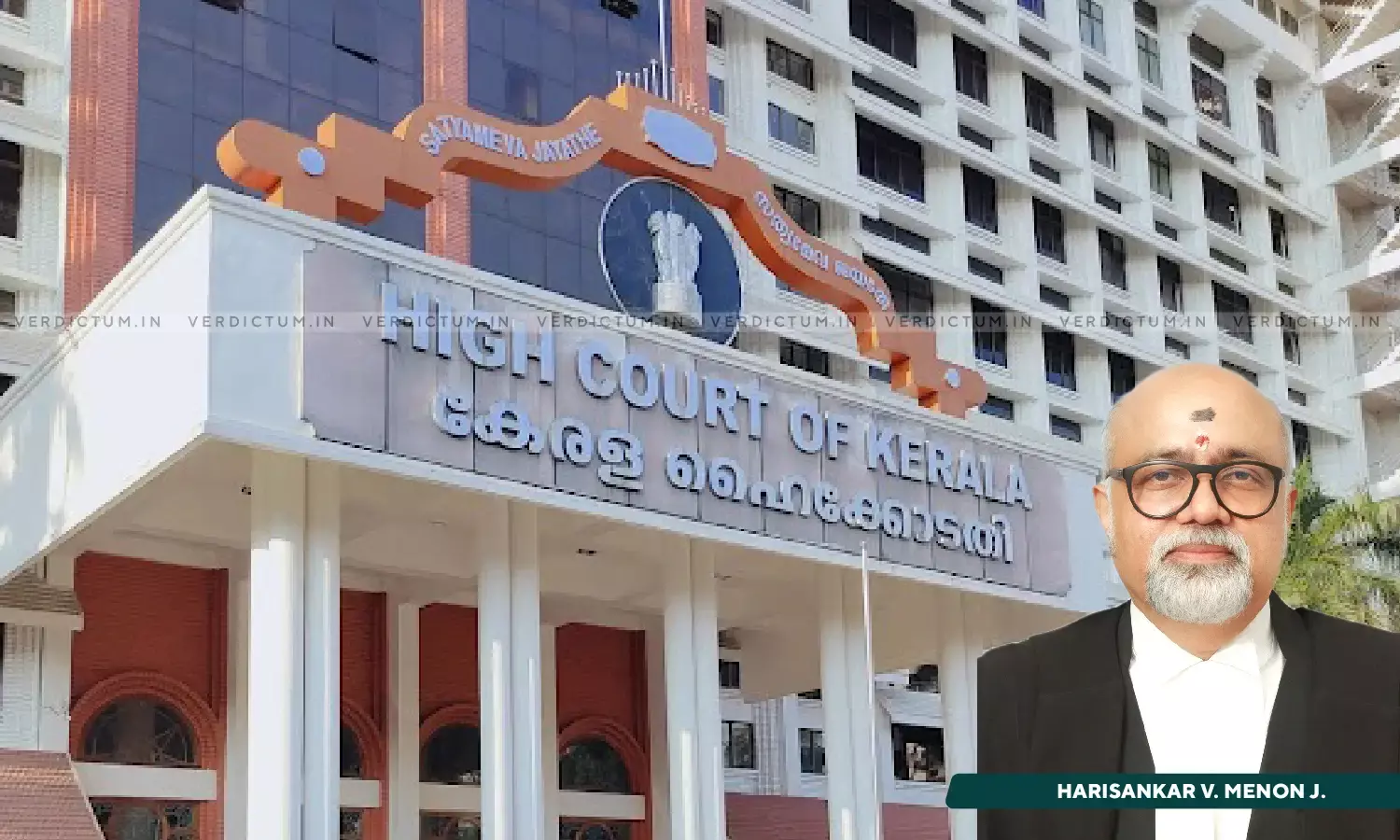
Justice Harisankar V. Menon, Kerala High Court
The Kerala High Court has granted relief to a teacher of a Government Higher Secondary School whose daughter was diagnosed with a rare disease, Adolescent Idiopathic Scoliosis- Type 6, which is stated to progress rapidly. The High Court ordered the reimbursement of the quantified amount for the charges of treatment, which was carried out through a non-empanelled private hospital, outside Kerala.
The High Court held that his request for reimbursement as regards the treatment of his daughter ought to have been sympathetically considered.
A teacher of a Government Higher Secondary School had approached the High Court, pointing out the predicament faced by him with reference to the refusal on the part of the Government to reimburse the treatment charges incurred for the treatment of his daughter, who was diagnosed with a rare disease – Adolescent Idiopathic Scoliosis- Type 6.
The Single Bench of Justice Harisankar V. Menon held, “On the basis of all the above, I am of the opinion that the orders passed on the applications made by the petitioner as above through Exts.P11 and P14 require to be set aside. The petitioner’s request for reimbursement as regards the treatment of his daughter ought to have been sympathetically considered, especially in the light of the decision taken through Ext.P9. This is especially so when there was no facility for carrying out the treatment within the State of Kerala or at least in the Government hospitals in Kerala.”
Advocate P. Nandakumar represented the Petitioner, while Government Pleader Sylaja S L represented the Respondent.
Factual Background
The petitioner’s daughter was suffering from a rare disease, which was stated to progress rapidly, and if not treated in the appropriate stage, would lead to a situation where the patient would have to lead the balance of her life with the assistance of others. It was brought to the Court’s notice that the Government pointed out that treatment for the afore-mentioned disease was not available in Kerala. Upon enquiry, he came to know that there was treatment available in a hospital at Coimbatore and sought sanction for carrying out the treatment through the said hospital with the hope that the Government would reimburse the charges. The application was forwarded to the Government. In the meantime, treatment was also carried out by the petitioner. The petitioner again submitted a representation repeating that there was no treatment facility available in the Government hospitals in Kerala, and the treatment was being carried out through a hospital at Coimbatore.
A letter was issued by the State of Kerala, Represented by Its Principal Secretary to Government, General Education Department, informing the Director of Higher Secondary Education that it was to forward the application for medical reimbursement along with original bills and connected documents for retransmitting the same with the verification report of the Director of Health Services regarding the admissible amount at Government rate as per a Circular dated December 18, 2014. Even thereafter, the application filed by the petitioner came to be returned to him, since, according to the Government, the treatment was carried out through a non-empanelled private hospital, outside Kerala. A Circular dated June 12, 2020, was also relied upon, as per which, taking into account the financial issues faced by the Government, a decision was taken not to provide reimbursement facilities where treatment was carried out in private hospitals. A subsequent request made by the petitioner was later rejected.
Reasoning
The Bench referred to the judgment of the Division Bench of the High Court in OP (CAT) No.50 of 2024, wherein it has been held that treatment extended through non-empanelled hospitals requires reimbursement and is not to be rejected on pure technicalities.
On a perusal of the facts of the case, the Bench noticed that the petitioner’s daughter has been suffering from a very rare disease which requires immediate attention, but for which the daughter would have to lead her remaining life with care from others. “This Court also notices the certificate at Ext.P2 issued by the District Medical Officer, Palakkad, that the facility for treating the afore disease was not available locally. In such circumstances, I am of the opinion that the petitioner, a father, cannot be faulted for carrying out the treatment through a hospital at Coimbatore”, it held.
The Court noticed that in the letter issued by the Government, the case of the petitioner and his daughter was considered sympathetically as a special case, deciding to extend the reimbursement facility with respect to a circular dated December 18, 2014. The Court further took note of the communication issued by the Director of Health Services, as per which, the eligible reimbursement was worked out and quantified.
Thus, allowing the writ petition, the Bench directed the respondents to act based on the letter issued by the Government and effect reimbursement of the quantified amount, as expeditiously as possible within a period of six weeks.
Cause Title: Yusuff A.M. v. State of Kerala (Neutral Citation: 2026:KER:8298)
Appearance
Petitioner: Advocates P. Nandakumar, Amrutha Sanjeev, Vivek Vijayakumar
Respondent: Government Pleader Sylaja S L