

Joint Will Does Not Automatically Become Mutual Will; Principles Of Mutuality Cannot Be Inferred & Implied By Courts: Kerala High Court
Court rules surviving mother could execute settlement deed; unilateral cancellation of gift deed impermissible once accepted

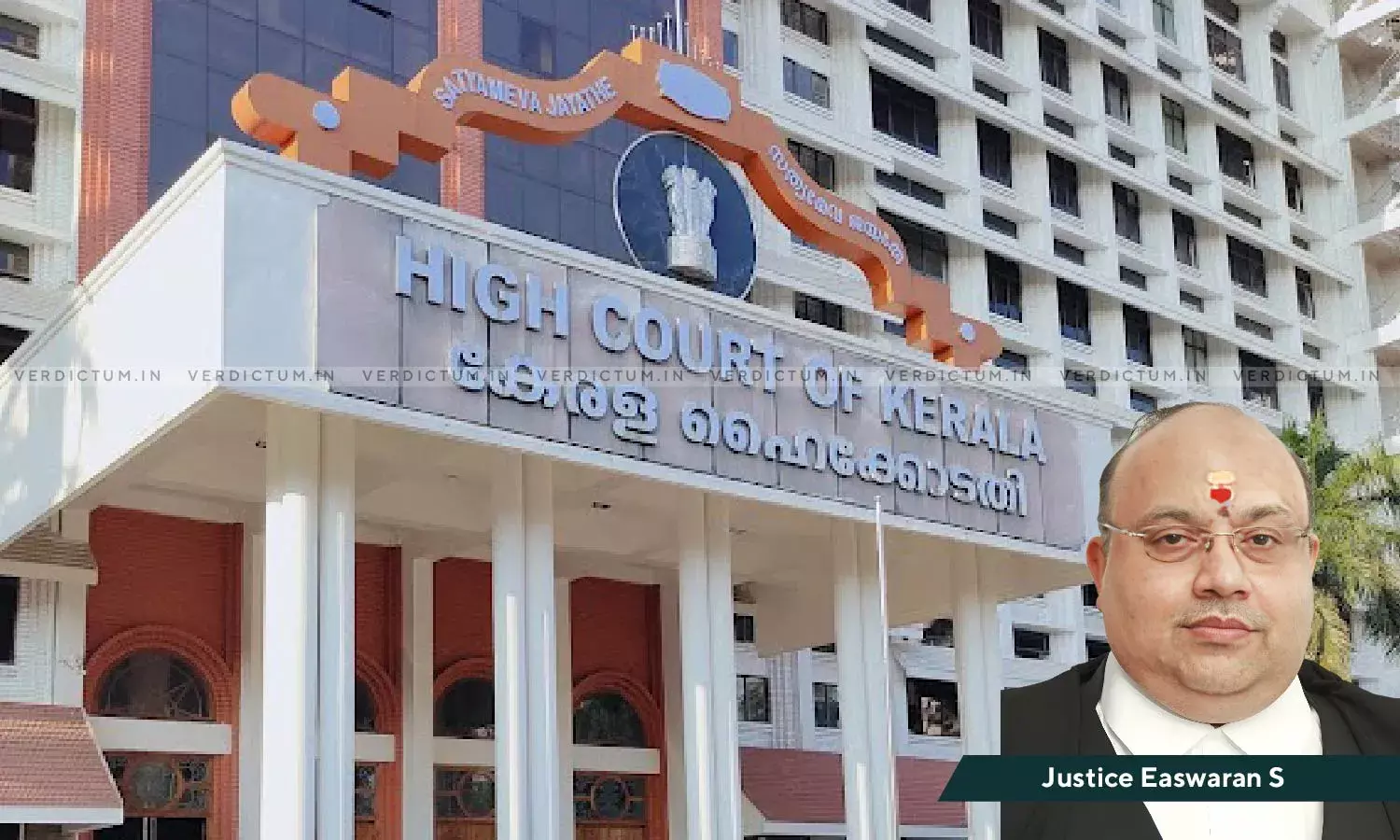
Justice Easwaran S., Kerala High Court
The Kerala High Court has allowed a daughter’s plea for partition of family property, holding that a joint will executed by parents does not automatically become a mutual will, and that the principles of mutuality cannot be inferred and implied by courts.
The Court also reiterated that a gift or settlement deed cannot be unilaterally cancelled once it has been accepted, even if possession has not been formally delivered.
Justice Easwaran S. observed, “Once the First Appellate Court found that there is no enabling clause in the Will, which entitled the 1st defendant, Devaki, to enjoy the property, it could not have proceeded to hold that there is an implied right in favour of Devaki to hold the property exclusively till her death. Once the testators having in no uncertain terms, reduced their intention into writing and conferred the right on the surviving testator to cancel or modify the conditions of the Will, there is no warrant for presumption of mutuality in the Will. Even, the nature of dispossession shows that, it is the respective shares which have been assigned in favour of the legatees…”.
“…The mere fact that the Will takes effect only on the death of both the testators, is not a ground to hold that what was intended between the parties is a mutuality. The principles of mutuality cannot be inferred and implied by the courts, but rather it must be depicted on a plain reading of the Will. That be so, it is inevitable for this Court to conclude that the contrary findings rendered by the courts below are clearly unsustainable under law”, the Bench further observed.
The Bench delivered the judgment while allowing a second appeal filed by the plaintiff, who had challenged concurrent findings of the trial court and the first appellate court dismissing her suit for partition. The dispute concerned 81 cents of property originally purchased by Narayanan and Devaki, who had executed a joint will in 1992 bequeathing their respective shares to their sons.
Advocate Abraham P. George appeared for the appellant and Advocate K.R. Vinod appeared for the respondent.
In the matter, after Narayanan’s death in 1995, Devaki (his wife and the mother of the appellant) executed a registered settlement deed in 1997 assigning her share in favour of her daughters, including the plaintiff-appellant. However, she later executed a revocation deed cancelling the settlement and attempted to transfer the rights to her sons, which led to the litigation.
The subordinate courts held that the will was a joint and mutual will, concluding that Devaki had no authority to execute the settlement deed in favour of her daughters and dismissed the partition suit.
The Court, re-examining the will, observed that mutuality cannot be presumed merely because a will is jointly executed. The Court noted that the will did not confer any reciprocal benefit on the surviving testator nor give Devaki the right to enjoy the entire property after her husband’s death. Therefore, the document could only be treated as a joint will and not a mutual will.
The Court, thus, while allowing the appeal, set aside the judgments of the lower courts and decreed the partition suit, directing that the property be divided by metes and bounds and allotting the plaintiff 11/80 share in the property. The Court also permitted other defendants to seek a supplementary preliminary decree for allocation of their shares.
Cause Title: Varnini Karthikeyan v. Padmakaran & Ors. [Neutral Citation: 2026:KER:18297]
Appearances:
Appellant: Braham P. George, M. Rajendran Nair, M. Santhy, Advocates.
Respondent: K.R. Vinod, Advocate.
Click here to read/download the Judgment