

Call For Strike By Bank Employees In Public Utility Services Sufficient To Trigger Conciliation Proceedings U/S 22 ID Act: Kerala High Court
If bank officers go on strike, it is the common citizen, the lower-middle-class or poor citizens, who are most adversely affected, not the wealthy, the bench said

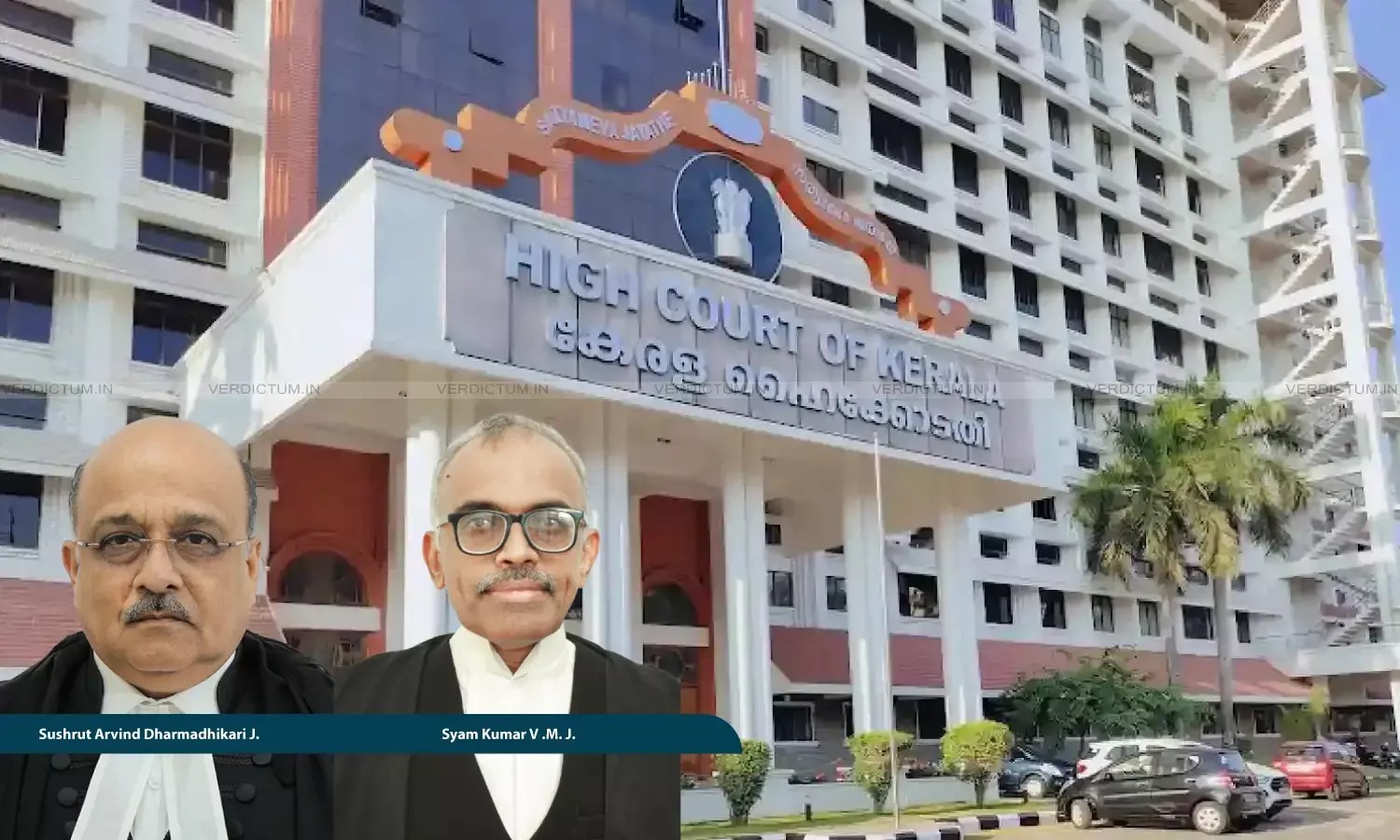
Kerala High Court, Justice Sushrut Arvind Dharmadhikari and Justice Syam Kumar V.M
The Kerala High Court has held that a mere call for strike by bank employees in a notified Public Utility Service is sufficient to trigger conciliation proceedings under Section 22 of the Industrial Disputes Act, 1947. Further that the provision applies to “any person employed” and is not confined to “workmen”, the Court observed that once an employer receives intimation, direct or indirect, of a proposed strike, it is competent to approach the Regional Labour Commissioner and initiate statutory conciliation, even in the absence of a pre-existing industrial dispute.
It further noted that officers of a bank, even if they do not fall within the definition of “workman” under the Industrial Disputes Act, 1947 (ID Act), are nevertheless bound by statutory restrictions governing strikes once the industry is notified as a Public Utility Service (PUS).
On the consequence of strike by the bank employees, the Bench observed, “This Court cannot ignore the practical realities of the present day, where strikes by employees, workmen, or even officers of any sector of public importance primarily harm the public at large, particularly ordinary citizens. If bank officers go on strike, it is the common citizen, the lower-middle-class or poor citizens, who are most adversely affected, not the wealthy. This is because the banking sector’s interface today is far more with ordinary citizens than with the affluent. Even for basic services such as issuing a money order or demand draft, ordinary citizens must wait in long queues, running from one counter to another”.
Justice Sushrut Arvind Dharmadhikari and Justice Syam Kumar V.M., thus, allowed the appeal filed by Federal Bank Ltd. and set aside the judgment of the Single Judge which had quashed conciliation proceedings initiated by the Regional Labour Commissioner (Central).
“…the restrictions imposed under Section 22 of the ID Act are designed to protect the interests of the public and ensure the smooth operation of a PUS. A PUS provides services of immense public importance, and permitting strikes or lockouts in such services would have unforeseeable repercussions on the public and the citizenry at large. The very definition of ‘strike’ under Sec. 2(q) of the ID Act contemplates that officers and non-workmen employees are included within the expression “body of persons employed in any industry”. Had Parliament intended a limited scope, it could have used the term ‘workman’ instead of ‘body of persons’. A conjoint reading of Sec. 2(q) with Sec. 22(1) of the ID Act clearly demonstrates that the learned Single Judge erred by overlooking the essential submission of the appellants - that Section 22, not Sections 12 or 23 of the ID Act, is applicable”, the Division Bench observed.
Senior Advocates C.U. Singh, Benny P Thomas appeared for the appellant and Senior Advocate P Chidambaram appeared for the respondents.
In the matter, the Federal Bank Officers Association issued a call for strike/abstention from work, pursuant to which, the Regional Labour Commissioner (RLC) initiated conciliation proceedings under Section 22 of the ID Act, which deals with prohibition of strikes in Public Utility Services.
The Officers Association challenged the proceedings, contending that its members, officers in Scale I to III cadres do not fall within the definition of “workman” under Section 2(s) of the ID Act. The Single Judge accepted this argument, holding that since no “industrial dispute” could exist in the absence of workmen, the RLC lacked jurisdiction to initiate conciliation proceedings. Therefore, being aggrieved from the impugned order, the Bank preferred a writ appeal.
The central question before the Bench was whether Section 22 of the ID Act, which restrains “any person employed in a public utility service” from going on strike without notice, applies only to “workmen” or extends to non-workman employees such as bank officers.
The Court noted that the Central Government, by Gazette Notification dated 05-06-2023, had notified banking services as a Public Utility Service under Section 2(n) of the ID Act. The Bench highlighted the indispensable role of banking in India’s post-COVID economic recovery, referring to official data showing massive growth in deposits, credit expansion, improved asset quality, and declining NPAs.
The Court observing that banking is integral to national economic stability, held that statutory restrictions governing strikes in such sectors must be interpreted purposively and in public interest.
The Court further distinguished Section 22 from Section 23 of the ID Act, noting that Section 23 specifically restrains “workmen,” whereas Section 22 imposes a wider embargo applicable to all persons employed in a PUS. Thus, even if officers are not “workmen”, they cannot bypass the statutory prohibition under Section 22 once the establishment is notified as a Public Utility Service.
Placing reliance on the Supreme Court’s judgments in T.K. Rangarajan v. Government of Tamil Nadu (2003) 6 SCC 581 and All India Bank Employees’ Association v. National Industrial Tribunal (Bank Disputes), Bombay & Others 1961 SCC OnLine SC 5, the Court reiterated that the right to strike is not a fundamental right under Article 19(1)(c) of the Constitution of India. Further that even trade unions cannot claim an unfettered right to resort to strike, and that the Industrial legislation can regulate, restrict, or even prohibit strikes in the public interest.
The Bench observed that large-scale strikes in vital sectors like banking can disrupt economic stability and adversely affect millions of customers and the broader economy. The Court also clarified that Section 22 is a preventive mechanism aimed at regulating strikes before they commence. The existence of a formally defined “industrial dispute” involving workmen is not a precondition for invoking Section 22 in a PUS context.
Cause Title: The Federal Bank Ltd. v. Federal Bank Officers Association & Ors. [Neutral Citation: 2026:KER:17176]
Appearances:
Appellant: C.U. Singh, Senior Advocate, Benny P Thomas, Senior Advocate, Abel Tom Benny, D.Prem Kamath, Tom Thomas (Kakkuzhiyil), Advocates.
Respondents: P Chidambaram, Senior Advocate, P.R. Ajith Kumar, CGC, P Ramakrishnan, Advocate.