

Kerala High Court Directs Trader's Full Records Disclosure; Impleads CDSCO & Pollution Control Board in Sabarimala Synthetic Kumkum Probe
The Court directed various authorities to conduct a joint physical verification of the KumKum stock in the premises and godown of the Enterprise.

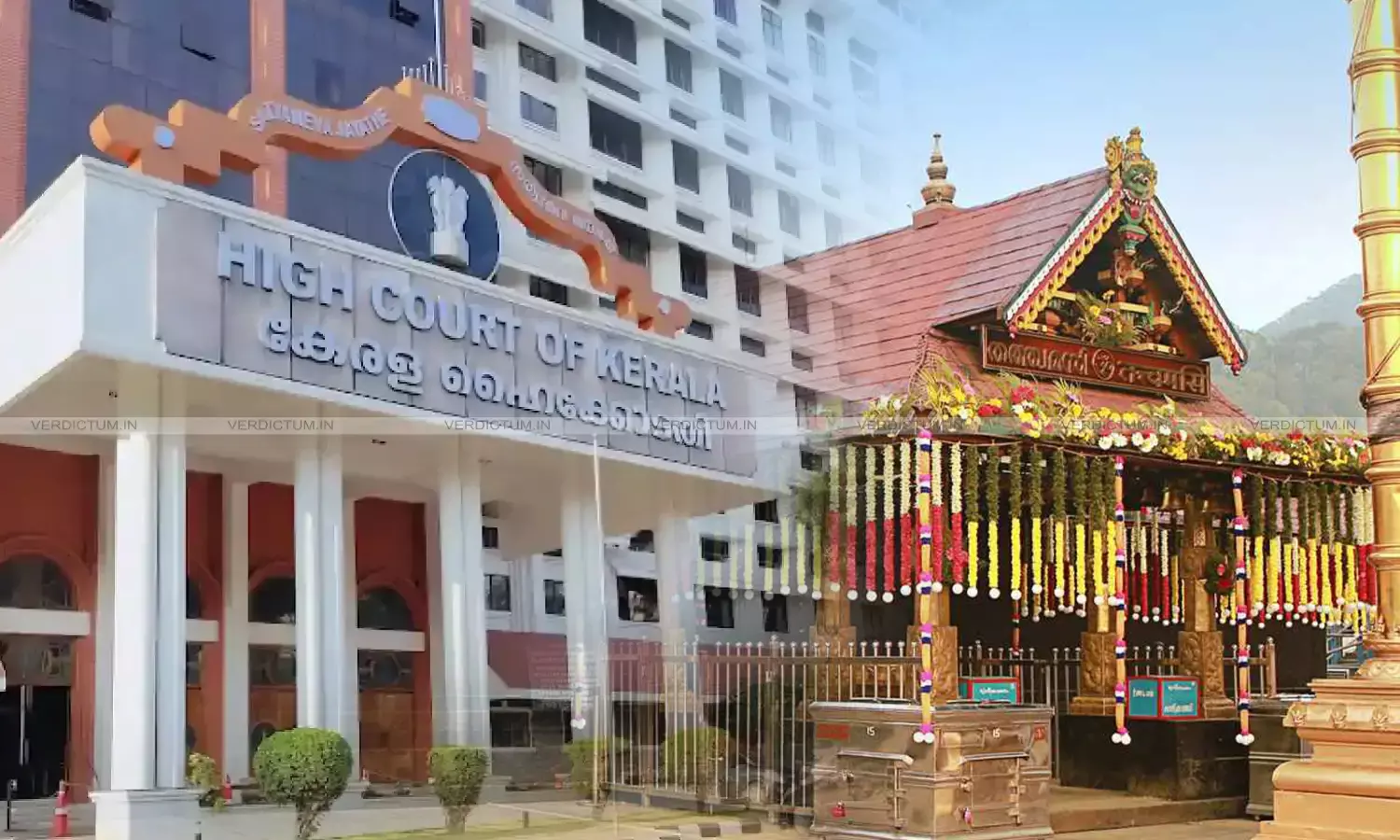
Kerala High Court, Sabarimala Temple
The Kerala High Court directed comprehensive investigations, inspections, and regulatory measures targeting synthetic Kumkum distribution amid environmental concerns to curb synthetic Kumkum sales during the Sabarimala Makaravilakku season.
The Division Bench of Justice Raja Vijayaraghavan V and Justice K.V. Jayakumar ordered, “The continued sale of synthetic KumKum, despite the clear ban imposed by this Court, coupled with the production of irrelevant laboratory reports, shows an attempt to mislead the statutory authorities. We have no hesitation in observing that such large quantities of KumKum cannot be manufactured using traditional methods at the prices at which they are being sold…To determine the extent of the 33rd respondent’s involvement in the stocking and sale of KumKum, whether synthetic or otherwise, we direct the said respondent to produce the following records without fail.”
Deputy Solicitor General of India S. Rajmohan and Advocate Babu Joseph Kuruvatazha appeared for the Respondents.
Background
On November 7, 2025, the High Court took suo moto cognizance of the increasing use of synthetic Kumkum and coloured powders by pilgrims and devotees during Pettathullal. The Court directed the Travancore Devaswom Board (TDB) to take immediate steps to ban the sale of chemical kumkum at Sabarimala, citing the serious environmental damage caused by such substances.
In an earlier order dated October 16, 2025, the Court had noted that the TDB, the Indian Railways, and the District Tourism Promotion Council (DTPC), Kottayam, were responsible for maintaining various Edathavalams that provide essential amenities such as shelter, sanitation, food, and safe drinking water for pilgrims. The Bench had then instructed these bodies to ensure that these facilities were properly maintained.
While holding that the circumvention of the ban on synthetic kumkum cannot be permitted, the High Court, on December 3, 2025, impleaded a Certifying Lab and a firm allegedly distributing synthetic kumkum in the suo moto case relating to Sabarimala Temple.
The Court had noted that as synthetic colour powders commonly used on humans and animals during festivals and processions are often manufactured in unregulated small-scale units using industrial pigments intended for textiles, plastics or paints, their use has become a significant source of chemical exposure, dermatological toxicity, and environmental degradation.
Contention of the Parties
The Counsel appearing for the Laboratory, submitted that the 33rd respondent had handed over two tins containing yellow and blue coloured powders, which were neither sealed nor sampled in accordance with law. He further stated that the chemical analysis carried out by the Laboratory was performed under the category “Pollution & Environment [Wastewater (Effluents/Sewage)]”. It was also clarified that the testing was confined strictly to the materials handed over by the customer and was not intended to certify the product for cosmetic use.
Observations of the Court
The Court observed, “This Court has already noted that under the Drugs and Cosmetics Act, 1940, and the Cosmetics Rules, 2020, KumKum is treated as a cosmetic and must comply with BIS Standard IS 10999:2021. Instead of assessing whether the product conforms to the safety parameters prescribed for cosmetics, the laboratory has applied effluent-testing protocols. Further, the report discloses testing only for a limited set of heavy metals. BIS IS 10999 mandates far more comprehensive testing, including microbial contamination, the presence of prohibited dyes under IS 4707, and specific evaluation of arsenic, mercury and a range of toxic dyes such as Malachite Green, Auramine, Rhodamine, Sudan dyes, Red Vermilion, and Prussian Blue. These toxic dyes, along with arsenic and mercury, constitute the most hazardous components of synthetic KumKum and pose severe risks to human health. None of these mandatory parameters has been tested.”
The Court said that from the photographs, it was clear that vendors are selling loose KumKum from open vessels. Though the lab report speaks of only yellow and blue powder, powders in myriad colours are being sold. The sale of such unlabelled and unpackaged material is in direct violation of the Legal Metrology (Packaged Commodities) Rules, 2011, the Cosmetics Rules, 2020 and BIS Standard IS 10999. Selling a substance meant to be applied on the human body without any labelling, packaging, or traceability poses serious public health risks, the Bench added.
“It is also evident from the submissions made on behalf of the 34th respondent that the sample tested by the laboratory was supplied by the customer himself. There is no chain of custody, no verification of the origin of the material, and the laboratory did not independently procure any market sample. Respondent No. 33 could have submitted any powder for testing. A certificate issued on such a basis cannot certify the quality or safety of the product actually being sold. Reliance on such a report is wholly misconceived and appears intended only to create an illusion of compliance.”, the Bench observed.
Conclusion
The Court directed Respondent-Ideal Enterprises to submit comprehensive procurement, stock, sales, and compliance records (invoices, registers, GST details, BIS/IS 10999 certifications) by 08.12.2025 to determine involvement in synthetic Kumkum trade. The Court also impleaded CDSCO, Kerala State Drugs Control, and Pollution Control Board; directs the Environmental Engineer to inspect Pamba, Valiyathodu, and Manimala rivers for chemical discharge impact.
The Court also directed the Inspector, Legal Metrology Department, Kothamangalam and the Drugs Inspector (Zone 3), Office of the Assistant Drugs Controller, Fourth Floor, Civil Station, Kakkanad, Ernakulam, shall conduct a joint physical verification of the KumKum stock in the premises and godown of the Respondent-Ideal Enterprises on December 6, 2025, and file a report of the stocks of KumKum /Coloured powder stored in sacks, bags or containers, as well as any packed units and file a report before the Court.
Accordingly, the Court listed the matter for a further date.
Cause Title: Suo Motu v. Union Government [SSCR No. 29 of 2025]
Appearances:
Respondents: Senior Government Pleader S.Rajmohan, Deputy Solicitor General of India, Standing Counsel Travancore Devaswom Board G.Biju, Standing Counsel for Cochin Devaswom Board, Malabar Devaswom Board, Guruvayoor Devaswom Managing Committee, Standing Counsel Erumely Grama Panchayath Chithra Chandrasekharan, Standing Counsel Chengannur Municipality Haridas V.N., Amicus Curiae Sayujya Radhakrishnan, Advocate V.Premchand