

Grave Dereliction Of Duty: Kerala High Court Directs Probe Into Misappropriation Of Funds From Ghee Sales At Sabarimala
The Court said that misappropriation of such magnitude occurred with the "wilful blindness" of high-ranking officials, whose failure to implement basic fiduciary safeguards to protect Temple revenue constitutes a grave dereliction of duty.

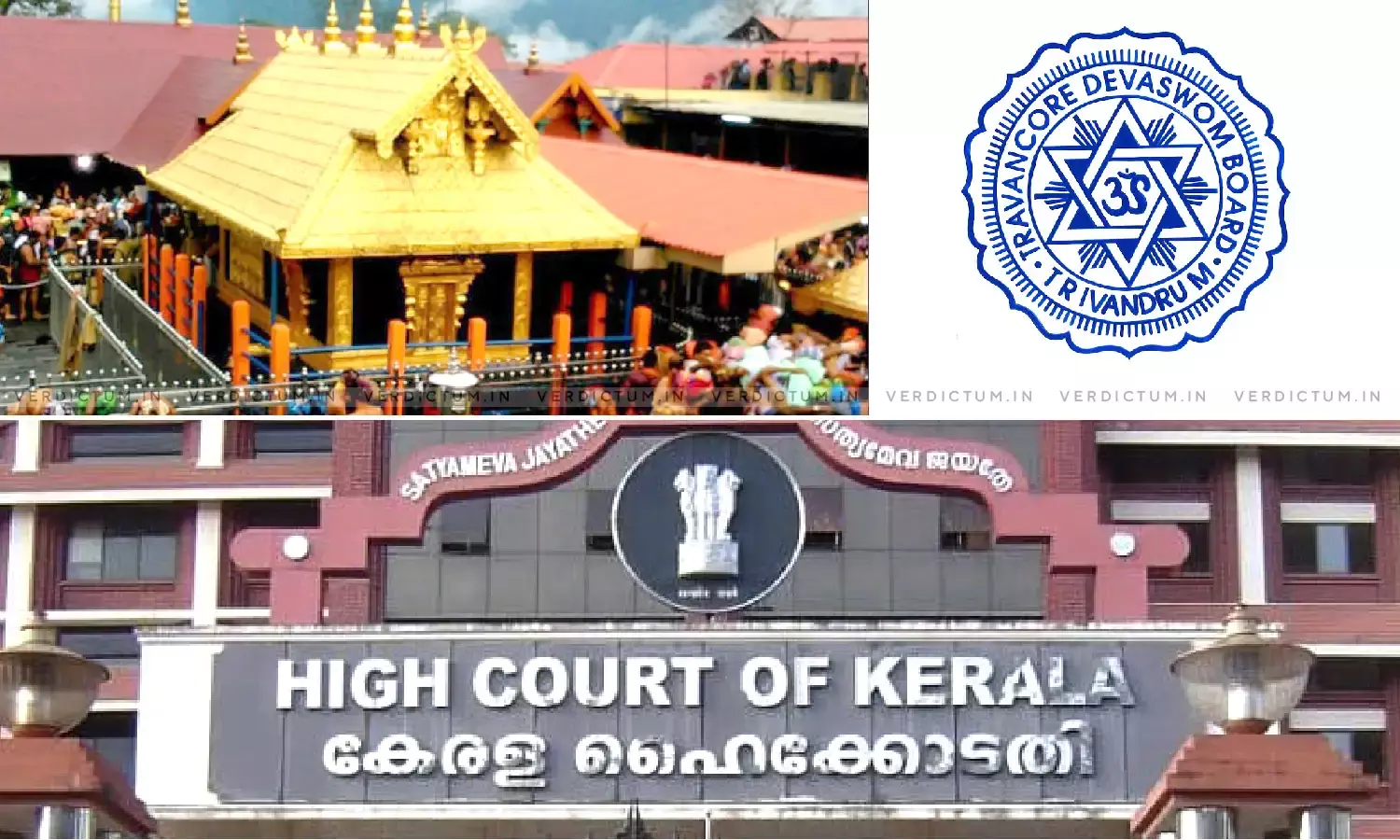
The Kerala High Court, while directing an investigation by the Vigilance & Anti-Corruption Bureau, has flagged the embezzlement of approximately ₹35 lakhs from the sale of “Adiya Sishtam Ghee” at Sabarimala, occurring over a period of less than two months.
The Court expressed deep concern over the “systemic failures” that allowed such a large-scale diversion of funds to occur within a limited span of time.
The Division Bench comprising Justice Raja Vijayaraghavan V and Justice KV Jayakumar observed, “This Court has repeatedly emphasised the bounden duty of the Board to ensure that a comprehensive, fully functional, and tamper-proof software system for all institutions governed by the Board is put in place at the earliest, so that all revenues and expenditures are captured, monitored, and reconciled on a day-to-day basis…We have also reminded the Board that any continued failure to act can only lead to the inference that the higher echelons of the Board are either unwilling or complicit in permitting such systemic lapses to continue…In the above circumstances, we are of the view that a comprehensive investigation is required to ascertain the full extent of the misappropriation of funds by employees of the Travancore Devaswom Board at Sannidhanam in relation to the sale of “Adiya Sishtam Ghee”.”
Senior Government Pleader S Rajmohan appeared for the Respondent with Amicus Curiae Sayujya Radhakrishnan.
The matter pertains to the report of the Sabarimala Special Commissioner, which concerns the detection of blatant acts of criminal misappropriation of the proceeds of “Adiya Sishtam Ghee” at various counters at Sannidhanam by the Devaswom Vigilance. The “Adiya Sishtam Ghee” is a sacred offering sold to devotees, and the sale proceeds constitute Devaswom revenue.
The report stated that the Chief Vigilance and Security Officer of the Travancore Devaswom Board conducted an inspection on the basis of a report received from the Temple Special Officer on December 14, 2025. The report disclosed that the sale proceeds of 16,628 packets of ghee sold from the counter situated in the Maramath Building had not been remitted to the Devaswom account.
An inspection covering the period from November 17 to December 26, 2025, revealed a significant financial shortfall in packet sales. Out of 3,52,050 total units produced, 89,300 packets were sent for sale at the Maramath Building counter. After accounting for 143 damaged units and a remaining stock of 28, the Devaswom Board should have received proceeds for 89,129 packets. However, employees only deposited funds for 75,450 units, leaving a deficit of 13,679 packets and an unremitted balance of ₹13,67,900.
“The magnitude of the short remittance, within a limited window of time, is alarming and cannot be brushed aside as an accounting lapse… This failure to insist upon a proper handing-over and taking-over process is a fundamental breach of elementary safeguards. It creates an environment conducive to such diversion of funds, misappropriation and with a view to make any subsequent accountability a difficult exercise. In the above circumstances, it can reasonably be inferred, at least prima facie, that the employees who were in charge during the period from 17.11.2025 to 26.12.2025 are responsible for the misappropriation of the sale proceeds corresponding to 13,679 packets of ghee. The report also names the employees as well as the Temple Special Officers who were in charge during the period from 17.11.2025 to 27.12.2025,”, the Court said.
The Court observed that a separate instance of significant stock deficit occurred between December 27, 2025, and January 2, 2026. Records indicate that after the Temple Special Officer took charge, an initial stock of 32,040 packets was augmented by a further supply of 22,200, totalling 54,240 packets of "Adiya Sishtam Ghee." While 25,690 packets were issued to the counter, physical verification on January 2 revealed only 5,985 packets remained—leaving a massive shortage of 22,565 units.
The Court determined that this discrepancy, representing a loss of ₹22,65,500, transcends mere negligence. It concluded that the facts prima facie establish a case of criminal misappropriation and falsification of records. Consequently, these actions constitute cognizable offences under the Bharatiya Nyaya Sanhita, 2023, and the Prevention of Corruption Act, 1988.
“It is inconceivable that siphoning of such magnitude could have been carried out without the knowledge, acquiescence, or at least wilful blindness of persons occupying positions at the higher rungs of the administrative hierarchy. Officers at the highest level are entrusted with a fiduciary duty to ensure that adequate safeguards, checks, and control mechanisms are put in place so that the revenue of the Temple is properly accounted for, protected, and not siphoned off. A failure to institute even basic safeguards amounts to a grave dereliction of duty.”, the Court said.
The Bench remarked that certain employees of the Travancore Devaswom Board are more interested in siphoning off amounts rather than conscientiously rendering the service entrusted to them. The conduct disclosed gives rise to a disturbing inference that the predominant objective of such employees is personal gain, by one means or another, rather than the faithful discharge of their duties to the institution and the devotees, it added.
In light of the findings, the Court issued the following directions to ensure a rigorous and independent investigation into the misappropriation: 1) The Chief Vigilance and Security Officer is ordered to forward the complaint to the Director of the Vigilance & Anti-Corruption Bureau immediately. 2) A team of upright, competent officers must be constituted to register a formal crime based on the report. The team must conduct a meticulous and coordinated investigation, but is strictly prohibited from disclosing any details to the public or the media. 3) The investigation team is answerable only to the Court. It must submit a progress report within one month and obtain the Court’s prior permission before filing a final report.
Accordingly, the Court listed the matter for further orders.
Cause Title: Suo Motu v. State of Kerala [SSCR No. 3 of 2026]
Appearances:
Respondents: Senior Government Pleader S Rajmohan, Special Public Prosecutor A Rajesh, Senior PP Rekha S.
Amicus Curiae: Sayujya Radhakrishnan