

Life Estate Granted To Widow Under Will Becomes Absolute U/S 14 Hindu Succession Act; Subsequent Bequest Ineffective: Kerala High Court
Court settles dispute over school management, applies Section 14 of Hindu Succession Act to uphold widow’s absolute rights.

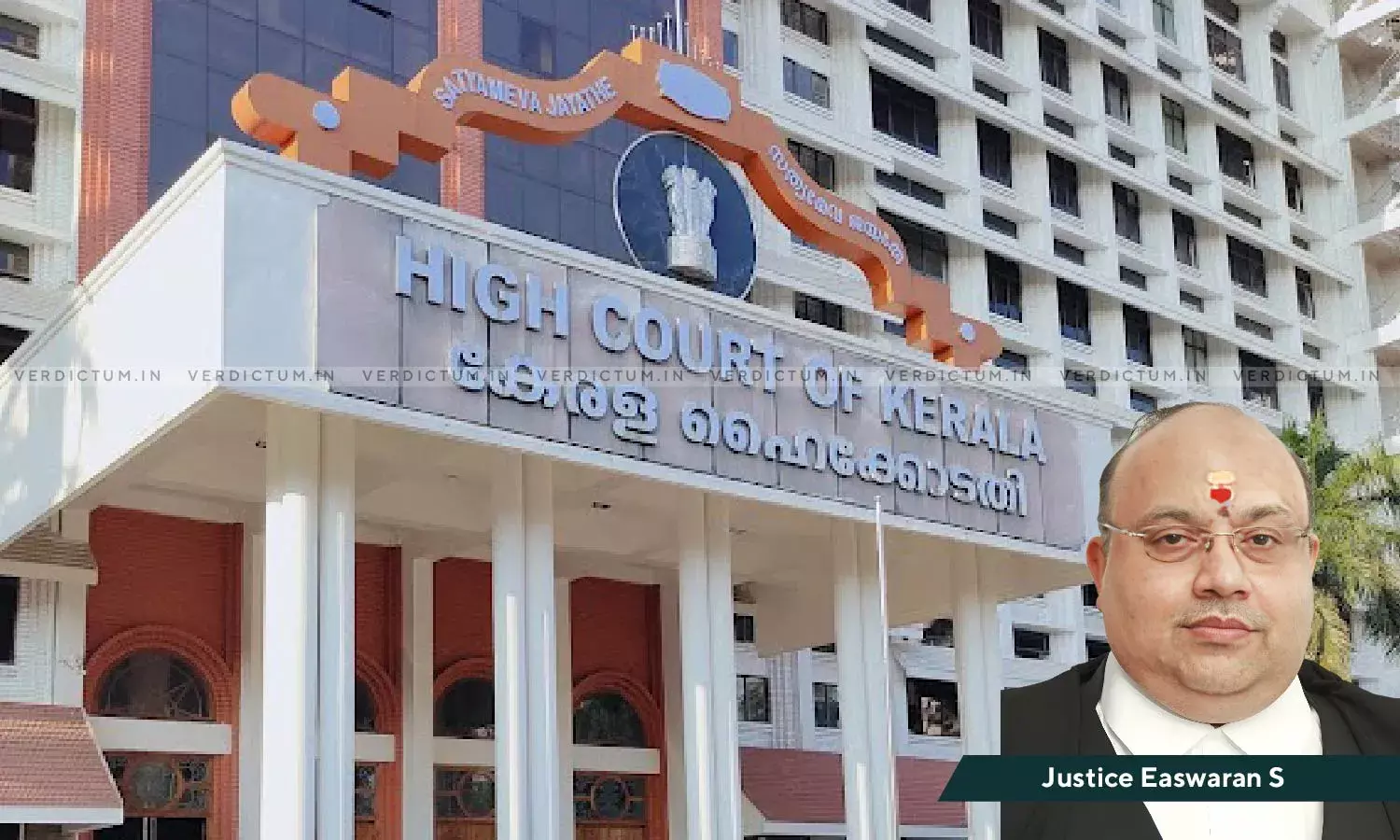
Justice Easwaran S., Kerala High Court
The Kerala High Court while resolving a long-standing dispute concerning the management of a school, held that a life estate granted to a Hindu widow under a Will enlarges into absolute ownership under Section 14(1) of the Hindu Succession Act, 1956, thereby rendering any subsequent restrictive bequest ineffective.
The Court further held that Section 14(2) of the Act, which permits restricted estates, must be read as a proviso and cannot override the beneficial intent of Section 14(1). Consequently, once the widow’s interest became absolute, any subsequent clause in the Will attempting to transfer rights after her death became ineffective, it noted.
Justice Easwaran S. while referring to V. Tulasamma and others v. Sesha Reddy (Dead) through Lrs (1977) 3 SCC 99 where it was concluded that sub-section (2) must be read as a proviso to sub-Section (1) of Section 14, observed, “…there is no room for further deliberation. In the light of the decision of the Three Judges Bench of the Supreme Court in V. Tulasamma (supra), this Court finds that there is no scope for any further deliberation in the matter, and therefore, this Court is inclined to answer the substantial questions of law (i) and (ii) in favour of the appellants and it is held that once a life estate is given to a Hindu widow under a Will, that limited right enlarges into a full ownership and if so, it cannot be taken away by limiting her claim for enjoyment of the absolute right”.
On the impact of subsequent bequest in Ext.B8 Will, the Bench further observed, “…because of the operation of Section 14(1) of the Hindu Succession Act 1956, the limited interest of the late Bachi@ Janaki elevates itself into an absolute right and once it becomes absolute right, the subsequent bequeath in Ext.B8 Will in favour of the plaintiff conferring him the right of management of the school cannot not have any efficacy of law”.
Advocate K.V. Pavithran appeared for the appellant and K. Denny Devassy, Senior Government Pleader appeared for the respondent.
The matter pertained to competing claims over Mooriyad Central Upper Primary School, originally governed by a Will executed in 1955. The testator had granted his wife the right to manage the school during her lifetime, with a further clause transferring management rights to another individual after her death.
After the widow’s death in 2002, disputes emerged between family members regarding who was entitled to manage the institution. Parallel suits were filed, one seeking recognition of managerial rights under the Will, and another seeking to declare the school a corporate agency and restrain individuals from acting as managers.
The trial court ruled in favour of the claimant relying on the Will, and the first appellate court upheld the decision, subsequent to which, the matter ultimately reached the High Court in second appeals.
The central question before the Court was the interplay between Section 14(1) and Section 14(2) of the Hindu Succession Act, 1956, particularly whether a limited estate created under a Will can mature into absolute ownership.
The Court acknowledged that later Supreme Court judgments have taken divergent views on Section 14 of the Act, however, it noted that the ruling in Tulasamma, being a three-judge bench decision, remains binding under Article 141 of the Constitution of India. It further observed that the reference to a larger bench in Tej Bhan (D) through Lr. and others v. Ram Kishan (D) through Lrs. and Others 2024 SCC Online SC 3661 does not dilute the precedential value of Tulasamma until conclusively decided.
“In the present case, it is indisputable that Bachi @ Janaki was entitled to execute Ext.B4 settlement deed. This Court has already seen that Bachi @ Janaki had an absolute right over the property. Therefore, she was having every right to execute Ext.B4 settlement deed. Once the settlement deed was presented before the court along with the written statement, it was imperative on the plaintiff to have sought cancellation of the same, or at least seek a declaratory relief qua the settlement deed and failure to do so will attract the proviso to Section 34 of the Specific Reliefs Act, 1963”, the Bench observed.
Interpreting Section 95 of the Indian Succession Act, 1925 the Court held that once absolute ownership vests in a legatee, any subsequent inconsistent bequest in the same Will is void. Therefore, the clause transferring management after the widow’s death could not operate.
Cause Title: P. K. Lakshmi & Ors. v. Gopi & Ors. [Neutral Citation: 2026:KER:20646]
Appearances:
Appellants: K.V. Pavithran, Jayanandan Madayi Puthiyaveettil, Nias Moopan, P. Saju, Advocates.
Respondents: K. Denny Devassy, Senior Government Pleader, Nisha George, M.P. Prabhakaran, C. P. Peethambaran, Advocates.