

Fraudulent Use Of Other Bank ATMs Not Covered Under Indemnity Policy: Kerala High Court Sets Aside Decree In Federal Bank’s ₹83 Lakh Claim
The High Court held that losses suffered by a bank due to fraudulent ATM transactions carried out using debit cards of other banks fall within the exclusion clauses of a Banker’s Indemnity Policy, which expressly excludes losses arising directly or indirectly out of the use of automated teller machines.
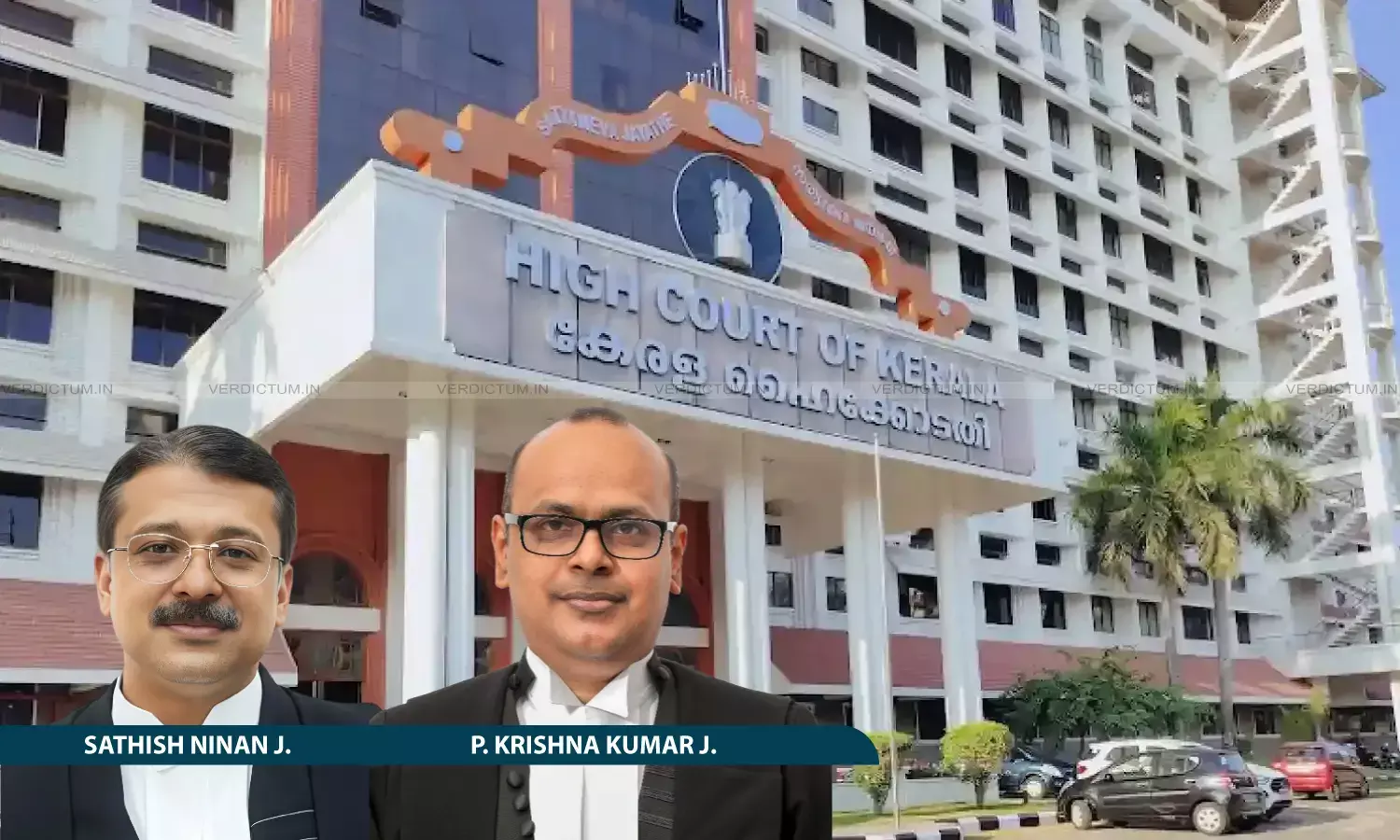
Justice Sathish Ninan, Justice P. Krishna Kumar, Kerala HC
The Kerala High Court, while setting aside the trial court decree directing the insurer to indemnify Federal Bank for the loss claimed in the suit, held that losses suffered by a bank due to fraudulent withdrawals made from its ATMs using debit cards issued by other banks are not covered under a Banker’s Indemnity Policy where the policy expressly excludes losses arising from the use of automated teller machines.
The Court was hearing a regular first appeal filed by the New India Assurance Company challenging the judgment and decree passed by the Additional Sub Court, Ernakulam, in a suit instituted by Federal Bank seeking indemnification under a Banker’s Indemnity Policy for losses allegedly suffered on account of fraudulent ATM transactions.
The Court observed that though the incidents could at first appear to constitute theft or malicious damage under the policy, the exclusion clauses in the policy clearly bar coverage for losses arising directly or indirectly out of the use of automated teller machines and electronic data processing systems.
A Division Bench comprising Justice Sathish Ninan and Justice P. Krishna Kumar observed: “On a first blush, it would appear that the instances in question are a form of ‘theft’ or ‘malicious damage’ under clause ‘A’ of the policy. But the exception clause (i) quoted above specifically excludes losses arising out of the use of ATMs. It mentions, “any direct or indirect use”. Therefore, losses occurring due to any direct or indirect use of ATMs are excluded under the clause. The incidents in question, upon which damage resulted to the plaintiff, have arisen out of the fraudulent use of the ATMs. Plainly read, the exclusion clause covers the same. The fact that fraudulent use of the plaintiff Bank’s debit cards is specifically included in the Add-on cover taken under the additional/extended policy implies that there is no coverage with regard to fraudulent use of other debit cards”.
Background
The case arose from a suit for recovery of money filed by the bank against the insurance company under a Banker’s Indemnity Policy.
The bank had obtained an insurance policy from the insurer for the period from April 1, 2012, to March 31, 2013. According to the bank, during the period between April 11, 2012 and May 20, 2012, several fraudulent transactions were carried out in its ATMs located across different parts of the country.
The bank described the modus operandi adopted by the fraudsters. According to the bank, a fraudster would approach an ATM of the bank using debit cards issued by other banks and request a withdrawal of ₹10,000 or less. When the ATM dispensed the cash, the fraudster would deliberately leave one or two currency notes in the presenter slot and take the remaining amount.
After a predetermined time of about 42 seconds, the ATM would automatically retract the currency notes that remained in the presenter slot. These retracted notes would not be counted by the ATM and would instead be moved to the divert tray.
As a result of this process, the system would reverse the entire amount of the transaction back to the account of the cardholder. According to the bank, this method enabled fraudsters to retain most of the cash dispensed by the ATM while also receiving a reversal of the entire amount to their accounts.
The bank claimed that multiple such transactions occurred during the relevant period, resulting in a total loss of ₹83,34,600. The bank, therefore, sought indemnification under the insurance policy.
The insurance company repudiated the claim, contending that the fraudulent transactions did not fall within the coverage of the policy. The insurer relied on specific exclusion clauses in the policy to contend that losses arising out of the use of ATMs were not covered.
The trial court decreed the suit in favour of the bank, holding that the transactions constituted fraudulent transactions covered under the policy. Aggrieved by the decree, the insurance company filed the appeal before the High Court.
Court’s Observation
The High Court examined the relevant clauses of the Banker’s Indemnity Policy to determine whether the loss claimed by the bank was covered.
The Court noted that clause “A” of the policy dealt with losses occurring “on premises”, including loss or destruction of money or securities due to events such as fire, riot, malicious damage, burglary, theft, robbery, or hold up.
The bank contended that the incidents constituted theft or malicious damage within the meaning of the clause. It was also argued that the additional policy taken by the bank specifically covered money held in ATMs and therefore the losses were covered.
The insurance company, on the other hand, relied on two exclusion clauses contained in the policy. One clause excluded losses attributable directly or indirectly to manipulation or fraudulent use of computer or electronic data processing systems by employees or outsiders. Another clause excluded losses arising directly or indirectly out of the use of automated teller machines.
The Court observed that although the incidents might appear at first glance to fall within the scope of theft or malicious damage under clause “A”, the exclusion clause expressly excluded losses arising out of the use of ATMs.
The Court noted that the exclusion clause used the words “any direct or indirect use” of ATMs and therefore clearly covered the losses in question, which arose from fraudulent use of the ATMs.
The Court further observed that the policy also excluded losses attributable to manipulation or fraudulent use of electronic data processing systems and that ATMs could not be said to fall outside the scope of such systems.
The Court therefore held that the fraudulent transactions in question, having arisen out of the use of ATMs, were clearly excluded from the coverage of the policy.
The Court also examined the additional cover policy relied on by the bank. It found that the additional policy merely enhanced the limit of indemnity for losses already covered under the base policy, particularly losses occurring “on premises” and “in transit”.
The Court held that the additional policy did not introduce any new category of risk or expand the coverage of the base policy. Instead, it only increased the limits of indemnity for items already covered.
The Court further noted that the additional policy specifically included a separate add-on cover protecting fraudulent transactions involving the bank’s own debit card holders. The Court observed that the specific inclusion of such protection indicated that fraudulent use of other banks’ debit cards was not intended to be covered.
Accordingly, the Court held that the loss claimed by the bank arose out of fraudulent use of ATMs and therefore fell squarely within the exclusion clauses of the policy.
Conclusion
In view of the above findings, the Court held that the claim made by the bank under the Banker’s Indemnity Policy was not sustainable.
Accordingly, the Court allowed the appeal filed by the insurance company, set aside the judgment and decree passed by the trial court, and dismissed the suit filed by the bank.
Cause Title: New India Assurance Company Limited v. The Federal Bank Limited (Neutral Citation: 2026:KER:17903)
Appearances
Appellants: George Cherian, Senior Advocate, assisted by Latha Susan Cherian and K.S. Santhi, Advocates
Respondent: Madhu Radhakrishnan, Advocate
