

Article 137 Limitation Act Applies To Maintenance Applications U/S.3 Of Muslim Women (Protection Of Rights On Divorce) Act: Kerala High Court
The Kerala High Court was considering an issue involving the application of Article 137 of the Limitation Act, 1963, to a claim under Section 3 of the Muslim Women (Protection of Rights on Divorce) Act, 1986.

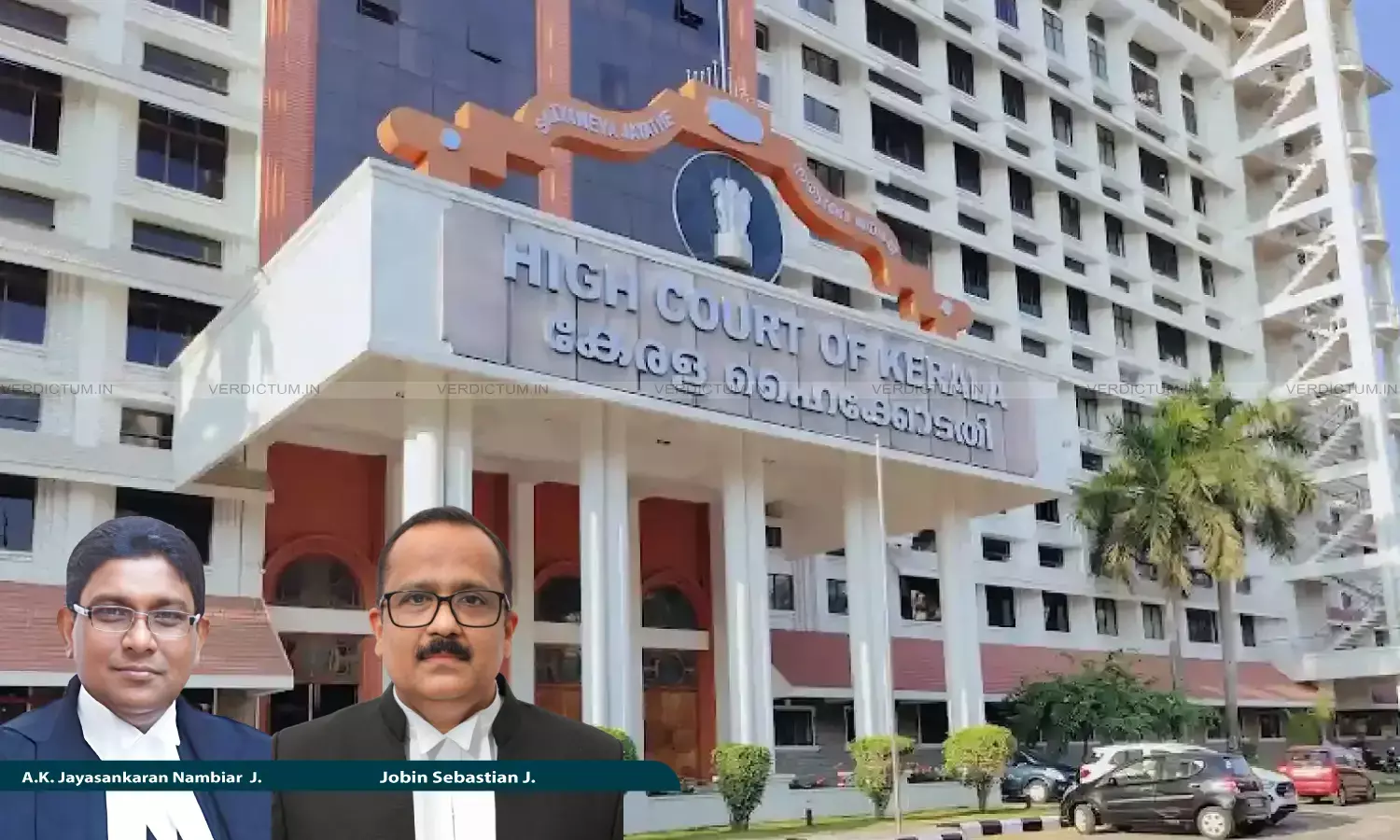
Justice A.K. Jayasankaran Nambiar, Justice Jobin Sebastian, Kerala High Court
While observing that a Muslim woman is granted a specific right under Section 3 of the Muslim Women (Protection of Rights on Divorce) Act, 1986, to claim maintenance from her husband who divorced her, the Kerala High Court has held that the provisions of Article 137 of the Limitation Act would apply to applications for adjudication made under Section 3.
The High Court was considering an Intra-Court Reference (ICR) application and a Criminal Miscellaneous Case for answering the legal question raised by a Single Judge on the application of Article 137 of the Limitation Act, 1963, to a claim under Section 3 of the Muslim Women (Protection of Rights on Divorce) Act, 1986.
The Division Bench of Justice A.K. Jayasankaran Nambiar and Justice Jobin Sebastian held, “In the result, we answer the question referred to us in the affirmative, by affirming the judgment of the learned Single Judge in Hassainar (supra) to the extent it holds that the provisions of Article 137 of the Limitation Act would apply to applications for adjudication made under Section 3 of the 1986 Act. The Crl.M.C is now remitted back to the learned Single Judge for deciding the correctness of the finding of the Sessions Court…”
Advocate Prashanth Padmanabhan represented the Petitioner while Public Prosecutor Sheeba Thomas represented the Respondent.
Factual Background
The petitioner was aggrieved by the judgment of the Sessions Court, which upheld an order of the Judicial First Class Magistrate Court-II, dismissing the claim for maintenance preferred by the petitioner under Section 3 of the Muslim Women (Protection of Rights on Divorce) Act, 1986. The Magistrate was of the view that the application under Section 3, which was preferred by the petitioner nine years after the dissolution of her marriage in 2004, was barred by limitation under Article 137 of the Limitation Act, 1963. The Magistrate also found that the petitioner had executed an agreement with her husband at the time of the pronouncement of Talaq whereby she had relinquished all her rights in connection with the divorce.
The claim of the petitioner was dismissed by the Magistrate. In the Revision preferred by the petitioner before the Sessions Court, her contention was that the provisions of the Limitation Act would not apply to a claim under Section 3 of the 1986 Act was rejected by the Court by placing reliance on the judgment in Hassainar v. Raziya (1993). However, the court found that the petitioner, having filed her claim within three years from the date of refusal by her husband to pay a reasonable and fair maintenance, the claim was not barred by limitation. The Revision Petition came to be dismissed by the Sessions Judge. Before the Single Judge, the grievance of the petitioner was essentially with regard to the findings of the Sessions Court dismissing her claim on the ground that she had relinquished all her rights under the 1986 Act through the agreement entered into with her husband at the time of pronouncement of the Talaq, and further that she had not proved that her husband had sufficient means to pay the amount claimed by her.
Reasoning
The Bench was of the view that the reference order proceeded on an erroneous premise viz. that the proceedings under Section 3 of the 1986 Act were criminal proceedings. “The exclusion of the provisions of the Limitation Act in criminal proceedings, unless there are express and specific provisions making them applicable, is premised on the fundamental principle that ‘crime never dies’ which is expressed through the Latin maxim nullum tempus aut locus occurrit regi that translates as ‘lapse of time is no bar to the Crown in proceeding against offenders”, it noted.
Considering that a criminal offence is a wrong against the State and the Society, notwithstanding that it has been committed against an individual, the Bench held that a mere delay in the prosecution approaching a court of law would not by itself be a ground for dismissing the case against an accused. “Proceedings under Section 3 of the 1986 Act are not criminal proceedings but civil proceedings, although the adjudicatory forum might be a Magistrate’s court. The nature of the right envisaged to a claimant under the 1986 Act, and which crystallises in her pursuant to an adjudication as envisaged under sub-section 3 thereof, being of a civil nature, the adjudication proceedings have necessarily to be seen as civil proceedings. The mere fact that the enforcement machinery to effectuate the adjudicated right is specified under the Cr.P.C does not take away from the fact that the adjudication proceedings themselves are civil proceedings”, it stated.
The Bench explained that the proceedings partake of the nature of criminal proceedings only at the stage of execution, when what is sought to be recovered from a claimant’s husband is the amount adjudged as payable by him in the adjudication proceedings, and in the payment of which he has defaulted. “This is what was stated by the Single Judge in Hassainar (supra), and we see no reason to take a different view”, it added.
The Bench also made it clear that a Muslim woman is granted a specific right under Section 3 of the 1986 Act, to claim maintenance from her husband who divorced her, but only subject to her establishing the extent of her needs and that her husband had neglected to pay her a reasonable and fair provision and maintenance despite having sufficient means to do so.
The Bench thus remitted the matter back to the Single Judge for deciding the correctness of the finding of the Sessions Court, that the petitioner had not proved that her husband had sufficient means to pay the amount claimed by her, and then disposing the case based on the finding already entered in the reference order on the issue of the petitioner’s claim not being affected by the agreement entered into between her and her husband, and the answer provided to the question relating to Limitation Act’s applicability.
Cause Title: ABC v. State Of Kerala (Neutral Citation: 2025:KER:91029)
Appearance
Petitioner: Advocates Prashanth Padmanabhan, K.V. Bhadra Kumari
Respondent: Public Prosecutor Sheeba Thomas, Advocates B.J.John Prakash, P. Pramel, Sooraj M.S., Varsha Vijayakumar Nair, Anagha Madath Thekkepatte, Sona A.B.