

Sessions Court Cannot Impose Life Imprisonment Till Natural Death Beyond Remission Or Deny Set-Off U/S. 428 CrPC: Karnataka High Court
The High Court held that while the Supreme Court and High Courts may, in appropriate cases, impose life imprisonment beyond the scope of remission as a substitute for the death penalty, such power is not vested in Sessions Courts, which cannot impose imprisonment for life till natural death or deny the statutory benefit of set-off under Section 428 of the Code of Criminal Procedure.
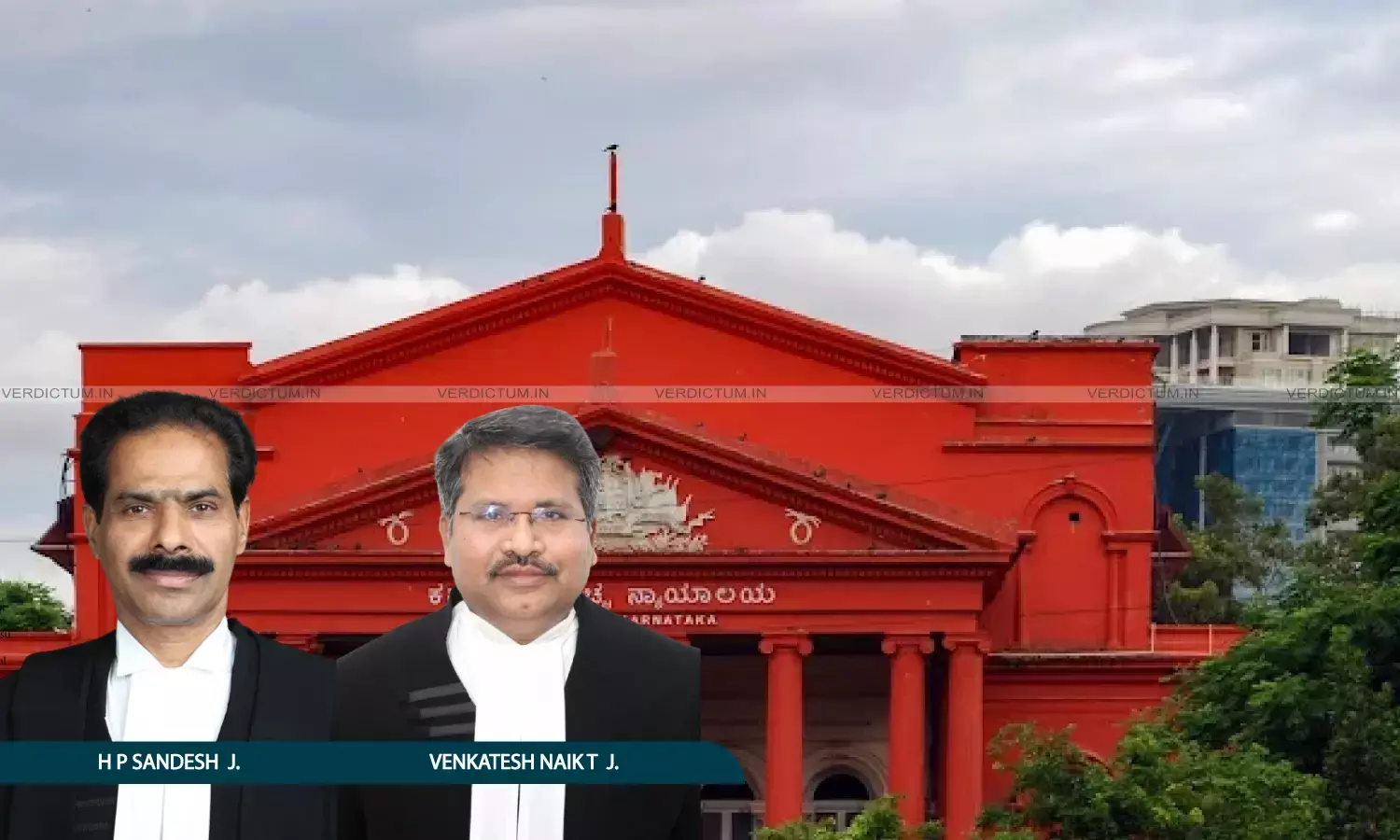
Justice H.P. Sandesh, Justice Venkatesh Naik T, Karnataka High Court
The Karnataka High Court reiterated that the power to impose imprisonment for life beyond remission is confined to Constitutional Courts and is not available to Sessions Courts.
The Court further held that a Sessions Court cannot prohibit the benefit of set-off under Section 428 of the Code of Criminal Procedure and that any such direction is without jurisdiction.
The Court was hearing a criminal appeal challenging both the conviction and sentence passed by the Sessions Court.
A Division Bench of Justice H.P. Sandesh and Justice Venkatesh Naik T, while partly allowing the appeal on sentence, observed: “The Supreme Court as well as High Courts can impose life sentence beyond any remission, can be awarded substituting the death penalty. But powers of the Sessions Court not conferred and the same was only on the Constitutional Courts i.e., Supreme Court as well as High Court”.
The Bench accordingly held that “the Session Court cannot prohibit the benefit of set off as provided under Section 428 of Cr.P.C.”, and that therefore, “with regard to sentence is concerned, it requires interference that, imprisonment for life till natural death is converted to imprisonment for life.”
Background
The appellant was tried before the Sessions Court for offences punishable under Sections 364 and 302 of the Indian Penal Code.
The prosecution's case was founded on circumstantial evidence, including alleged motive, preparation, recovery of incriminating material, medical evidence, and scientific evidence.
Upon trial, the Sessions Court convicted the accused of the offence under Section 302 IPC and sentenced him to imprisonment for life with a specific direction that he shall remain in prison till his natural death.
The Sessions Court further denied the statutory benefit of set-off under Section 428 of the Code of Criminal Procedure.
Aggrieved by both conviction and sentence, the accused preferred a criminal appeal before the High Court.
Court’s Observation
The High Court undertook a detailed re-appreciation of the oral and documentary evidence on record and examined the chain of circumstantial evidence relied upon by the prosecution, including motive, preparation, recovery, medical opinion, and forensic evidence.
On the issue of conviction, the Court held that the prosecution had successfully established the chain of circumstances pointing to the guilt of the accused and that the conviction under Section 302 IPC did not warrant interference.
The Court then turned to the legality of the sentence imposed by the Sessions Court.
The Bench examined the law laid down by the Supreme Court on the power to impose imprisonment for life beyond remission and noted that such power has been exercised by the Supreme Court and High Courts in appropriate cases as a substitute for the death penalty.
Relying on binding precedent, including recent decisions of the Supreme Court, the Court held that the authority to impose imprisonment for life without remission is vested only in the Constitutional Courts.
The High Court held that the Sessions Courts are not conferred with jurisdiction to impose life imprisonment till natural death or to curtail the statutory remission framework.
The Court further held that the Sessions Court had no jurisdiction to deny the statutory benefit of set-off under Section 428 CrPC.
The High Court held that the sentencing order of the Sessions Court, insofar as it directed imprisonment till natural death and denied set-off, was without authority of law and required interference.
Conclusion
The Karnataka High Court upheld the conviction of the accused under Section 302 of the Indian Penal Code.
However, the Court modified the sentence by setting aside the direction of the Sessions Court imposing imprisonment for life till natural death.
The Court converted the sentence to imprisonment for life in accordance with law and held that the accused shall be entitled to the statutory benefit of set-off under Section 428 of the Code of Criminal Procedure.
Accordingly, the appeal was partly allowed to the extent of modifying the sentence, while maintaining the conviction.
Cause Title: Rudresh @ Rudraiah v. State of Karnataka
Appearances
Appellant: Sunil Kumar S., Advocate
Respondent: Rajath Subramanya, High Court Government Pleader
