

Public Representatives Must Show Restraint In Speech: Karnataka High Court Refuses To Quash Case Against Congress Leader For Abusing Female Officer
The High Court held that a person who has once held the status of a lawmaker is expected to be circumspect and restrained in speech, particularly when addressing a woman public servant who is discharging her statutory duties, and declined to interfere with criminal proceedings at the stage of investigation.
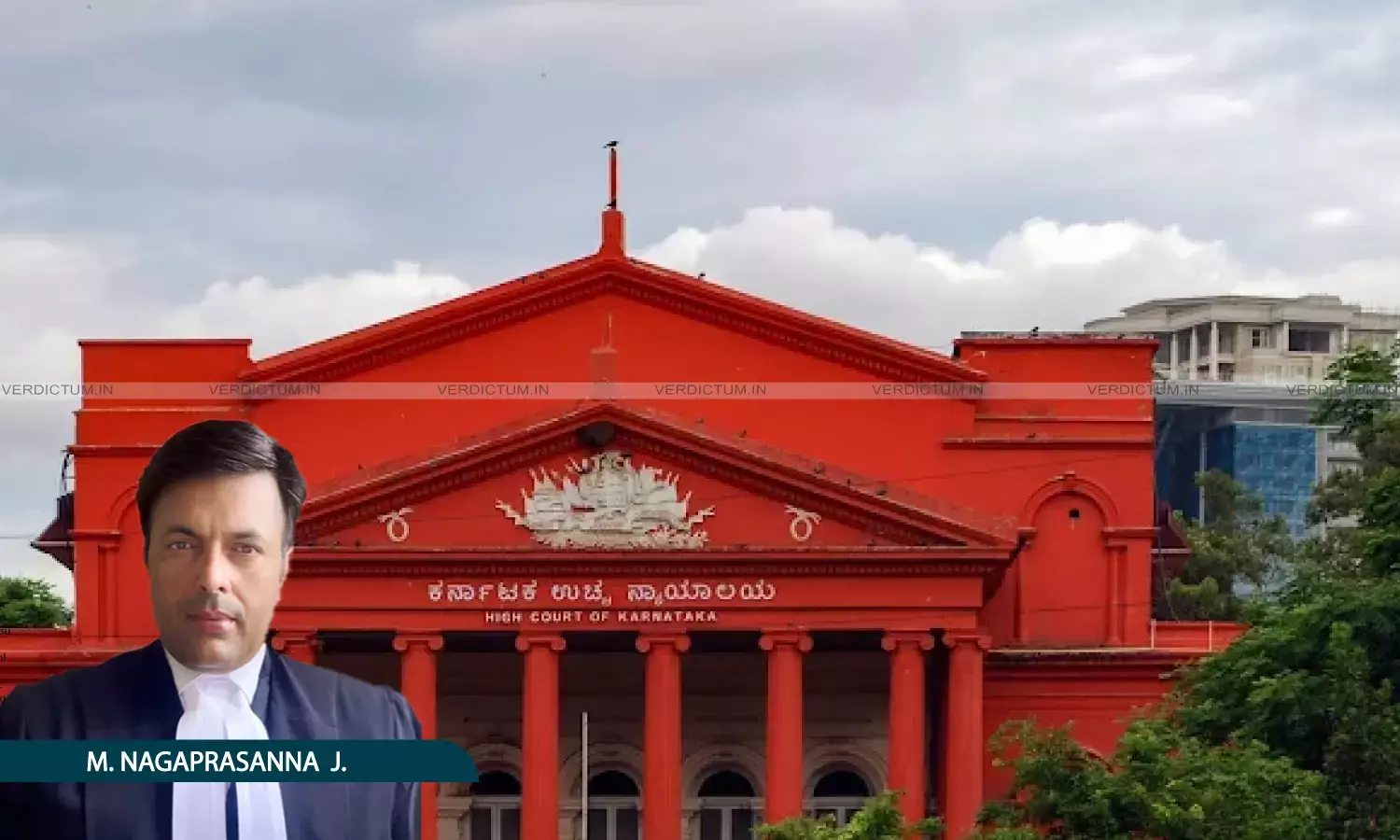
Justice M. Nagaprasanna, Karnataka High Court
The Karnataka High Court has refused to quash criminal proceedings initiated against a Congress leader in connection with alleged abusive and threatening telephonic remarks made to a Municipal Commissioner, who is a woman public servant.
The Court was hearing petitions seeking the quashing of two FIRs registered in relation to an incident arising out of the removal of banners and flexes allegedly erected for the promotion of a Kannada film “Cult” in Shidlaghatta town.
A Bench of Justice M. Nagaprasanna noted that the allegations stemmed from a telephonic conversation in which abusive and derogatory language was allegedly used against the Municipal Commissioner while she was discharging her official duties, and held that “…a person who once held the status of a lawmaker is expected to be circumspect and restrained in his speech, particularly when addressing a woman, a public servant who is only discharging her statutory duty”.
Background
The proceedings arose out of an incident relating to the removal of banners and flex boards erected in Shidlaghatta town for the promotion of a Kannada film, Cult. The Municipal Commissioner of Shidlaghatta Municipality directed the removal of the banners on the ground that they were erected without permission and were causing obstruction and inconvenience to the public.
Following the removal of the banners, a telephonic conversation allegedly took place between the petitioner and the Municipal Commissioner. It was alleged that during the said conversation, the petitioner used abusive, threatening and derogatory language against the Municipal Commissioner while she was discharging her official duties.
Based on the said incident and the alleged telephonic conversation, two FIRs came to be registered against the petitioner for offences including obstruction of a public servant in discharge of official duties and offences relating to insulting the modesty of a woman.
Aggrieved thereby, the petitioner approached the Karnataka High Court seeking quashing of the FIRs, contending that the allegations did not disclose the essential ingredients of the offences and that the continuation of criminal proceedings amounted to abuse of the process of law.
Court’s Observation
The High Court noted that the genesis of the dispute lay in the erection of banners and flexes for film promotion, which were removed by the Municipal Commissioner in the course of her official duties, as they were allegedly causing obstruction and inconvenience to the public.
It was observed that the complainant, being a public servant, was prima facie performing her lawful functions, and that no individual could claim a licence to intimidate or abuse a public servant for the discharge of statutory duties.
The Court further examined the contents of the telephonic conversation and held that the language attributed to the petitioner, at a prima facie stage, disclosed conduct that struck at the dignity of a woman and warranted investigation. The Court observed that even if certain penal provisions were disputed, it was not appropriate at the threshold stage to evaluate the exact applicability of individual sections.
The Bench specifically noted that Section 79 of the Bharatiya Nyaya Sanhita, corresponding to Section 509 of the IPC, deals with words, gestures or acts intended to insult the modesty of a woman, and that the nature and tenor of the conversation justified permitting investigation to proceed.
The Court observed that a person who once held the status of a lawmaker is expected to be circumspect and restrained in speech, particularly while addressing a woman public servant discharging her statutory duty. The Court emphasised that such conduct, if established, could not be brushed aside at the stage of registration of FIR.
The Bench also reiterated the settled principle that an FIR is not expected to be an encyclopedia of offences and that investigation must ordinarily be permitted to proceed unless the FIR does not disclose any cognizable offence at all.
Relying upon the principles laid down by the Supreme Court in Neeharika Infrastructure v. State of Maharashtra, the Court held that interference at the stage of investigation is warranted only in exceptional circumstances and that criminal proceedings ought not to be scuttled at the initial stage.
The Court further noted that the complaint was lodged within days of the incident and that the investigation had barely commenced, making it premature for the Court to assess the sustainability of individual charges.
Conclusion
In view of the above, the High Court held that no case was made out for exercising inherent powers to quash the FIRs and that the investigation deserved to proceed in accordance with law.
Accordingly, both criminal petitions were dismissed, with the Court clarifying that the observations made were only for the purpose of deciding the quashing petitions and would not influence the course of investigation.
Cause Title: Rajeev Gowda B.V. v. State of Karnataka
Appearances
Petitioner: Senior Advocate Vivek Reddy
Respondents: B N Jagadeesha, Additional Special Public Prosecutor
