

Demand And Acceptance Are Sine Qua Non For Offence U/S. 7 PC Act: Karnataka High Court Quashes FIR Against Police Officer
The High Court held that in the absence of proof of demand and acceptance of illegal gratification, proceedings under Section 7(a) of the Prevention of Corruption Act cannot be sustained, reiterating that mere allegations without foundational facts are insufficient to prosecute a public servant.
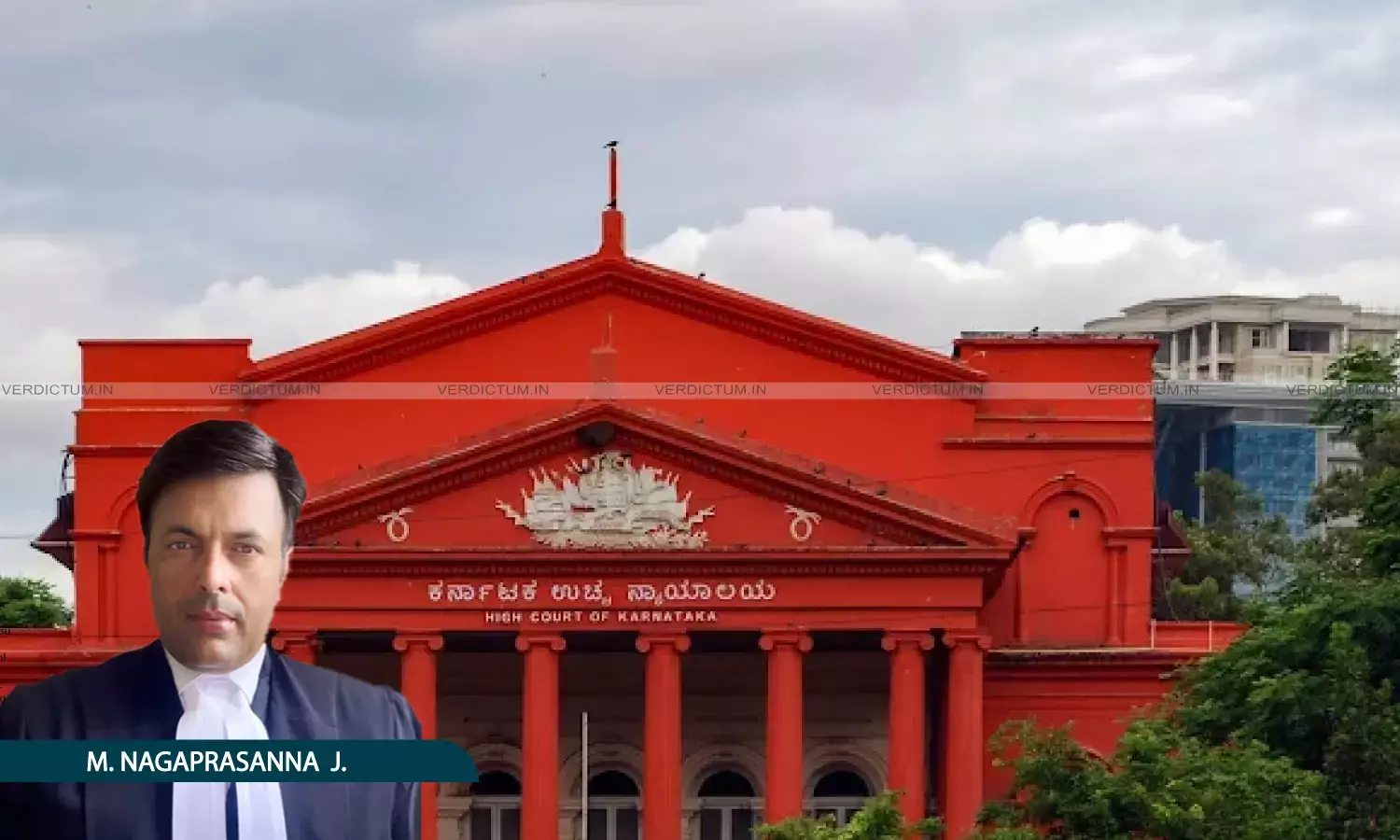
Justice M. Nagaprasanna, Karnataka High Court
The Karnataka High Court has reiterated that demand and acceptance constitute the core ingredients of an offence under Section 7(a) of the Prevention of Corruption Act, 1988, holding that in the absence of proof of these foundational elements, continuation of criminal proceedings would amount to abuse of process.
The Court was hearing a petition under Section 482 of the Code of Criminal Procedure seeking quashing of FIR in Crime No.45 of 2019 registered for the offence punishable under Section 7(a) of the Act, pursuant to a complaint alleging demand of a bribe by a police officer.
A Bench of Justice M. Nagaprasanna, while allowing the petition, observed: “On a coalesce of the judgments rendered by the Apex Court, as quoted supra, the soul of Section 7 of the Act is demand and acceptance. The unmistakable inference on the interpretation, in the considered view of the Court, would be that if there is a demand but no acceptance, it would not make an offence under Section 7 of the Act. If there is acceptance but no demand, it would then also make no offence under Section 7 of the Act. An act alleged under Section 7 of the Act should have the ingredients of demand and acceptance, and it is for the performance of a public duty or forbearance from performance. Therefore, demand and acceptance should be for the purpose of performing some public duty. For such performance, there should be work pending at the hands of the public servant against whom Section 7 of the Act is alleged.”
Background
The petitioner, a Sub-Inspector of Police, had investigated a criminal case registered against the complainant and had filed a final report for offences under the IPC. Before filing the charge sheet, the complainant approached the Lokayukta alleging that the petitioner, along with others, had demanded ₹1,00,000/- for filing a ‘B’ report to close the case.
The complaint narrated that one co-accused allegedly made telephonic demands and that the petitioner was present in certain meetings. However, it was undisputed that no trap was laid, no tainted currency was recovered, and there was no pre-trap mahazar. The FIR came to be registered solely based on the complaint.
The petitioner contended that the complaint was filed to wreak vengeance, as he had registered several cases against the complainant. It was further contended that there was neither proof of demand nor acceptance, and therefore the essential ingredients of the offence were absent.
Court’s Observation
The Court examined the legal position governing Section 7 of the Prevention of Corruption Act, both prior to and after amendment. After analysing precedents of the Supreme Court, including Constitution Bench decisions, the Court emphasised that proof of demand and acceptance is mandatory.
On a survey of the law, the Court held that if there is a demand but no acceptance, it would not make an offence under Section 7 of the Act and that If there is acceptance but no demand, it would then also make no offence under Section 7 of the Act.” The Bench observed that both ingredients must coexist and must be proved beyond a reasonable doubt.
The Court further clarified that demand and acceptance must be in relation to performance or forbearance of a public duty, and that there must be work pending with the public servant. It was observed that demand and acceptance should be for the purpose of performing some public duty. For such performance, there should be work pending in the hands of the public servant against whom Section 7 of the Act is alleged.
Applying the law to the facts of the case, the Court noted: “…there is no trap, and there is not even a prima facie finding that there has been demand and acceptance. There is no tainted money recovered from the hands of the petitioner, and it is a fact that the petitioner was instrumental in registering several crimes against the complainant and the complaint against the petitioner is filed undoubtedly to wreak vengeance.”
The Court also recorded that the complaint was filed a week before the filing of the charge sheet by the petitioner in the underlying IPC case, and that multiple cases were pending against the complainant. In the absence of foundational facts to establish demand and acceptance, continuation of the investigation would not be justified.
Conclusion
The Court concluded that “there is no warrant to permit investigation to continue six years after registration of the crime, when there is not even a titter of document to permit such investigation.”
Holding that the essential ingredients of the offence under Section 7(a) of the Prevention of Corruption Act were not made out even prima facie, the High Court allowed the petition and quashed the FIR in Crime No.45 of 2019.
Cause Title: Prabhugowda Patil v. State of Karnataka & Anr.
Appearances
Petitioner: Tejas N., Advocate
Respondents: Venkatesh S. Arbatti, Advocate, Suresh S., Advocate
