

Karnataka High Court Quashes Notice Of State Bar Council Against Senior Advocate Accused Of Taking Side Of Company As ICC Member Under POSH Act
The Karnataka High Court allowed a Writ Petition filed by a Senior Advocate, seeking quashing of the a notice as well as the Complaint filed against her by the POSH accused.
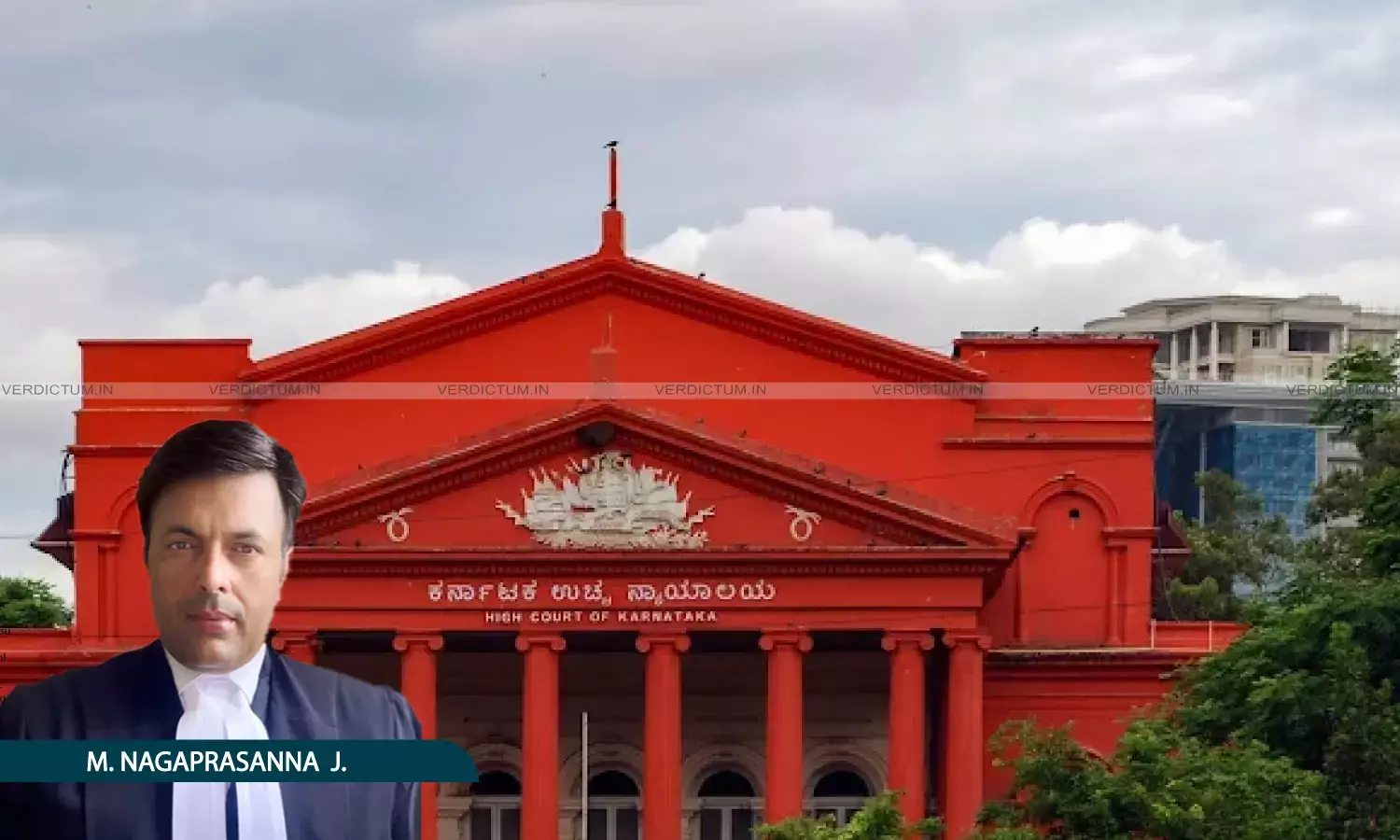
Justice M. Nagaprasanna, Karnataka High Court
The Karnataka High Court has quashed a Notice issued by the State Bar Council against a Senior Advocate who was accused of taking side of a company as a member of ICC (Internal Complaints Committee) under the Sexual Harassment of Women at Work Place (Prevention, Prohibition and Redressal) Act, 2013 (POSH Act).
A Writ Petition was filed by Senior Advocate Jayna Kothari, seeking quashing of the said notice as well as the Complaint filed against her by the POSH accused.
A Single Bench of Justice M. Nagaprasanna held, “The foundation in the complaint, inter alia, touches upon the merits of the opinion of the Committee which decided to terminate the services of the 1st respondent. To wreak vengeance the complaint is registered before the Bar Council, without having any locus to do so, as there is no contract or a client-advocate relationship between the petitioner and the 1st respondent. In that light, permitting the complaint to proceed any further would amount to becoming an abuse of the process of the law and result in miscarriage of justice.”
Senior Advocate K.N. Phanindra appeared for the Petitioner, while Advocates Harsha Swaroop P. and G. Nataraj appeared for the Respondents.
Case Background
The Petitioner was a designated Senior Advocate practicing in the Courts of the country and said to have put in more than 25 years of practice. Based on her expertise on the issue of tackling sexual harassment of women at work place, she was requested by Zoomcar India Private Limited to be its General Counsel to the Internal Complaints Committee (ICC) constituted by the Company. As a General Counsel, she was given a role of an external member. She accepted the request to be a part of the ICC as an external member and being the external member, she was in her personal and individual capacity, and not as a Senior Advocate. It was averred in the Petition that she had no previous association of any kind with the Company and had never represented the Company in the capacity of an Advocate at any time in her career. She was part of the ICC, as an external member, without any kind of payment or even honorarium. In May 2019, a complaint of sexual harassment in the Company was made by a female employee against the Respondent-accused.
The Respondent was the company’s employee and following the receipt of the complaint, the ICC sent a notice to him. He was directed to submit his response to the complaint within 10 days. Post enquiry, the ICC members deliberated on the matter and unanimously passed an Order, holding that the Respondent is guilty under Section 2(n) of the POSH Act. Resultantly, he was terminated and being aggrieved, he approached the Additional Labour Commissioner (ALC). The ALC held that the ICC’s findings are baseless. The Petitioner challenged this and a Writ Petition was allowed. In the interregnum, the Respondent filed a Complaint before the Karnataka State Bar Council, alleging that the Petitioner took sides with the Company in the proceedings and tried to falsely implicate him. It was further alleged that the Petitioner did not act independently or impartially during the proceedings. Challenging the registration of complaint, the Petitioner was before the High Court.
Court’s Observations
The High Court in the above context of the case, observed, “The issue now would be, whether the petitioner accepting the role of an external member of the Internal Complaint’s Committee of the Company, in her individual capacity and not as an Advocate, would amount to professional misconduct under the Advocates Act, 1961?”
The Court referred to the Judgment in the case of Paras Jain v. Karnataka State Bar Council (2024) wherein it was held that any professional mis-conduct by an Advocate has to be complained by persons who have the locus standi to complain against the said mis conduct and the Bar Council of the State is a statutory authority empowered to enquire into any mis-conduct of an Advocate and pass appropriate orders and a member of the Bar has no locus standi to complain about any other member of the bar in the realm of professional mis-conduct unless the said member of the bar is a litigant himself.
“In the light of the law as laid down by the Apex Court, different High Courts and that of this Court in PARAS JAIN supra, the complaint itself ought not to have been entertained by the Bar Council, as Section 35 mandates that to entertain a complaint against an Advocate, the Bar Council must have reason to believe that the Advocate is guilty of misconduct”, it noted.
The Court said that a perusal at the complaint would clearly indicate that it was a product of mala fides or suffering from want of bona fides.
“The 1st respondent/complainant having chosen to file an appeal before the Additional Labour Commissioner, Bengaluru succeeds and also contemporaneously complains to the Bar Council. The observations of the Labour Commissioner have been expunged by the coordinate bench”, it added.
Accordingly, the High Court allowed the Writ Petition and quashed the complaint as well as the impugned notice.
Cause Title- Jayna Kothari v. Manish Kumar & Anr. [Case Number: WRIT PETITION No.19619 OF 2022 (GM - RES)]
Appearance:
Petitioner: Senior Advocate K.N. Phanindra and Advocate Aditya Narayan.
Respondents: Advocates Harsha Swaroop P., G. Nataraj, and Adithya Karthik K.
