Dying Declaration Recorded By Police Officer U/S 161 CrPC Admissible If Voluntary, Truthful And Consistent: Karnataka High Court
The High Court held that a dying declaration recorded by a police officer, even if in the form of an FIR or under Section 161 of the Code of Criminal Procedure, is admissible in evidence and can form the basis of a conviction, provided the Court is satisfied that it is voluntary, truthful, and made in a fit state of mind.
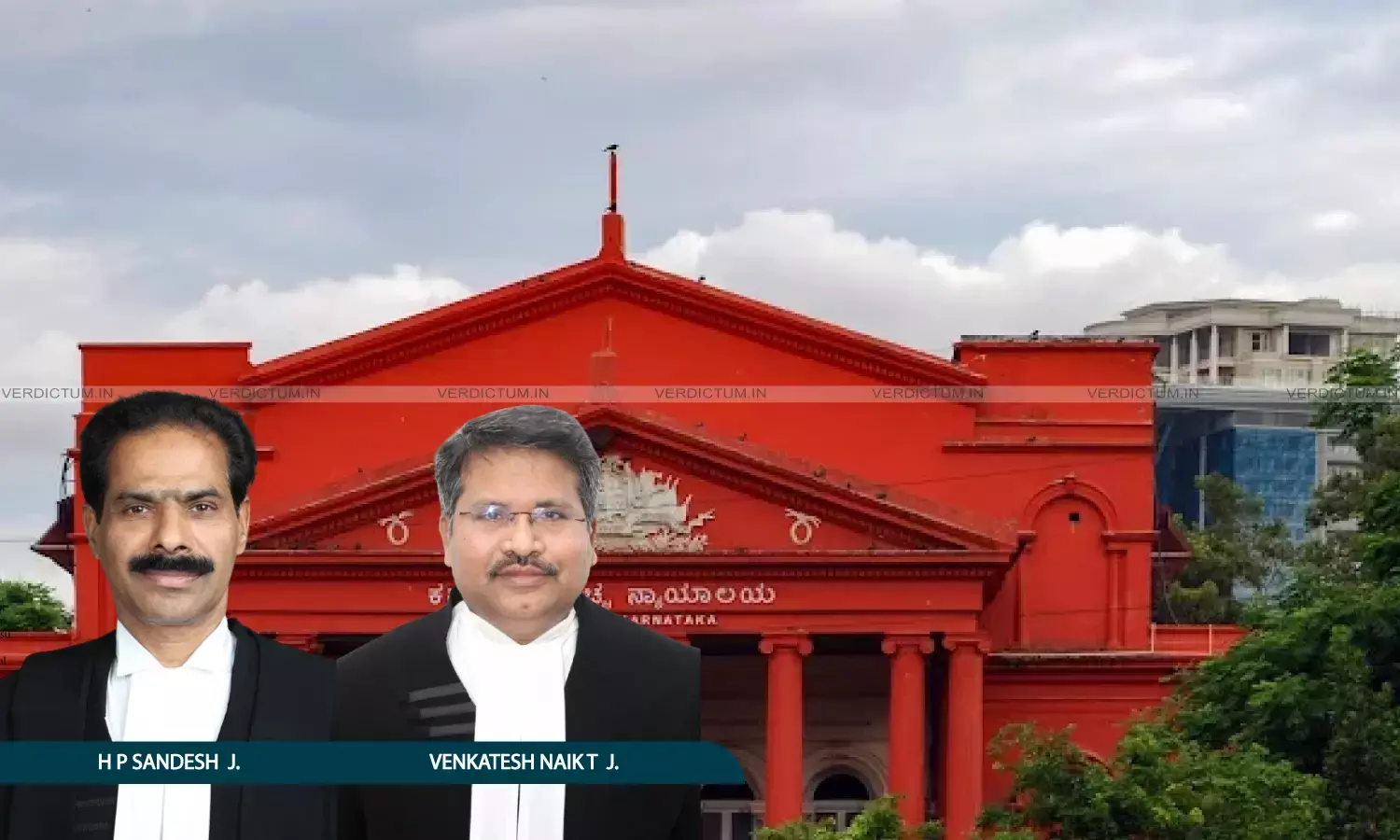
Justice H.P. Sandesh, Justice Venkatesh Naik T, Karnataka High Court
The Karnataka High Court has reiterated that a dying declaration does not lose its evidentiary value merely because it is recorded by a police officer under Section 161 of the Code of Criminal Procedure or forms the basis of the FIR.
What is determinative, the Court explained, is whether the statement is voluntary, consistent, truthful, and made when the maker was conscious and in a fit mental condition.
The Court was hearing a criminal appeal filed under Section 374(2) CrPC challenging the conviction of the accused for the offence punishable under Section 302 of the Indian Penal Code by the Sessions Court.
A Division Bench comprising Justice H.P. Sandesh and Justice Venkatesh Naik T while refering to the Judgment of Allahabad High Court in Gulab Singh v. State of U.P. (2004), reaffirmed that “a dying declaration recorded by a Police Officer is admissible and can be relied upon if it is consistent, voluntary, and truthful, even if recorded as an F.I.R. or under Section 161 of Cr.P.C”.
The Court added that in the matter at hand, the victim's statement to the officer was found to be “reliable as a dying declaration, supported by the evidence like eyewitness testimony and the Post-Mortem examination report”.
Background
According to the prosecution, the accused suspected that his wife was in an illicit relationship with the deceased, who was working with her. On the date of the incident, the accused allegedly arrived at the spot carrying petrol in a plastic can, poured it over the deceased, and set him on fire. The victim sustained burn injuries and succumbed to septicaemia a few days later.
The injured victim’s statement was recorded by the Investigating Officer in the presence of a doctor while he was undergoing treatment. Based on this statement, the FIR was registered, and an investigation commenced.
The prosecution examined multiple eyewitnesses and relied on forensic and medical evidence, including the post-mortem report and FSL findings confirming the presence of petrol residue.
The trial court convicted the accused under Section 302 IPC and sentenced him to life imprisonment, leading to the present appeal.
Court’s Observation
The principal contention raised by the appellant was that the statement recorded by the police officer could not be treated as a valid dying declaration and that reliance upon it was erroneous.
The High Court examined the legal position relating to dying declarations and emphasised that courts must exercise caution while evaluating such statements, since the maker is not available for cross-examination. The Bench observed that a mechanical approach in accepting a dying declaration merely because it exists would be unsafe, and the Court must carefully assess whether it is voluntary, truthful, and made in a conscious state of mind.
Addressing the specific issue of a dying declaration recorded under Section 161 CrPC, the Court referred to the decision of the Allahabad High Court in Gulab Singh v. State of U.P., and noted that a dying declaration recorded by a police officer is admissible and can be relied upon if it is consistent, voluntary, and truthful, even when it forms part of the FIR or is recorded under Section 161 CrPC.
Applying this principle to the facts of the case, the Bench found that the statement of the injured (Ex.P6) was recorded by the Investigating Officer in the presence of a doctor. The doctor deposed that the victim was conscious and in a fit state of mind to give the statement. The Court noted that nothing was elicited in cross-examination to discredit this position.
The Court held that in the absence of any material suggesting that the victim was not in a fit condition or that the statement was influenced or fabricated, there was no reason to doubt its reliability. It was therefore concluded that the statement could be safely relied upon as a dying declaration.
Apart from the dying declaration, the Court also relied upon the consistent testimony of eyewitnesses who deposed that the accused poured petrol on the deceased and set him ablaze. The forensic report confirmed the presence of petrol residue in the seized container, and the post-mortem report established that the death occurred due to septicaemia resulting from burn injuries.
The Bench further rejected the contention that the absence of CCTV footage or seizure of the motorcycle allegedly used by the accused weakened the prosecution's case. It held that when credible eyewitness testimony is available, such omissions do not go to the root of the matter.
On the question of intention, the Court observed that the accused had come prepared with petrol and a matchbox and set the victim on fire. Such conduct clearly disclosed intention and knowledge of the likely fatal consequences.
Conclusion
Finding that the dying declaration recorded by the Investigating Officer was voluntary, consistent, and supported by medical and eyewitness evidence, the Karnataka High Court upheld the conviction of the accused under Section 302 IPC.
The Court dismissed the appeal and affirmed the sentence of life imprisonment, holding that no error had been committed by the trial court in appreciating the evidence.
Cause Title: Asif v. State of Karnataka (Neutral Citation: 2026:KHC:8117-DB)
Appearances
Appellant: Advocate Sparsh Shetty
Respondent: Rashmi Patel (HCGP)