

Reputation Of Government Servant Cannot Be Tarnished By Sweeping Allegations Unsupported By Service Record: J&K And Ladakh High Court
The High Court has held that the assessment of a government servant’s reputation for the purpose of premature retirement must be based on cogent material emanating from the service record, and that unsubstantiated sweeping statements are insufficient to form a lawful basis for such action.
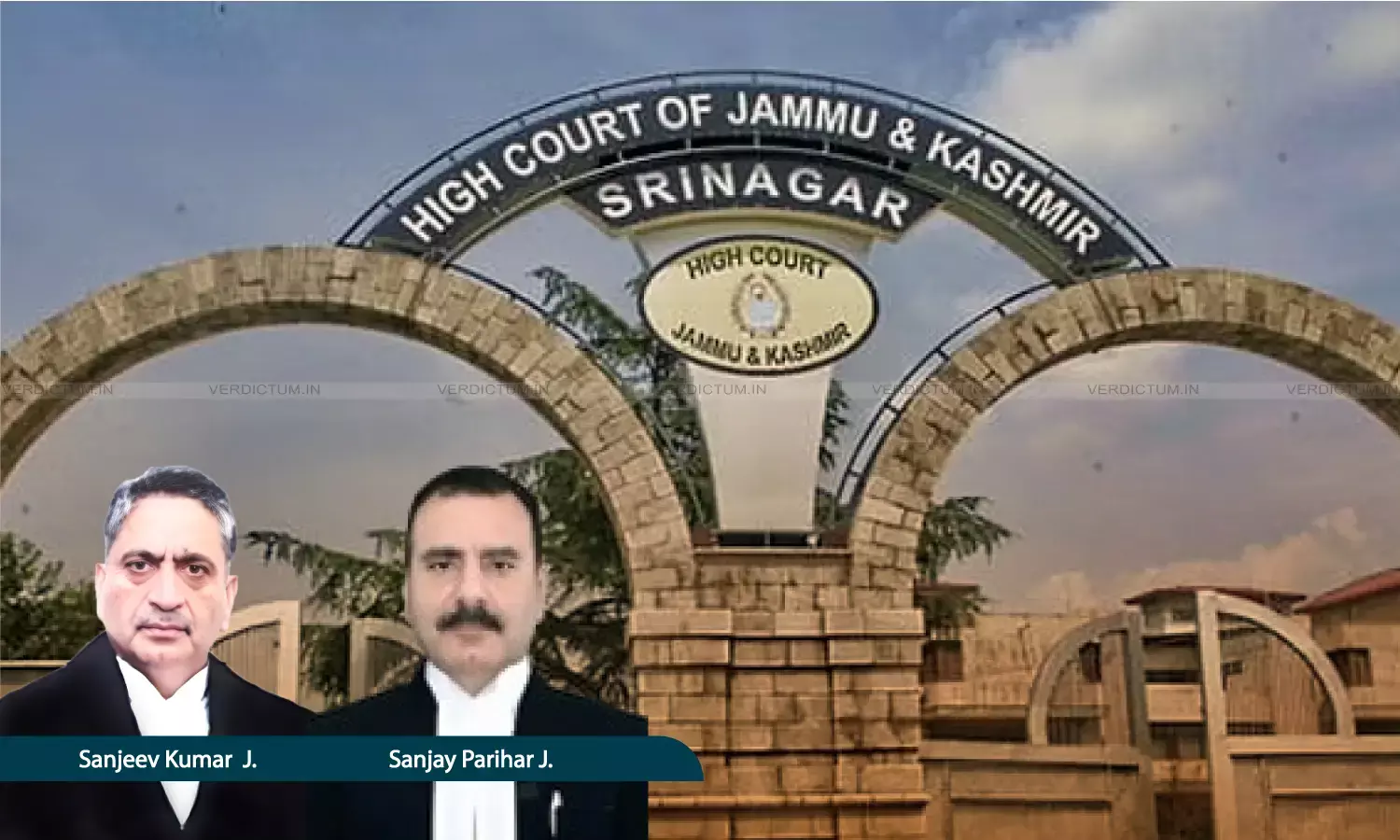
Justice Sanjeev Kumar, Justice Sanjay Parihar, Jammu & Kashmir and Ladakh High Court
The Jammu & Kashmir and Ladakh High Court has reiterated that the power of premature retirement cannot be exercised based on vague perceptions or unsupported assertions regarding a government servant’s reputation.
The Court held that any opinion regarding doubtful integrity or loss of public confidence must be founded on tangible material drawn from the employee’s service record.
The Court was hearing an intra-court appeal filed by the State of Jammu & Kashmir challenging a judgment of the Writ Court which had quashed the order of compulsory retirement passed against the respondent officer.
A Division Bench comprising Justice Sanjeev Kumar and Justice Sanjay Parihar dismissed the appeal, and observed: “for the purpose of assessing the reputation of a Government servant, the material to be relied upon must be cogent and should emanate from the service record of such an employee. The opinion of the officers under whom such employee has worked from time to time would be relevant to be taken into consideration. A sweeping statement, without being supported by any material worth the name, is not good enough to ruin somebody’s reputation”.
Hakim Aman Ali, Deputy Advocate General, represented the state, while Senior Advocate Azhar Ul Amin represented the respondents.
Background
The respondent was appointed as a Sectional Officer (later Junior Engineer) in the Roads & Buildings Department in 1982 and had served in various capacities over a long career. In 2011, he was implicated in a vigilance FIR under the J&K Prevention of Corruption Act and placed under suspension.
During the investigation, the respondent asserted that no incriminating material was recovered from his possession and that the trap money had been recovered from a location not under his control. He was subsequently reinstated in service in 2015.
However, by an order dated 21.11.2016, the respondent was prematurely retired under Regulation 226(2) of the J&K Civil Services Regulations, on the premise that his continuance in service was not in the public interest. Aggrieved, he approached the Writ Court, which quashed the order and directed reinstatement with consequential benefits.
The State carried the matter on appeal.
Court’s Observation
The Division Bench of the Jammu and Kashmir High Court examined the statutory framework governing premature retirement under Regulation 226(2) of the Jammu and Kashmir Civil Services Regulations and the executive instructions issued thereunder, including SRO 246 of 1999 and the Office Memorandum dated 25.10.2010. The Court reiterated that the formation of opinion for premature retirement must be bona fide, based on consideration of the entire service record.
The Court noted that the Screening Committee is required to consider relevant material such as Annual Performance Reports, disciplinary history, vigilance inputs, audit paras, and opinions of superior officers. Reputation, the Court held, cannot be assessed in abstraction.
The Bench observed that the only material relied upon by the authorities in the present case was the respondent’s involvement in a single FIR. No attempt was made to examine his service book, past performance, or conduct during his long tenure. The Committee recorded a sweeping observation that the respondent did not enjoy a good public reputation, without disclosing any material basis for such inference.
The Court stressed that for the purpose of assessing the reputation of a Government servant, the material to be relied upon must be cogent and should emanate from the service record of such an employee. It further held that the opinions of officers under whom the employee had worked would be relevant, but a bald assertion unsupported by record could not justify compulsory retirement.
Relying on the decisions of the Supreme Court in M.S. Bindra v. Union of India and State of Gujarat v. Suryakant Chunilal Shah, the Court reiterated that mere involvement in a criminal case does not establish guilt, and suspicion or conjecture cannot replace evidence.
The Bench also referred to Baikuntha Nath Das v. Chief District Medical Officer, reiterating that although judicial review in such matters is limited, interference is warranted where the decision is arbitrary, based on no evidence, or where relevant material has been ignored.
On the facts of the case, the Court found that the competent authority had merely accepted the recommendations of the Screening Committee without independent application of mind. The absence of any material beyond the registration of the FIR rendered the impugned order unsustainable.
Conclusion
The High Court held that the order of premature retirement was vitiated in law, having been passed without consideration of the respondent’s service record and based on unsupported allegations regarding reputation. The Court found no infirmity in the judgment of the Writ Court quashing the impugned order.
Accordingly, the appeal filed by the State was dismissed, and the direction for reinstatement with consequential benefits was upheld.
Cause Title: State of Jammu & Kashmir v. Ahsan-ul-Haq Khan
Appearances
Appellant: Hakim Aman Ali, Deputy Advocate General; Mohd. Younis Hafiz, Advocate
Respondent: Azhar-ul-Amin, Senior Advocate; Numan Shafi, Advocate
