Appellate Tribunal Under PMLA Empowered To Remand Matters After Setting Aside Confirmation Orders: High Court Of J&K And Ladakh
The High Court held that the statutory power to “pass such orders as it thinks fit” under Section 26(4) of the Prevention of Money Laundering Act necessarily includes the power to remand proceedings to the Adjudicating Authority after setting aside its order.
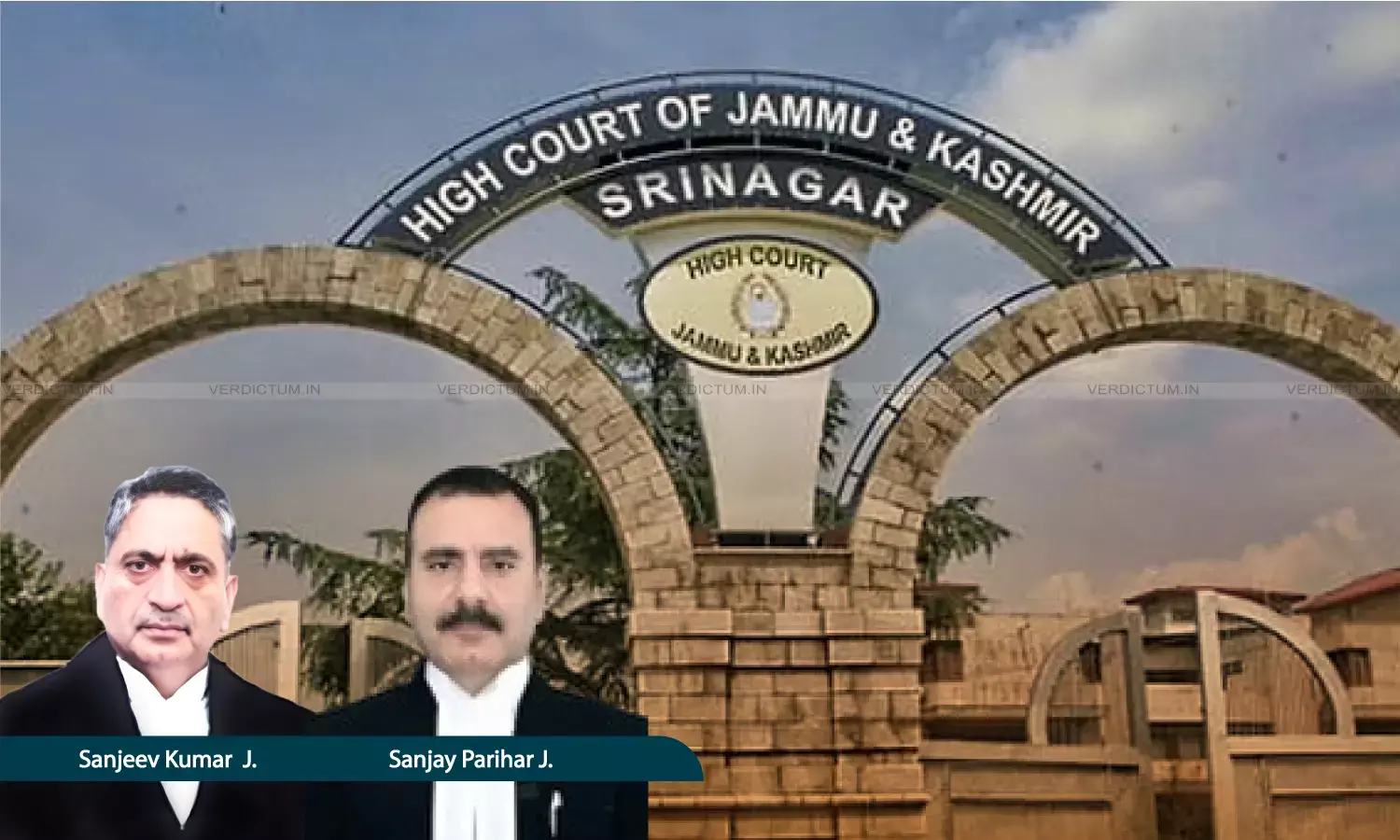
Justice Sanjeev Kumar, Justice Sanjay Parihar, Jammu & Kashmir and Ladakh High Court
The High Court of Jammu & Kashmir and Ladakh has held that the Appellate Tribunal constituted under the Prevention of Money Laundering Act, 2002 (PMLA) possesses the legal authority to remand matters to the Adjudicating Authority after setting aside confirmation orders passed under Section 8 of the Act.
The Court was hearing statutory appeals challenging an order of the Appellate Tribunal whereby the confirmation of provisional attachment was set aside and the matter was remanded for fresh consideration, after supply of “reasons to believe” and full opportunity of hearing.
A Division Bench of Justice Sanjeev Kumar and Justice Sanjay Parihar observed that “the words ‘may pass such orders thereon as it thinks fit’ are of the widest amplitude and would vest in the Appellate Tribunal powers of remand as consequential to the power to set aside the order appealed against.”
Senior Advocate R.A. Jan represented the appellants, while T.M. Shamsi, DSGI, represented the respondents.
Background
The appeals arose out of provisional attachment of immovable property under Section 5 of the PMLA, followed by confirmation by the Adjudicating Authority against the appellants, alleging involvement in illegal transfer of funds.
On appeal, the Appellate Tribunal set aside the confirmation order solely on the ground of non-supply of “reasons to believe,” but remanded the matter for de novo proceedings.
The appellants challenged the remand direction, asserting that the Tribunal lacked statutory power to remand and that provisional attachment had lapsed by efflux of time.
Court’s Observation
The J&K and Ladakh High Court examined Section 26 of the PMLA and held that its structure confers appellate jurisdiction allowing confirmation, modification, or setting aside of orders, and includes all “ancillary powers necessary to give effect to that jurisdiction”, including remand. It noted that appellate power would become ineffective if remand were denied in cases where decisions are annulled on technical grounds.
The Bench relied on Union of India v. Umesh Dhaimode, where the Supreme Court interpreted similarly worded provisions to hold that an order of remand necessarily annuls the order appealed against and thus falls within the appellate power.
The High Court also concurred with the view of the Calcutta High Court in Partha Chakraborti v. Directorate of Enforcement, holding that the broad phrase “as it thinks fit” includes remand to avoid “a paradoxical situation” where procedural violations would render appellate relief meaningless.
Rejecting the appellants’ argument that statutory tribunals lack inherent powers, the Court clarified that the power of remand is not inherent but a necessary concomitant of the authority expressly conferred to set aside or annul orders.
“If we were to concede that the appellate Tribunal can only confirm, modify or set aside the order of Adjudicating Authority appealed against and cannot remand the matter, it would present a paradoxical situation where the Tribunal, after setting aside an order on the ground of procedural error or a technicality, would be left helpless and allow the appellants to reap the fruits of procedural error or of a mere technicality”, the Bench remarked.
On the contention of the attachment order having expired, the Court referred to Kaushalya Infrastructure Development Corporation Ltd. v. Union of India to hold that adjudication proceedings may continue despite the expiry of the provisional attachment. The Court clarified that the Tribunal only set aside the confirmation order, not the underlying proceedings under Section 8, and therefore the matter remained alive.
Conclusion
Holding that the Appellate Tribunal acted within its jurisdiction in remanding the matter, the Court dismissed all connected appeals and upheld the impugned Tribunal order. Interim directions, if any, were vacated.
Cause Title: Sarwa Zahoor & Zahoor Shah v. Directorate of Enforcement & Another
Appearances
Appellants: R.A. Jan, Senior Advocate, with Advocate Shahid Habib
Respondents: T.M. Shamsi, DSGI, with Faizan Ahmad, CGC