Right To Establish Educational Institution Does Not Include Right To Recognition Or Grant-In-Aid From State: J&K And Ladakh High Court
The High Court held that, though establishing a private educational institution is a fundamental right under Article 19(1)(g), no citizen or institution can claim recognition, affiliation, or grant-in-aid from the Government as a matter of right. Such recognition remains subject to statutory conditions imposed by the State.
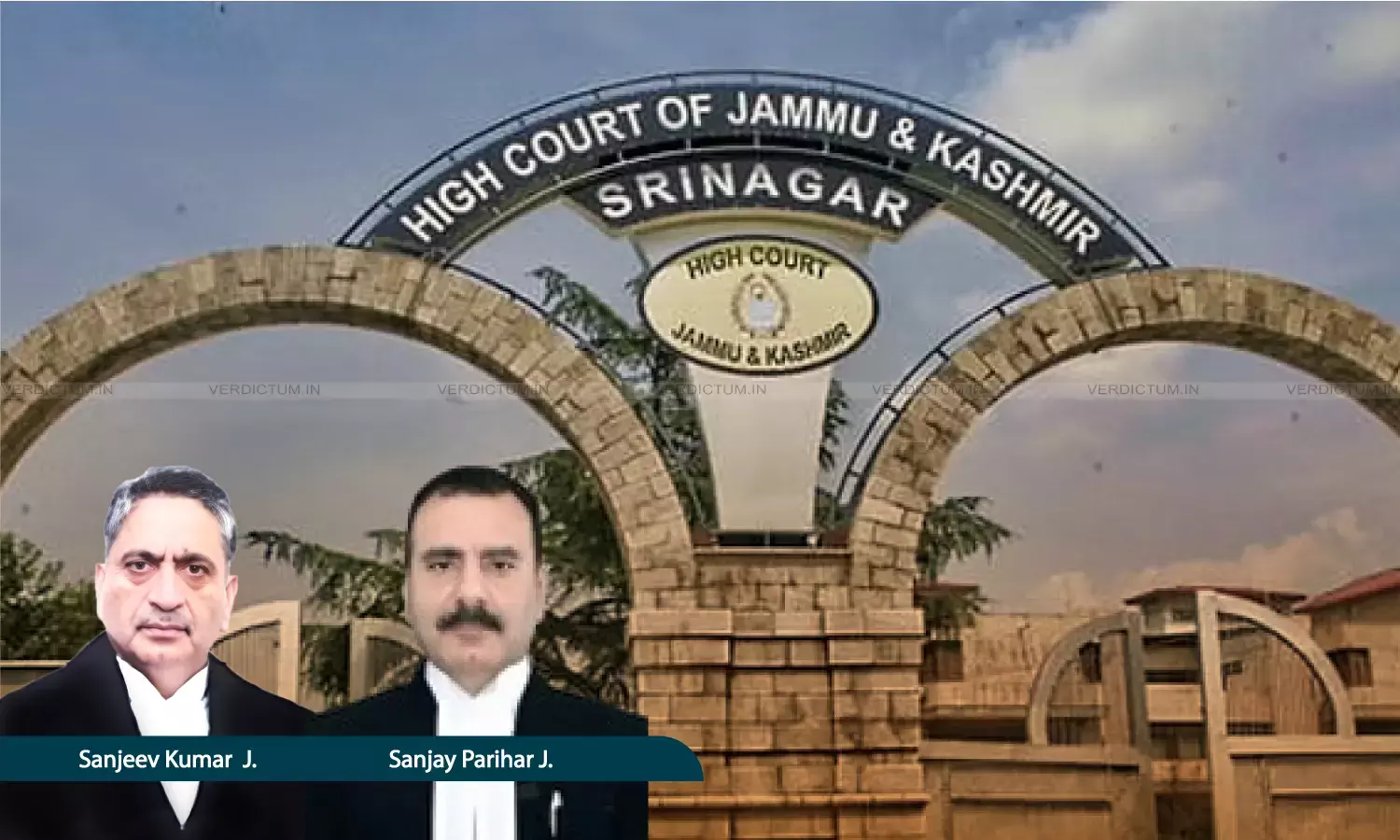
The High Court of Jammu & Kashmir and Ladakh held that while a citizen may have a right to establish a private educational institution, neither the citizen nor the institution has a fundamental right to seek recognition or grant-in-aid from the Government.
The Court observed that recognition and affiliation are to be granted by the State, subject to conditions laid down by law, and that the right to establish an educational institution under Article 19(1)(g) is amenable to reasonable statutory regulation.
The Court was hearing a writ petition filed by a group of private unaided schools challenging the amendments made to the Jammu and Kashmir School Education Act, 2002, the constitution of the Fee Fixation and Regulation Committee for Private Schools (FFRC), the J&K Private Schools (Fixation, Determination and Regulation of Fee) Rules, 2022, and orders issued by the FFRC regulating transport fee.
A Bench of Justice Sanjeev Kumar and Justice Sanjay Parihar observed: “A citizen of this country may have a right to establish an educational institution, but no citizen or educational institution has a right, much less a fundamental right, to seek recognition or grant-in-aid from the Government. Such recognition and affiliation shall be granted by the State subject only to the conditions laid down by the Government. It is in this background that it can be said that though the right to establish a private educational institution is a fundamental right guaranteed under Article 19(1)(g), yet such right is subject to reasonable restrictions and can be regulated by the State by an Act of the Legislature.”
Background
The petitioners were private unaided schools in Jammu and Kashmir. They challenged Government Order No. S.O. 3466(E) dated 05.10.2020, by which Sections 20A to 20J were inserted into the J&K School Education Act, 2002, creating a statutory framework for the constitution of the FFRC and regulation of fees in private schools. They also challenged S.O. No. 177 of 2022, S.O. No. 233 of 2022, which framed the Fee Fixation Rules, 2022, and the FFRC orders dated 09.03.2022 and 06.10.2022 relating to the transport fee.
The schools contended that, being unaided institutions, they enjoyed autonomy in fixing fees, and that the amended provisions conferred sweeping powers on the FFRC to fix, determine, and regulate fees in a manner contrary to the law declared in T.M.A. Pai Foundation, Islamic Academy of Education, P.A. Inamdar, and Modern School. They also questioned the legality of appointing a government officer of the rank of Financial Commissioner or above as Chairperson of the Committee.
The respondents defended the statutory framework by arguing that the amendments were intended to implement the Supreme Court’s directions against commercialisation and profiteering in education, and that the FFRC was a statutory mechanism created for that purpose.
Court’s Observation
The High Court undertook a detailed survey of the law governing private educational institutions, beginning from Unni Krishnan and moving through T.M.A. Pai Foundation, Islamic Academy of Education, Modern School and P.A. Inamdar. The Court noted that it is now settled that the establishment of a private educational institution is not a trade or business but an occupation within the meaning of Article 19(1)(g). At the same time, the Court held that such a right is not absolute and is subject to reasonable statutory restrictions.
The Bench observed that the obligations flowing from Articles 21, 41 and 45 of the Constitution can be discharged by the State either by establishing institutions of its own or by recognising and affiliating private institutions. It was in that context that the Court observed that though a citizen may have a right to establish an educational institution, there is no corresponding right to demand recognition or grant-in-aid from the Government. Recognition and affiliation, the Court held, are matters governed by conditions imposed by the State.
The Court also discussed the growth of private schools in Jammu and Kashmir and recorded that private schooling had come to play a major role in the Union Territory, particularly because of the perceived failure of the public education system. It noted that private schools in the Union Territory had become a robust alternative to Government schools and that the Government should avoid unnecessary interference in their functioning.
On the issue of profiteering and commercialisation, the Court held that these expressions cannot be read to mean that private educational institutions must function on a strict no-profit-no-loss basis. The Bench observed that what is prohibited is excessive or unfair profit and treating education purely as a business activity. It added that allowing private institutions to derive reasonable profit on investments made in establishing and maintaining school infrastructure would not be wholly unjustified, and said such profit should not exceed the commercial rate of interest at the relevant time.
The Court concurred with the principles laid down by the Kerala High Court in Lisie Medical and Educational Institutions v. State of Kerala and added that transport fee should ordinarily be outside the purview of the FFRC, though if it is treated as part of school fee, it should be determined in association with expert agencies such as the Transport Department and CAPD, with inputs from relevant fuel-distribution bodies. It further held that the FFRC should frame regulations indicating how schools or proposals would be selected for detailed scrutiny, especially in cases of specific complaints of profiteering.
The High Court did not accept the broad challenge to the statutory framework. It held that the Act of 2002 and the Rules of 2022 provide sufficient guidelines for the FFRC to determine whether a particular school is indulging in commercialisation and undue profiteering. At the same time, the Court cautioned that the FFRC should not enter into extensive scrutiny of every school’s proposed fee structure and should ordinarily accept the fee proposed by a private institution unless the conscience of the Committee is shocked by its nature and magnitude. The Court said the FFRC should devise a rational method of selecting only some cases for in-depth scrutiny, particularly bigger institutions in urban areas or schools against which specific complaints are received.
The Court further urged the Government of the Union Territory to revisit the Fee Fixation Regulations, 2022 to bring them in tune with the observations made in the judgment, and to lay down proper parameters and adequate guidelines to ensure a uniform yardstick in fee determination, to curb undue profiteering without stifling genuine private schools, especially in rural areas.
Conclusion
The High Court disposed of the writ petition. It held that the FFRC must keep in view the conclusions recorded by the Court while approving, disapproving, or suggesting the fee structure of particular institutions.
The Court also directed that, until the contemplated exercise for transport fee fixation is undertaken through the mechanism suggested by the Court, FFRC Order No. 09 dated 06.10.2022 would continue to regulate transport charges to be levied by private educational institutions in the Union Territory of Jammu and Kashmir.
Cause Title: New Convent High School, Gogji Bagh, Srinagar & Ors. v. Union of India & Ors.
Appearances
Petitioners: N.A. Beigh, Senior Advocate with Mohd. Murshid Rashid, Advocate.
Respondents: T.M. Shamsi, DSGI with Shagufta Maqbool, Advocate; Mohsin Qadri, Senior AAG with Maha Majeed and Mohd. Younis Hafiz, Advocates.