

Prosecution Cannot Recall Witnesses When Accused Admits Their Depositions Recorded U/S 299 CrPC: J&K&L High Court
The Court also granted the petitioner-an accused under NDPS Act, a 45-day temporary bail on medical grounds.

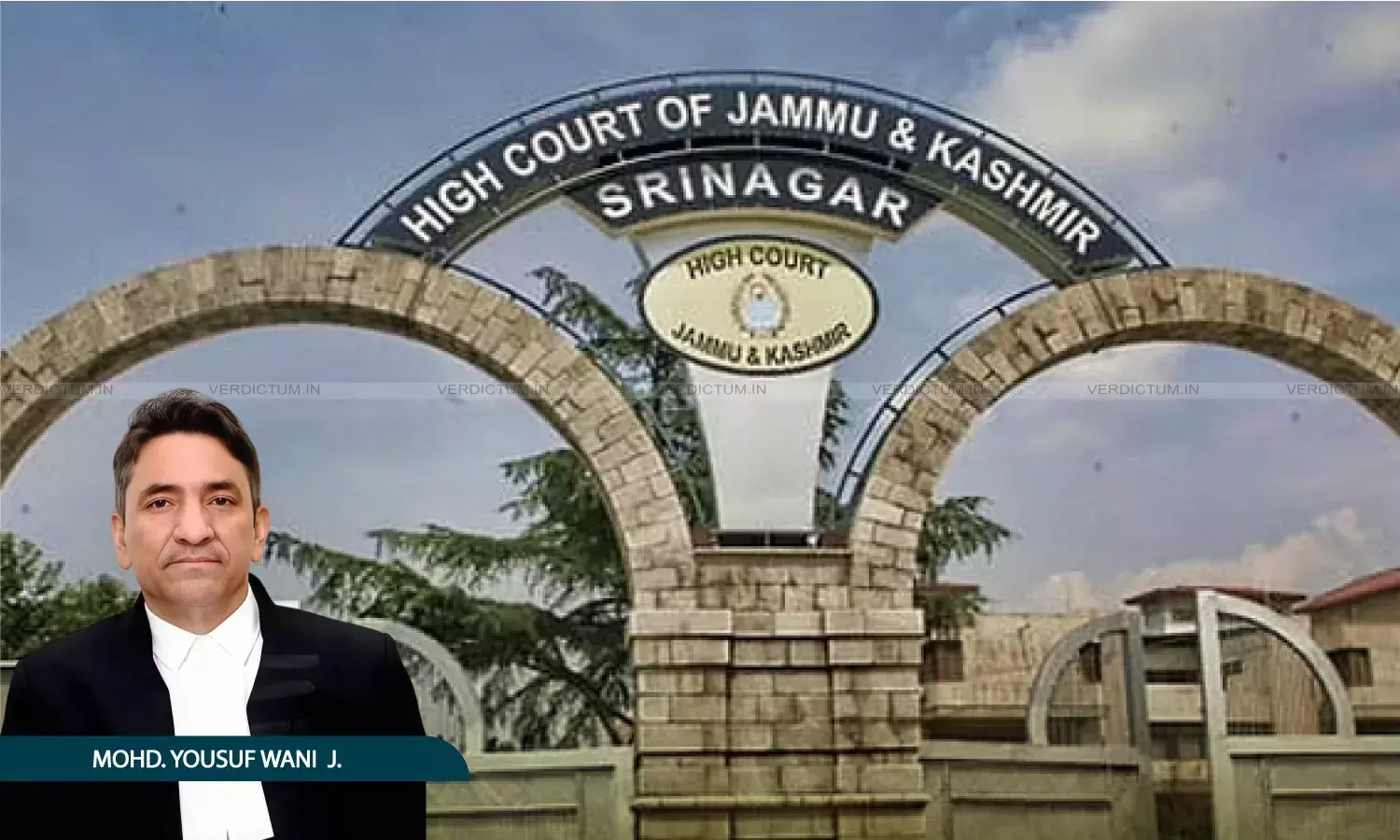
The Jammu & Kashmir and Ladakh High Court has held that where evidence has been recorded in the absence of an accused under Section 299 of the Code of Criminal Procedure, 1973, and the accused later appears before the court and admits those depositions, the prosecution cannot seek to recall the witnesses to re-examine them.
The Bench observed that allowing the prosecution to recall witnesses despite the accused admitting their previously recorded testimonies would amount to granting an undue opportunity to improve its case, which would defeat the purpose of Section 299 CrPC.
Further, in a connected bail application, the Court granted the petitioner temporary bail for 45 days on medical grounds, noting that he was suffering from serious cardiac ailments including dilated cardiomyopathy with approximately 20% cardiac functioning and had been advised urgent surgical intervention.
While observing that the statutory restrictions under Section 37 of the NDPS Act apply when bail is considered on merits, the Court held that High Courts are not powerless to grant temporary bail on humanitarian grounds in exceptional circumstances.
Justice Mohd Yousuf Wani observed, “Allowing the prosecution to recall the already examined witnesses despite the admission of their depositions will tantamount to granting undue concession to the prosecution for making an attempt to improve its case, besides being against the logic and object of the provisions of Section 299 of the Code. The prosecution witnesses 1 to 10 are reported to have been already examined and their examinations in chief in case of their death or disability or incapability of attending the court were to be read against the present petitioner/accused after his appearance at the trial. The petitioner/accused has admitted the evidence of all the recorded prosecution witnesses and, as such, the said witnesses cannot be recalled at the discretion of the prosecution. The provisions of Section 299 of the Code are in the form of an exception to the general rule that evidence needs to be recorded in the presence of the accused or his legal representative”.
“This Court can derive its authority from the provisions of the Section 483 of the BNSS read with the provisions of Article 21 of the Constitution, to address an eventuality, like the present one and pass the appropriate orders regarding temporary bail subject to some stringent conditions, under exceptional and compelling circumstances. After all, a health issue even of a detenue is of paramount consideration. All under trial and convicts have their fundamental right to claim proper medical care and treatment… When bail is to be considered on humanitarian grounds, the merits of the case do not apply…”, the Bench while granting bail observed.
Advocate Hakim Suhail Ishtiyaq appeared for the petitioner and Zahid Noor, GA appeared for the respondent.
The matter pertained to an FIR registered under Sections 8/15 and 29 of the Narcotic Drugs and Psychotropic Substances Act, 1985, and Section 207 of the Motor Vehicles Act, 1988 in which the petitioner was alleged to have been involved along with other accused in the seizure of 281.5 kilograms of poppy straw.
Pursuant to the filing of the FIR, during the investigation, the petitioner could not be traced and was treated as absconding, following which proceedings under Section 299 CrPC were initiated and prosecution witnesses were examined in his absence while the trial proceeded against the co-accused.
After subsequently surrendering before the trial court and being formally charged, the petitioner filed an application stating that he accepted the depositions of prosecution witnesses already recorded in his absence and did not wish to recall them for cross-examination, as they had already been cross-examined by counsel for the co-accused.
However, the prosecution moved an application seeking recall of those witnesses for further examination to the extent of the petitioner, which the trial court allowed while rejecting the petitioner’s plea.
The Court setting aside the trial court’s order, noted that the object of Section 299 CrPC is to preserve evidence against an absconding accused so that it is not lost due to delay or inability to secure the presence of witnesses.
The Court also rejected the prosecution’s contention that a separate trial was required against the petitioner, holding that recalling witnesses in such circumstances would run contrary to the logic and purpose of the provision.
Accordingly, the Court directed that the petitioner be released on temporary bail subject to furnishing ₹1 lakh personal bond and surety, and ordered him to surrender before the trial court after the expiry of the 45-day period.
Cause Title: Mohammad Yaqoob Beigh v. Union Territory (UT) of J&K Bail App 13/2026 c/w CRM(M) 640/2025
Appearances:
Petitioner: Hakim Suhail Ishtiyaq, Syed Haroon Rashid, Advocates.
Respondent: Zahid Noor, GA.