

Explicit Purpose Of Garnering Political Advantage: Jammu & Kashmir & Ladakh High Court Rejects Mehbooba Mufti’s Plea Seeking Transfer Of Undertrial Prisoners
The J&K&L High Court said that the PIL cannot be allowed to be utilised as an instrument for advancing partisan or political agendas or transforming the Court into a political platform.
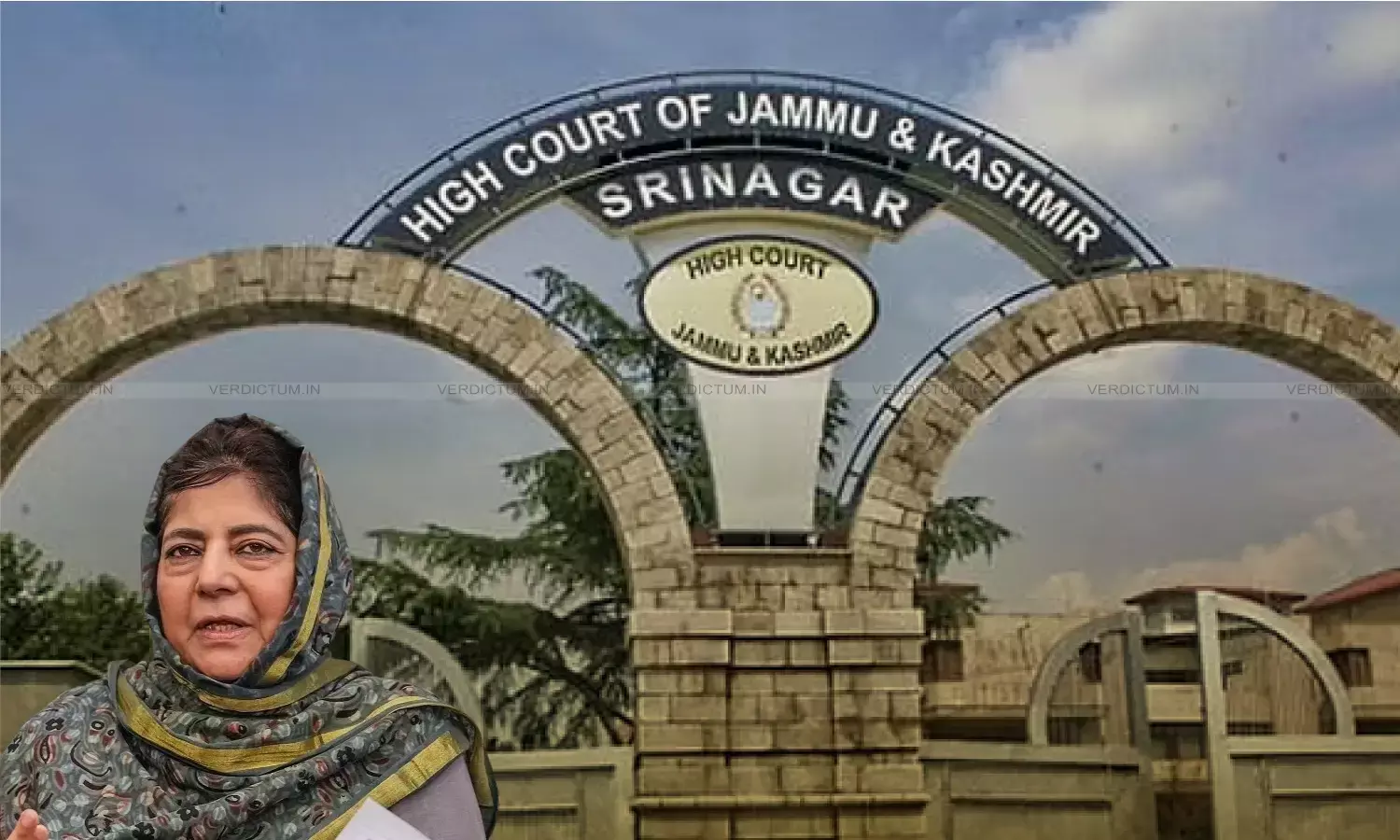
Jammu & Kashmir & Ladakh High Court, Mehbooba Mufti
The Jammu and Kashmir and Ladakh High Court has dismissed the Public Interest Litigation (PIL) filed by Mehbooba Mufti, President of Jammu and Kashmir Peoples Democratic Party (PDP party) and former Chief Minister of the erstwhile State of Jammu and Kashmir (J&K).
Mehmooba sought transfer of undertrial prisoners belonging to J&K presently lodged in the various prisons outside the Union Territory of J&K to jails within the J&K, unless the jail authorities place before the High Court the specific reasons demonstrating unavoidable/compelling necessity for keeping them in prisons outside J&K.
A Division Bench comprising Chief Justice Arun Palli and Justice Rajnesh Oswal remarked, “… it appears that the instant petition has been initiated by the petitioner for the explicit purpose of garnering political advantage and positioning herself as a crusader of justice for a particular demographic. … We also cannot remain oblivious to the violent past, which the residents of Jammu and Kashmir have passed through, because of forces hostile to the unity and integrity of this great country.”
The Bench said that the PIL cannot be allowed to be utilised as an instrument for advancing partisan or political agendas or transforming the Court into a political platform.
Advocate Aditya Gupta represented the Petitioner, while DSGI T. M. Shamsi represented the Respondents.
Background
The Petitioner-Mehbooba Mufti sought for directing the Respondents to immediately repatriate and transfer forthwith all undertrial prisoners belonging to J&K, presently lodged in the various prisons outside the Union Territory of J&K, to jails within the Union Territory of J&K, unless the jail authorities place before the Court the specific reasons demonstrating unavoidable/compelling necessity for keeping them in prisons outside J&K. Additionally, the Petitioner also sought the framing and enforcement of an access protocol ensuring minimum weekly family interviews in person, unrestricted privileged lawyer-client interviews, subject to reasonable regulations and no denial on cost/escort pretexts. Further, directions were also sought to be issued to the Legal Service Authorities to monitor and file quarterly compliance reports.
The Petitioner also sought the fixing of outer timelines for recording of evidence and preventing adjournments attributable to custody logistics. Simultaneously, she further sought the indulgence of the Court to constitute a Two-Member Oversight and Grievance Redressal Committee of retired District Judge and Member of State Legal Service Authority to audit undertrial locations, family contact logs, lawyer-interview registers and production orders and recommend disciplinary action for non-compliance and submit bi-monthly status reports to the Court. She also sought a direction for issuance of reasonable travel and accommodation reimbursement for one family member per month to meet the under-trial lodged outside the UT of J&K.
Court’s Observations
The High Court in the above regard, noted, “In fact, the petitioner too recognises the special circumstances of Jammu and Kashmir, when in relief part of this petition, she states that the undertrials be detained in the prisons in U.T of Jammu and Kashmir, unless the Jail Authorities furnish reasons before this court demonstrating 'unavoidable and compelling necessity' in exceptional cases. The detailing of such exceptional cases has been conveniently ignored by the petitioner.”
The Court observed that PIL is also not a mechanism for gaining political leverage, and the Courts cannot serve as a forum for electoral campaigns.
“While political parties possess manifold legitimate avenues to engage with the electorate, courts cannot be employed as an instrument for achieving electoral advantage”, it added.
The Court further said that under-trials, whose cause, the Petitioner claims to have projected in this Petition, are facing trials before the respective Courts and Judicial avenues were/are available to such undertrials for the redressal of any grievance concerning their detention.
“The omission on their part to avail themselves of these legal remedies is an indicative of the fact that they are not genuinely aggrieved by their retention in the prisons outside the UT of Jammu and Kashmir. Additionally, a robust legal aid framework exists under the Legal Services Authorities Act, monitored by the Hon’ble Supreme Court and the High Court. Under this framework, any prisoner aggrieved by illegal State action is provided access to counsel to challenge the legality of such action”, it also observed.
The Court added that an institutional mechanism is already in place to protect the rights of these undertrial prisoners and none of the person(s) alleged to be aggrieved of his/their detention in prisons outside the Union Territory of Jammu and Kashmir, has/have approached the Court even through this institutional framework, the Petitioner, in her capacity as a leader of the political party, lacks the standing to espouse their cause.
“It is worth mentioning here that this Court also has come across few cases where the under-trial prisoners, being aggrieved of their transfer from one prison to another, have approached this Court against such transfers. Even otherwise, a purely individual grievance pertaining to a prisoner's rights cannot typically form the subject matter of Public Interest Litigation, as if any undertrial prisoner is aggrieved of his detention in the prisons outside the U.T of Jammu and Kashmir, he can approach the court and the validity of the order in respect of his detention in the prisons outside the Union Territory of Jammu and Kashmir can be examined”, it said.
Conclusion
Furthermore, the Court remarked that the Petitioner’s request for omnibus directions is legally unsustainable, particularly as no specific transfer orders have been challenged or even brought on record for the Court's consideration and given that the affected undertrials have raised no grievance regarding their transfer to prisons outside U.T of Jammu and Kashmir, the Petitioner stands as a third-party stranger to the cause and has no locus standi to invoke the Court's jurisdiction.
“A PIL is maintainable only upon a prima facie showing of public interest. Where such interest is in doubt or compromised by extraneous considerations, the Court must decline to interfere, as preventing the abuse of legal process is, in itself, a matter of significant public interest”, it concluded.
Accordingly, the High Court dismissed the PIL.
Cause Title- Mehbooba Mufti v. Union of India & Ors. (Neutral Citation: 2025:JKLHC-SGR:373-DB)
Appearance:
Petitioner: Advocate Aditya Gupta
Respondents: DSGI T. M. Shamsi, Sr. AAG Mohsin S. Qadri, Advocate Faizan Majeed Ganaie, Assisting Counsel Maha Majeed, and GA Faheem Nisar Shah.
