

Section 27A NDPS Act Cannot Be Invoked Without Proof Of Financing Or Harbouring: J&K And Ladakh High Court Grants Bail
The High Court held that mere receipt of money from a co-accused, without material showing provision of funds or sheltering offenders, does not satisfy the statutory ingredients of financing illicit traffic under the NDPS Act.
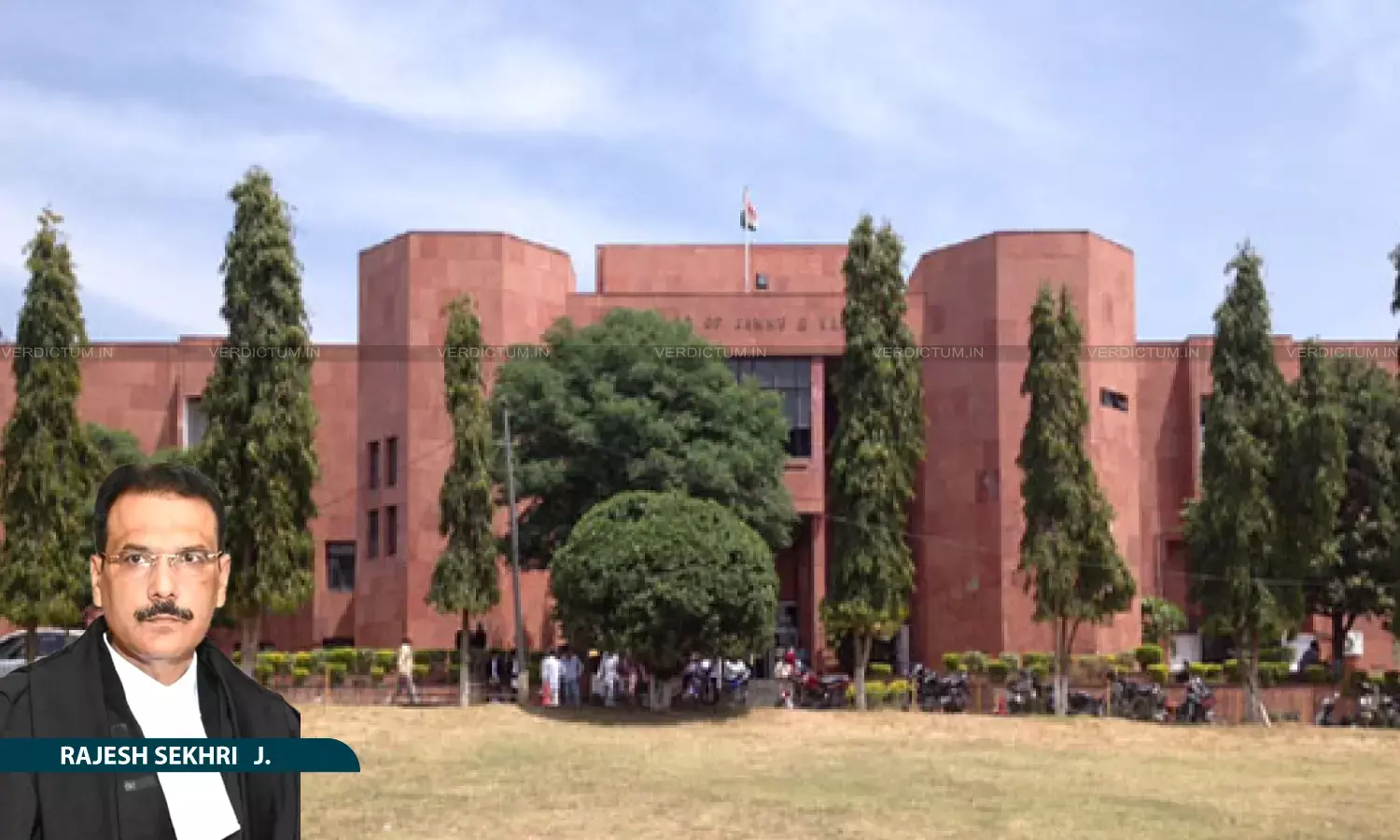
Justice Rajesh Sekhri, Jammu & Kashmir and Ladakh High Court
The High Court of Jammu & Kashmir and Ladakh has held that Section 27A of the NDPS Act cannot be invoked in the absence of prima facie material demonstrating that the accused financed illicit drug activity or harboured offenders, while granting bail to an accused implicated based on monetary transfers and a co-accused’s statement.
The Court was hearing an application seeking bail in anticipation of arrest in an FIR registered for offences under Sections 8, 21 and 22 of the NDPS Act.
A Bench of Justice Rajesh Sekhri, while allowing the application, observed: “…there is no prima facie evidence to support the Section 27-A charge, as the material available does not meet the direct threshold. The allegation against the applicant is that some amounts had been credited into his account by Latief Ali and co-accused Sanjay Kumar. However, there is nothing on the record or in the CD file to reflect that the applicant at any point of time provided money or financed the co-accused or anybody else or credited any amount into the account of the co-accused or anybody else to finance the activities within the meaning of sub-clause (v) of Clause (viiib) of Section 2 NDPS Act. I do not find the factual foundation to verify the allegation that petitioner, at any point of time, directly or indirectly indulged in financing the activities specified in sub clause (v) of clause (viiib) of Section 2 NDPS or harboured any person engaged in such activities”.
Background
The case arose from a police interception during naka duty, where a co-accused was found carrying a heroin-like substance along with a weighing machine, mobile phone, and cash, leading to registration of an FIR against him and another person.
The applicant was later implicated during the investigation on the allegation that he was a supplier and that certain amounts had been deposited into his bank accounts by co-accused persons.
The trial court rejected his bail plea, relying on bank transactions allegedly showing deposits by the co-accused into his accounts and statements made during the investigation.
The applicant contended that no contraband was recovered from him, that the monetary deposits represented legitimate loans and family transactions, and that similarly placed co-accused had already been granted bail.
Court’s Observation
The High Court first outlined the governing principles for the grant of bail, noting that discretion must be exercised by balancing societal interest with the presumption of innocence and factors such as the gravity of the offence, likelihood of tampering with evidence, and severity of punishment.
The Court then analysed the statutory framework of Section 27A NDPS Act and its linkage with the definition of “illicit traffic” under Section 2(viiib), emphasising that the provision distinguishes between participation in narcotics activities and financing such activities, and that these categories carry different legal consequences.
Referring to dictionary meanings and precedent, the Court explained that “financing” ordinarily denotes providing funds to enable or sustain an activity, whereas a payment made as consideration for a transaction cannot be equated with financing.
It further clarified that harbouring requires conduct amounting to shielding or protecting a trafficker from legal consequences.
Applying these principles, the Court held that there was no prima facie evidence to support a Section 27-A charge, while further stating that the material available did not meet the direct threshold as there was nothing to reflect that the applicant had provided money or financed co-accused, or harboured any person engaged in such activities.”
The Court noted that contraband had been recovered from a co-accused and not from the applicant, and that those co-accused had already been granted bail, which had not been challenged by the prosecution.
It also considered the evidentiary value of statements made during investigation, observing that confessional statements recorded by officers empowered under Section 53 of the NDPS Act are inadmissible under Section 25 of the Evidence Act, as held by the Supreme Court.
The Court additionally referred to precedent where bail was not cancelled despite reliance on call data records, noting that such material is ultimately to be evaluated during trial and not at the stage of bail.
Having independently assessed the record, the Court concluded that the factual foundation necessary to sustain allegations under Section 27A was absent and that continued custodial restraint was unwarranted.
Conclusion
The High Court allowed the bail application and directed the release of the applicant upon furnishing bonds and subject to conditions, including cooperation with the investigation, non-interference with evidence, and restriction on travel outside the jurisdiction.
Cause Title: Mazeed Ali v. Union Territory of Jammu & Kashmir
Appearances
Appellant: Abhinav Sharma, Sr. Advocate with Abhimanyu Sharma, Advocate.
Respondents: Sumeet Bhatia, GA.
