

Second FIR Permissible Where It Targets Broader Criminal Conspiracy Distinct From Earlier Case: J&K And Ladakh High Court
The High Court held that the bar on multiple FIRs is confined to identical occurrences and does not extend to situations where subsequent investigation uncovers a wider conspiracy involving distinct acts and participants.
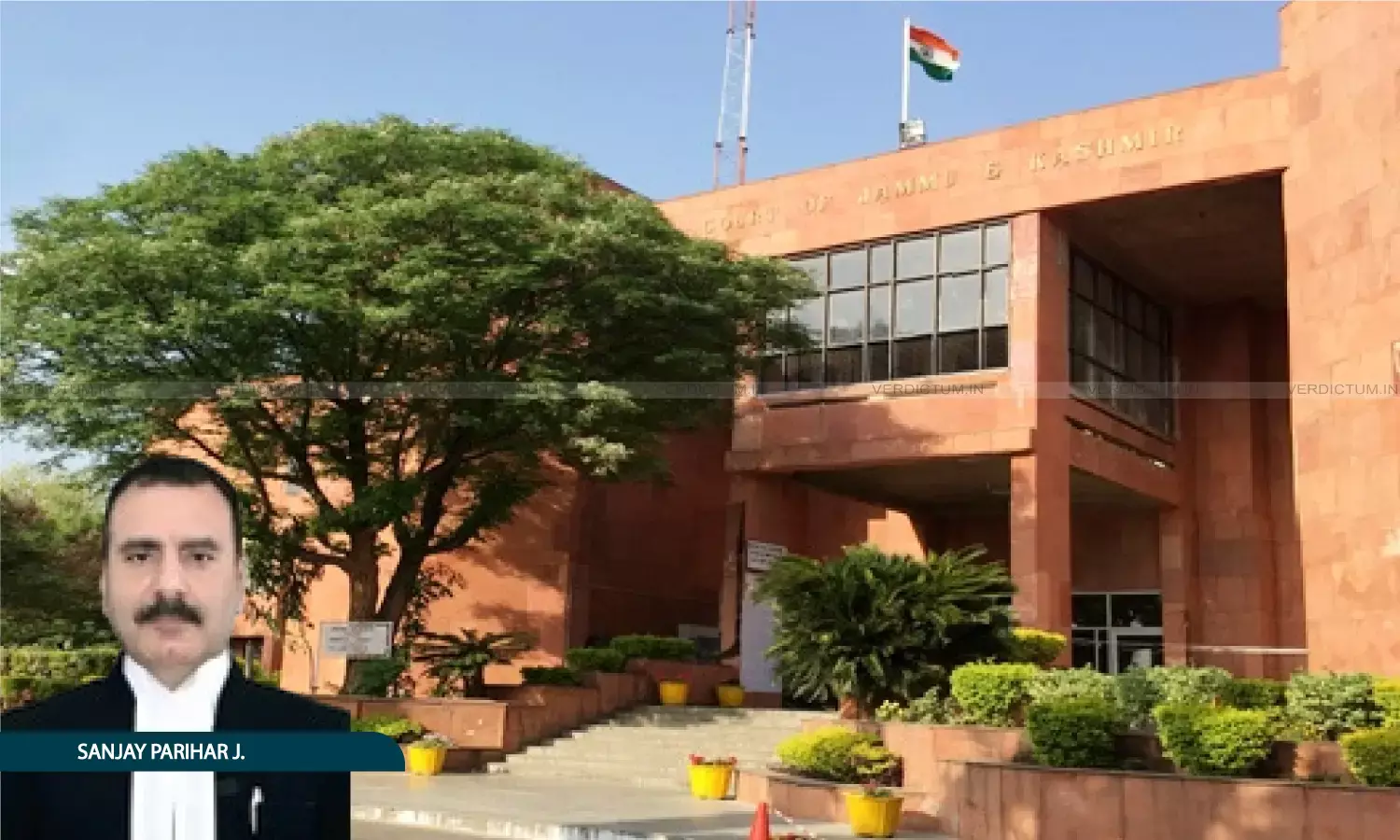
Justice Sanjay Parihar, Jammu & Kashmir and Ladakh High Court
The High Court of Jammu & Kashmir and Ladakh has held that registration of a second FIR is legally permissible where it pertains to a larger and distinct conspiracy, even if it is factually connected to an earlier case, reiterating that the controlling principle is the “test of sameness.”
The Court was hearing petitions challenging an order of the Sessions Court directing the framing of charges against the petitioners in a case involving allegations of fabrication and the use of forged allotment orders for the diversion of kerosene oil under the public distribution system.
A Bench of Justice Sanjay Parihar observed: “The argument that FIR No. 31/2006 is barred as a second FIR in view of the law laid down in “T.T. Antony v. State of Kerala, (2001) 6 SCC 181”, does not impress this Court. The prohibition against multiple FIRs applies only where the subsequent FIR relates to the same incident or occurrence forming the subject matter of the earlier FIR. The decisive test is the test of sameness”.
“Therefore, the second FIR cannot be said to be legally impermissible. Rather, it falls within the permissible category where subsequent investigation reveals a wider conspiracy, justifying independent registration within territorial jurisdiction”, the Bench added.
Senior Advocate O. P. Thakur appeared for the petitioners, while Deputy Advocate General P. D. Singh represented the State.
Background
The proceedings originated from a case registered at Police Station Satwari, where excess kerosene oil was recovered from a licensed outlet, leading to allegations of black-marketing. During the investigation, the supply of kerosene was traced to an allotment order that was suspected to be forged.
Subsequent inquiry revealed that such forged allotment orders were not confined to a solitary transaction but formed part of a broader pattern. Acting on this information, another FIR came to be registered at Police Station Peer Mitha to investigate the larger network involving the preparation, circulation, and use of fake allotment orders.
The petitioners, who were officials associated with the relevant department, were implicated in allegations that they had facilitated the verification and use of such forged documents. They challenged the order framing charges, contending that the second FIR was impermissible and that there was no material connecting them to the fabrication of forged documents.
Court’s Observation
The Court reiterated that at the stage of framing a charge, the exercise is confined to examining whether the material on record discloses a prima facie case or raises a grave suspicion. It emphasised that a detailed appreciation of evidence is impermissible at this stage.
Referring to State of Bihar v. Ramesh Singh (1977) and Union of India v. Prafulla Kumar Samal (1979), the Court held that even a strong suspicion founded on material is sufficient to justify proceeding to trial.
On the facts, the Court noted that the investigation had unearthed multiple allotment orders, some of which were found to be forged, and that such documents were used over a period of time. It was observed that the recovery of numerous allotment orders, coupled with indications of forgery, pointed towards a systematic pattern rather than an isolated irregularity.
The Court also took note of statements indicating that departmental officials had verified allotment orders as genuine, leading to the release of kerosene oil. At this stage, such material was sufficient to raise a grave suspicion warranting trial.
The Court emphasised that offences involving conspiracy are rarely established through direct evidence and may be inferred from surrounding circumstances. It was observed that the allegations of coordinated activity between private individuals and departmental officials could not be rejected outright at the threshold stage.
Addressing the argument that the implication was based on statements of the co-accused, the Court acknowledged that such statements are not substantive evidence. However, it held that the prosecution's case was not founded exclusively on such statements and that additional material existed linking the accused to the alleged acts. The question of admissibility and probative value, the Court held, is a matter for trial.
On the central issue, the Court examined the applicability of T.T. Antony v. State of Kerala (2001) and clarified that the prohibition against multiple FIRs is not absolute. It held that such a prohibition applies only where both FIRs arise from the same incident or occurrence.
The Court further noted that while the earlier FIR related to a specific instance of black-marketing based on a particular allotment order, the subsequent FIR was directed at a broader conspiracy involving fabrication and circulation of multiple forged documents.
Relying on Babubhai v. State of Gujarat (2010), the Court reiterated the distinction between a “same transaction” and a “distinct conspiracy,” holding that even connected facts may give rise to separate FIRs where the scope and nature of criminality differ.
The Court rejected reliance on departmental circulars and other defence pleas at this stage, holding that such matters may be relevant during trial but cannot be evaluated in depth at the stage of framing charge, in view of State of Orissa v. Debendra Nath Padhi (2005).
Conclusion
The High Court held that the second FIR was legally maintainable and that the material on record disclosed a prima facie case raising grave suspicion against the petitioners. It further held that the trial court had exercised due application of mind in framing charges for certain offences while discharging the accused for others, and no interference was warranted.
Accordingly, the petitions were dismissed, and the trial court was directed to proceed with the trial in accordance with the law.
Cause Title: Kali Dass & Anr. v. State of J&K
Appearances
Petitioners: Senior Advocates O. P. Thakur & Aseem Kumar Sawhney (through virtual mode); Advocates R. K. S. Thakur, Anandita Thakur, Tehseena Bukhari, Sarfaraz Ahmed, Piyush Behal, Dheeraj Singh, & Harsh Singh.
Respondent: P. D. Singh, Deputy Advocate General
