

If Every Allegation Of Fact In Plaint Isn't Denied Specifically Or By Implication, It Would Be Taken As Admission: Jammu & Kashmir and Ladakh High Court
The Petitioner had approached the Jammu & Kashmir and Ladakh High Court seeking the issuance of appropriate writs to the respondents for the clearance of their pending liability towards hiring the Petitioner Hotel for protected political persons.

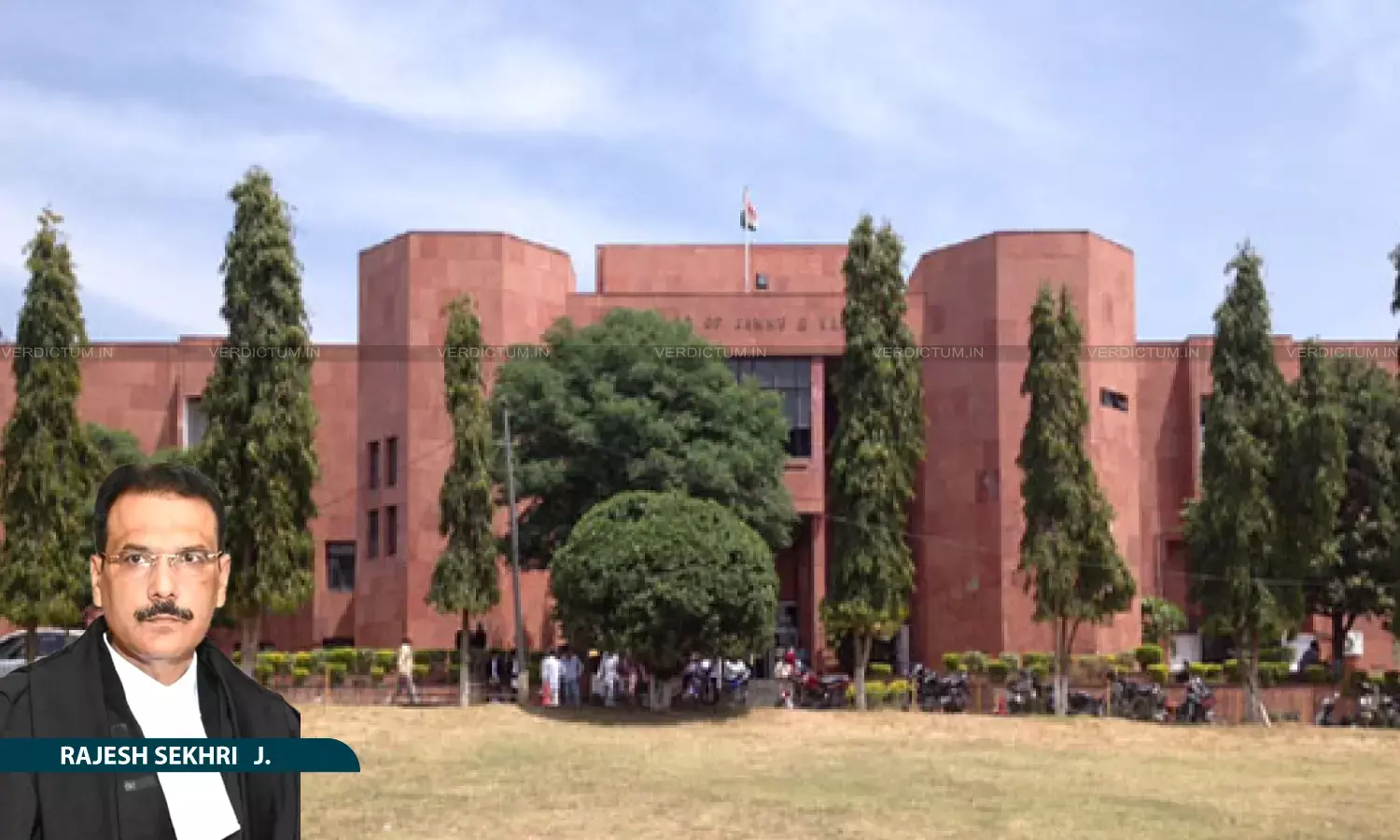
Justice Rajesh Sekhri, Jammu & Kashmir and Ladakh High Court
The Jammu & Kashmir and Ladakh High Court has reaffirmed that if every allegation of fact in the plaint is not denied specifically or by necessary implication, it shall be taken to be an admission in terms of Rule 5 of Order VIII of the Code of Civil Procedure.
The Petitioner had approached the High Court seeking the issuance of appropriate writs to the respondents for the clearance of their pending liability towards hiring the Petitioner Hotel for protected political persons.
The Single Bench of Justice Rajesh Sekhri held, “In terms of Order VIII Rule 3 of the Code of Civil Procedure, it is not sufficient for a defendant in his written statement to make a general denial of the grounds alleged by the plaintiff, he is required to specifically deal with each allegation of fact of which he does not admit the truth and it is a settled principle of law of pleadings that if every allegation of fact in the plaint is not denied specifically or by necessary implication, it shall be taken to be an admission in terms of Rule 5 of Order VIII of the Code.”
Factual Background
Pursuant to a circular dated November 7, 2020 and a communication dated December 12, 2020 and various communications issued thereafter from time to time by the Divisional Commissioner, Kashmir, a request was made to provide accommodation, on a sharing basis, to protected persons, including Panches, Sarpanches, Municipal Councillors etc., and police personnel/security forces. Subsequently, the accommodation came to be de-hired by the Divisional Commissioner. Immediately after de-hiring, a fresh requisition was made at the District Level by the second respondent, Deputy Commissioner, Srinagar, vide his communication, by virtue of which four Hotels, including the Hotel in question, came to be re-hired for accommodating protected persons of District Srinagar including Sarpanches, Councilors, DDC Members, contesting candidates etc.
The petitioner raised bills, for the periods Hotel premises came to be hired, first at the Divisional level and later at the District level; however, the grievance of the petitioner was that its payment was not being cleared despite the fact that hiring charges were verified and approved by the competent authorities and funds released by the Government. The petitioner for the protection and preservation of its right to hold, the property in the manner provided under law, had approached the High Court on the ground that bill verification committee constituted by Financial Commissioner (Additional Chief Secretary), Home was a colorable exercise of power with a view to reduce its liability, and that ex parte report of the committee, was violative of principles of natural justice. The Petitioner thus sought quashment of the order by virtue of which a Bill Verification Committee came to be constituted and quashment of the report of the said Committee.
Senior Advocate Jahangir Iqbal Ganai represented the Petitioner while Senior Additional Advocate General Mohsin Qadri represented the Respondent.
Reasoning
On a perusal of the facts of the case, the Bench noted that 14 Hotels, including the petitioner Hotel, came to be hired for protected persons, on a sharing basis, including the security forces, who were assigned the duty of providing round-the-clock security to the said protectees. Subsequently, they came to be dehired by the Divisional Commissioner. It was noticed that the claim of the petitioner comprised of two parts; first, when it came to be hired at the Divisional Level w.e.f. November 18, 2020, to October 5, 2021, and second, when it came to be hired at the District level, w.e.f. October 6, 2021, to May 31, 2022.
The Bench stated, “Now, when law relating to admission is examined in the light of Order XII Rule 6 CPC, I need not say anything more than what the legislature has intended in its framework that where admission of fact is made in the pleadings or otherwise, the Court at any stage of the proceedings has the jurisdiction to pass such order or give such judgment as it needs fit, having regard to such admission. It is also settled in law that such admission includes one that can be inferred from facts and circumstances of a case without any dispute, as held by Hon’ble Supreme Court in “Charanjit Lal Mehra vs. Kamal Saroj Mahajan”; 2005 (11) SCC 279. It is also settled in law that facts admitted need not be proved in terms of Section 58 of the Evidence Act and a party’s admission is substantive evidence ex proprio vigore.”
The first claim of the petitioner was that pursuant to the circular and the communication issued by the Divisional Commissioner, Kashmir, its Hotel came to be hired by the respondents to accommodate protected persons on a sharing basis w.e.f. November 18, 2020, to October 5, 2021. The Bench noted that same having not been denied by the respondents, amounted to admission, and the petitioner was entitled to the relief prayed for.
The Bench was of the view that the claimant, in the circumstances and for the purpose for which the Committee is constituted, is to be accorded a right of hearing to submit explanations during the process of verification of bills, particularly when the Committee proposes or intends to reject or reduce the claim. “Principle of Audi alteram partem applies with full force if the rejection of a bill is based on allegations of fraud or misconduct or that claim is inflated. To ensure procedural fairness, the Committee must provide the claimant an opportunity to produce evidence, explain the discrepancies identified during verification and justify the claim”, it added.
Considering that the Bill Verification Committee had not verified whether said accommodation was provided by the petitioner to anybody else during the period, the premises were hired by the respondents at the Divisional or District level, the Bench held, “Under these circumstances, it is not open to the respondents, at this length of time, to dispute the claim of the petitioner.”
Thus, allowing the petition, the Bench quashed the order by virtue of which the respondents constituted a Committee for verification of Bills and the ex parte report of the said Committee. “Respondents are directed to liquidate claims of the petitioner within a period of eight weeks from the date a copy of this judgment is made available, failing which they shall be liable to pay interest @ 6% per annum”, it ordered.
Cause Title: Hotel New Metro v. UT of J&K & Ors. (Neutral Citation: 2026:JKLHC-SGR:15)
Appearance
Petitioner: Senior Advocate Jahangir Iqbal Ganai, Advocate Sohail Mehraj
Respondents: Senior Additional Advocate General Mohsin Qadri, Government Advocate Illyas Laway