

Jammu & Kashmir & Ladakh High Court: Courts Must Remain Judicious In Granting Interim Relief In Public Infrastructure & Welfare Schemes Related Matters
The Jammu & Kashmir & Ladakh High Court remarked that every minute spent on avoidable litigation is a minute denied to a deserving litigant awaiting adjudication.
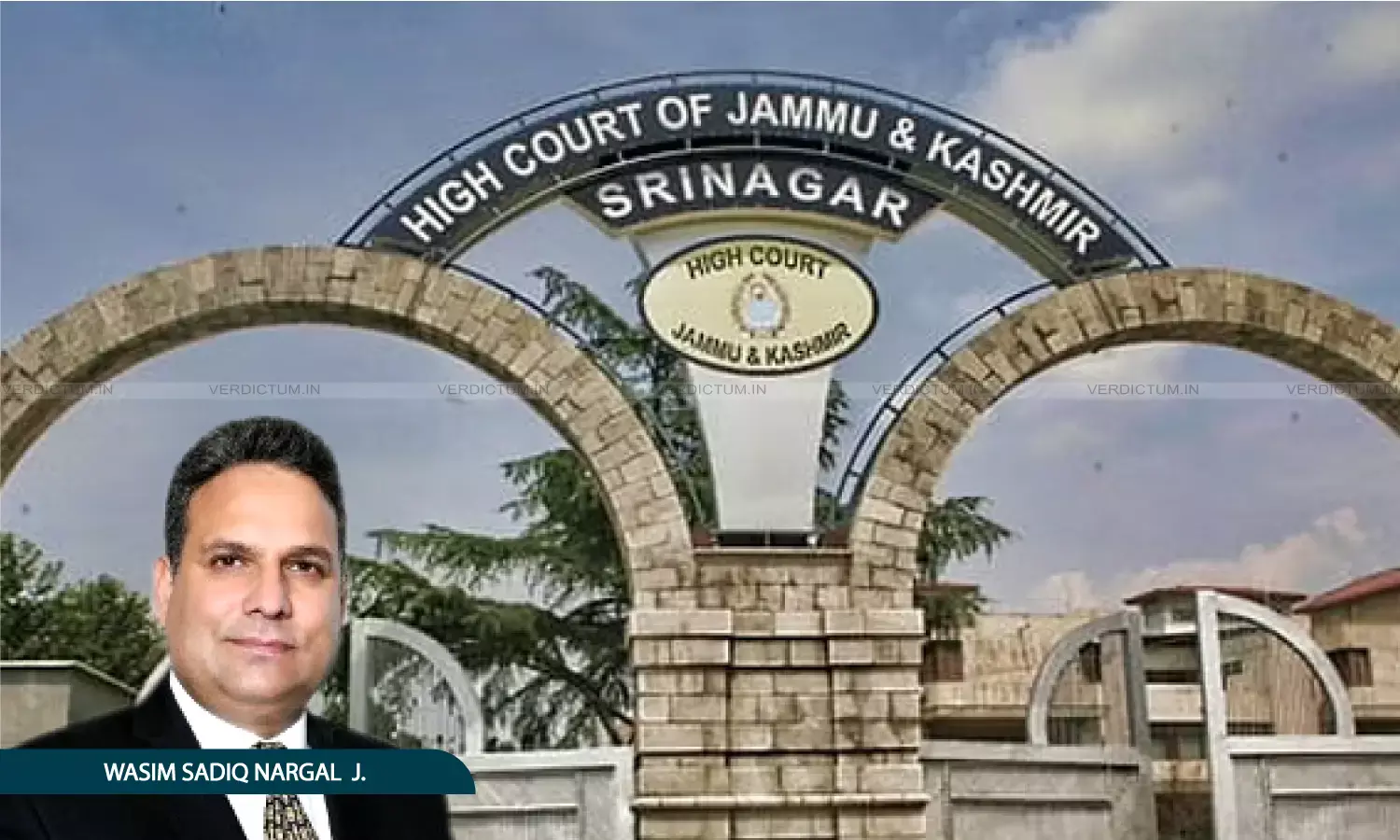
Justice Wasim Sadiq Nargal, Jammu & Kashmir & Ladakh High Court
The Jammu and Kashmir and Ladakh High Court has emphasized that the Courts must remain judicious and miser in granting interim relief in matters involving public infrastructure and welfare schemes.
The Court was hearing two Writ Petitions seeking the establishment of a proposed Government Degree College at the respective native places of Petitioners, namely Aishmuqam and Siligam.
A Single Bench of Justice Wasim Sadiq Nargal observed, “While this Court cannot undo the hardship already endured, the present case must stand as a cautionary reminder. Public authorities, before embarking on litigation or maintaining adversarial positions, must exercise restraint and adopt decisions grounded in public interest and expert inputs. Likewise, Courts must remain judicious and miser in granting interim relief in matters involving public infrastructure and welfare schemes. Interim orders should be time bound, and matters of such public significance must be adjudicated with urgency to prevent stalling of projects essential for societal progress.”
The Bench reiterated that the determination of the location for establishment of an educational institution is fundamentally a matter of policy falling within the exclusive domain of the executive, however, such policy decisions are amenable to judicial review where such policy decisions are shown to be arbitrary, irrational, or contrary to the material on record.
Advocate G. A. Lone appeared for the Petitioners, while Senior Advocate A. H. Naik and Government Advocate Ilyas Laway appeared for the Respondents.
Court’s Observations
The High Court in view of the facts and circumstances of the case, remarked, “This Court would be failing in its duty if it does not issue a word of caution to both the Government as well as the litigants. The self-contradictory and inconsistent orders issued by the Government, from time to time, with regard to the location for establishment of the Government Degree College have not only created avoidable confusion, but have also caused immeasurable prejudice to the student community, who were otherwise entitled to be admitted and pursue their education therein. Such indecisiveness on the part of the administration has, in turn, furnished repeated occasions to the petitioners to re-agitate the issue, thereby further depriving aspiring students of the opportunity to study in the said institution.”
The Court noted that that a considerable amount of judicial time has been squandered owing to the lackadaisical approach of the Government and the filing of cross Writ Petitions by litigants and the time of the Court is invaluable, especially in view of the ever-increasing pendency of cases.
“Every minute spent on avoidable litigation is a minute denied to a deserving litigant awaiting adjudication. … The Hon’ble Apex Court has, on numerous occasions, deprecated, in the strongest terms, attempts by litigants to misuse the judicial process and to fritter away valuable court time. It has been consistently emphasised that the administration of justice cannot be permitted to be obstructed by frivolous, dishonest or dilatory tactics, as such conduct erodes public confidence in the justice-delivery system and places an unwarranted burden on an already over-stretched judiciary”, it added.
The Court said that both the State and the litigants are under a solemn obligation to act responsibly and refrain from conduct which results in abuse of the process of law and frivolous, repetitive and strategically motivated litigation, as well as administrative indecision, must be curbed with a firm hand, lest the very majesty of law be reduced to a casualty of avoidable delay and misuse.
“Having heard learned counsel for parties and perused the material on record this Court is deeply concerned over the manner in which the indecisiveness of the Government has, for several years, deprived the residents, particularly the student of the benefits that would have naturally flowed from the timely establishment of the college. What ought to have been a straightforward administrative exercise has, due to repeated contradictions, avoidable delays, and absence of a clear stand, escalated into prolonged litigation, thereby frustrating the very purpose for which the institution was sanctioned”, it observed.
The Court was of the view that an entire generation of students, who could have availed the convenience, accessibility, and academic opportunities offered by a local degree college, has been compelled to travel long distances and such avoidable hardship to young students and their families, caused solely by the administrative lapses of the authorities, weighs heavily upon the conscience of this Court.
“Educational institutions are not mere buildings, they are instruments of social advancement and empowerment, a direct measure of the State’s commitment toward education, nation-building, and inclusive growth. Education, particularly at the higher level, shapes informed citizens, strengthens democratic values, and enables social and economic development. When establishment becomes entangled in prolonged disputes, it is not merely a procedural setback but a loss to the community at large and to the nation’s development. The opportunity to pursue higher studies within reasonable proximity is essential for students of rural areas, who often lack the means to travel long distances or relocate”, it further remarked.
The Court enunciated that Courts do not possess the institutional expertise to determine the suitability of one location over another, nor can the Court substitute its Judgment for that of the competent authority, particularly when the Government has already undertaken a detailed exercise through a duly constituted committees.
“While the damage already inflicted cannot now be undone, this Court cannot but express the pain and concern it has felt while dealing with a matter where the ultimate sufferers have been the students , individuals who were entitled to timely access to higher education and who have been deprived of these benefits solely due to administrative lapses and unnecessary procedural entanglements”, it noted.
Conclusion
The Court held that the committee report is comprehensive, evidence-based, and the product of comparative analysis of all relevant parameters, geographical centrality, accessibility, land availability, proximity to feeder institutions, transportation networks, and existing educational infrastructure.
“The present case is a stark example of how indecision, litigation, and administrative inconsistency can inflict unintended yet severe harm upon the public at large. Had the project proceeded unhindered, the College would have been operational long ago, providing substantial educational and developmental benefits to the region. Instead, successive generations of students have borne the cost of protracted proceedings and governmental ambiguity”, it also added.
The Court, therefore, concluded that in matters concerning education and public welfare, the administration and the judiciary must act with concerted diligence to ensure that decisions are neither derailed nor rendered infructuous by the mere passage of time and the public interest, especially the educational aspirations of the youth, must remain paramount.
Accordingly, the High Court dismissed the Writ Petition and directed the Government to establish the Government Degree College at Aishmuqam in accordance with the consistent recommendations of both the expert committees and the stand taken by the Government in both the Petitions that the college is required to be established at Aishmuqam.
Cause Title- Ghulam Rasool Bhat & Ors. v. Union Territory of Jammu & Kashmir & Ors. (Case Number: WP(C) 309/2020 C/W)
