

Residential Restrictions For District Cadre Appointments Unconstitutional: Jammu & Kashmir And Ladakh High Court
The Court reaffirmed the supremacy of Constitutional mandates over administrative recruitment rules.

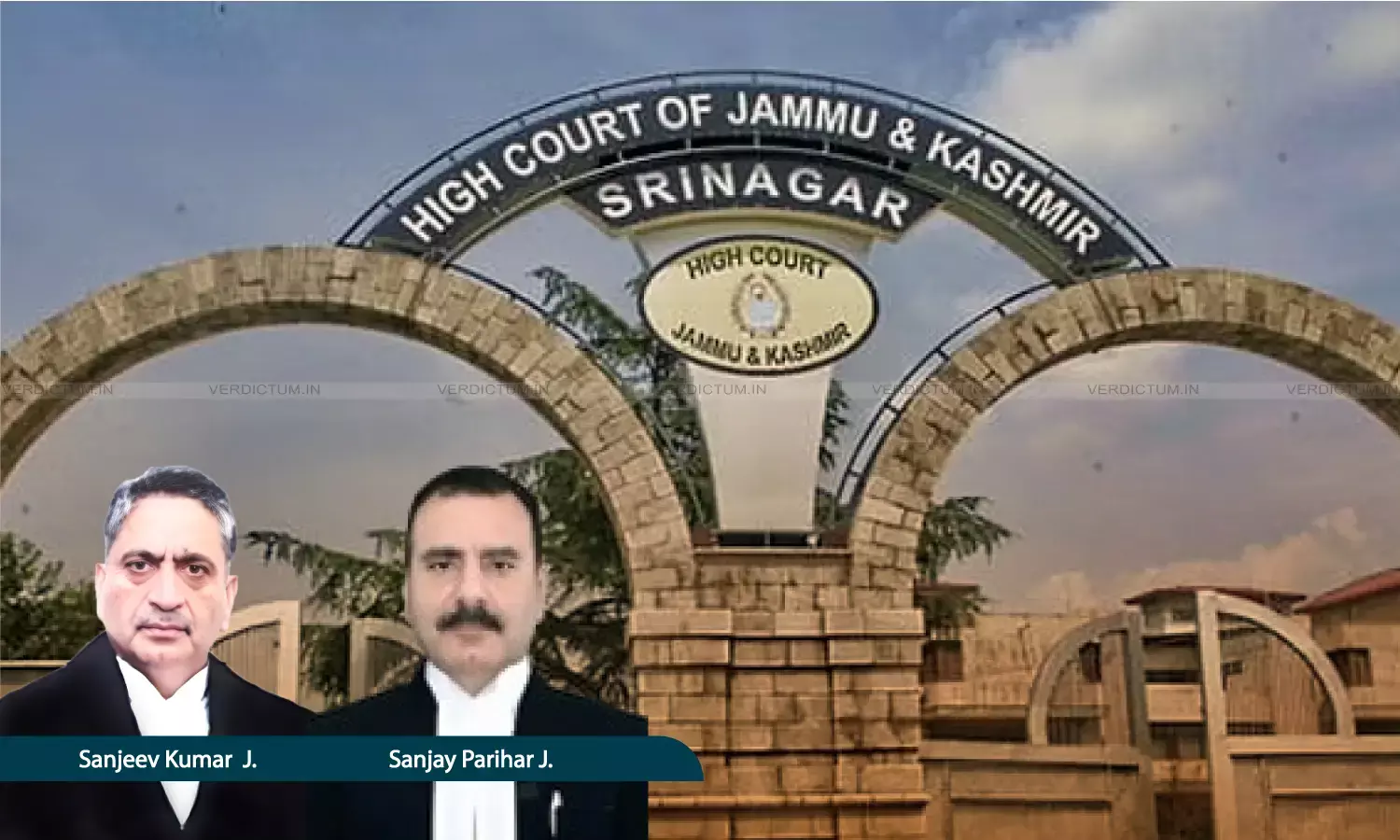
Justice Sanjeev Kumar, Justice Sanjay Parihar, Jammu & Kashmir and Ladakh High Court
The Jammu & Kashmir and Ladakh High Court ruled that prohibiting a citizen from seeking employment based solely on their place of residence is ultra vires of the Constitution of India.
The Court was hearing a writ petition challenging an advertisement notification, which restricted eligibility to local residents of the district.
The Division Bench comprising Justice Sanjeev Kumar and Justice Sanjay Parihar observed, “It is thus beyond the pale of any discussion that impugned Clause of the advertisement notification clearly brought about discrimination, in that, it prohibited the petitioner for participating in the selection process for a post borne on District cadre Baramulla only on the ground of his residence. He was not allowed to participate on the ground that he belonged to District Samba, whereas, the notified post was borne on District cadre Baramulla…For the foregoing reasons, this petition is allowed. Clause 1 (i) (a) of the advertisement notification is declared ultra virus the Constitution of India. The respondents 3 to 5 are directed to interview the petitioner and consider him for the post of Orderly under SC Category in District Baramulla notified vide advertisement notification No. 01 of 2019 dated 10th of January 2019.”
Advocate Mohammad Ashraf Wani appeared on behalf of the Petitioners, whereas Advocate Aatir Javed Kawoosa appeared for the Respondents.
Facts of the Case
Vide advertisement, the High Court had invited online applications from eligible candidates for participating in the selection process for various posts borne on the Divisional and District cadres of the District judiciary of Jammu and Kashmir. The petitioner, being a candidate belonging to the SC Category, submitted his online application for the post of Orderly in District Baramulla against the lone post earmarked for the SC Category.
The petitioner was amongst the candidates shortlisted for viva voce. The name of the petitioner figured at serial No. 623 in the shortlist of candidates selected for interview for the post of Orderly (Class IV) in District Baramulla. The interview of the petitioner was scheduled to be held in the office of respondent No. 5, i.e., Principal District and Session Judge Baramulla, on 16th of July 2019. The petitioner responded to the call for an interview and appeared before respondent No. 5 for the purpose on the date fixed. However, he was not permitted to participate in the interview process on the grounds that he belonged to District Samba and, therefore, was not eligible to apply for the post notified for District Baramulla.
Having faced his rejection at the stage of the interview, the petitioner approached the court through a writ petition seeking to issue directions.
Contention of the Parties
The Respondents submitted that the petitioner, being fully aware of the stipulation contained in Clause 1 (i) (a) of the advertisement notification, participated in the selection process with his eyes wide open and, therefore, is estopped from challenging the validity of the Clause after having faced rejection at the stage of the interview.
It was submitted that a conjoint reading of Rule 2(f), 2(n) and Rule 5 and 12 of the Rules of 2016 read with Entry 19 of Schedule-A makes it clear that the Chief Justice is empowered to make appointments to the District cadre posts and regulate such selections and appointments by framing regulations providing for method of selection to a particular post.
Observations of the Court
The Court considered two questions for determination: i) whether the petitioner having submitted his application despite being aware of Clause 1 (i) (a) of the advertisement notification dated 10th of January 2019 is estopped from challenging the constitutionality of the said clause after having been rejected by the Selection Committee at the stage of interview/ viva voce, ii) Whether Clause 1 (i) (a) of the advertisement notification offends Clause 1 and 2 of Article 16 of the Constitution and therefore ultra vires the constitution.
The Court said, “Viewed thus, it is not a case where the petitioner being aware of the offending clause in the advertisement notification participated with his eyes wide open and took chance in the selection. It is also not anybody's case that petitioner approached this court to challenge the impugned Clause of the advertisement notification after he failed to make grade in the selection. Strictly speaking, the doctrine of ‘estoppel’ as contended by the respondent is not attracted in the case on hand.”
“It is trite law that what is precluded from challenge after having participated in the selection process is the process, the procedure and selection criteria adopted. The estoppel however cannot be pleaded where a challenge by the candidate who has participated in the process of selection pertains to gross illegality in the selection process or where the selection has been completed under a provision which is ultra virus the Constitution.”, the Court held.
The Court relied on the judgment of the Supreme Court in Dr. (Major) Meeta Sahai Vs. State of Bihar and Ors. (2019), and said that it is well settled that a candidate, by participating in the selection process, only accepts the laid down procedure and not the illegality in it. Where the selection process has been conducted as per the rules or stipulations in the advertisement notification, which bring about discriminatory consequences therefrom is not immune from challenge at the behest of a candidate who has partaken in it, as is held by the Supreme Court. The constitutional scheme is sacrosanct, and its violation in any manner is impermissible. Where the selection process suffers from incurable illegality or is conducted in derogation of the provisions of the Constitution, the plea of estoppel against the candidate who has partaken in the selection process cannot be permitted, the Court added.
Conclusion
The Court opined that in the present case, the petitioner was found to be the most meritorious candidate for the post in question, and an order of appointment in his favour should be issued.
Accordingly, the Court directed the Respondents to complete the entire process within a period of two months from the date of a copy of this judgment.
Cause Title: Balwinder Kumar v. The State of J&K and Ors. [WP (C) No. 2849/2019]
Appearances:
Appellants: Advocate Mohammad Ashraf Wani
Respondents: Advocate Aatir Javed Kawoosa