

Right To Bail Not To Be Denied Merely Because Of Sentiments Of Community Against Accused: Jammu & Kashmir & Ladakh High Court
The Jammu and Kashmir and Ladakh High Court reaffirmed that the exact role of the accused must be properly comprehended before arrest is made.
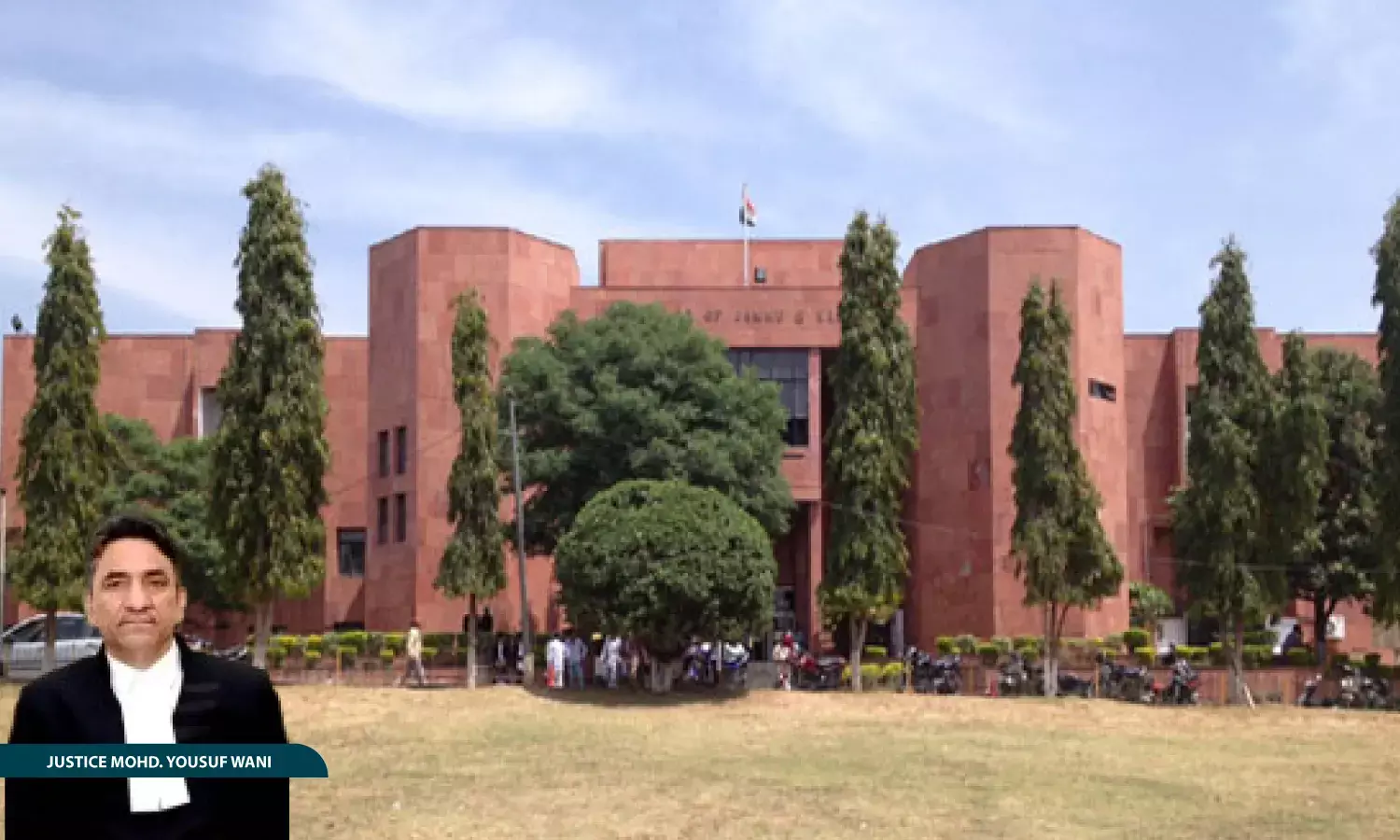
Justice Mohammad Yousuf Wani, Jammu & Kashmir and Ladakh High Court
The Jammu and Kashmir and Ladakh High Court reiterated that right to bail is not to be denied merely because of the sentiments of the community against the accused.
The Court reiterated thus in a Bail Application filed by an accused under Section 483 of the Bhartiya Nagarik Suraksha Sanhita, 2023 (BNSS), seeking bail in a crime registered under Sections 8, 21, 22, 27A, and 29 of the Narcotic Drugs and Psychotropic Substances Act, 1985 (NDPS Act).
A Single Bench of Justice Mohd. Yousuf Wani observed, “The Hon’ble Apex Court in Sanjay Chandra’s case cited supra has inter alia held at para 40 of the judgment, “the grant or refusal to grant bail lies within the discretion of the Court. The grant or denial is regulated, to a large extent, by the facts and circumstances of each particular case. But at the same time, right to bail is not to be denied merely because of the sentiments of the community against the accused. The primary purposes of bail in a criminal case are to relieve the accused of imprisonment, to relieve the State of the burden of keeping him, pending the trial, and at the same time, to keep the accused constructively in the custody of the Court, whether before or after conviction, to assure that he will submit to the jurisdiction of the Court and be in attendance thereon, whenever his presence is required.”
The Bench reaffirmed that the exact role of the accused must be properly comprehended before arrest is made.
Advocate Prince Khanna appeared for the Petitioner, while DSGI Vishal Sharma appeared for the Respondents.
Brief Facts
The bail in this case was sought on the ground that the Petitioner-accused is innocent and falsely/frivolously implicated in the case. It was submitted that the accused is a young qualified businessman running a hotel and a restaurant. It was further submitted that he is a sole bread earner of his family having old and ailing parents as also his wife and a child and that he and the co-accused are known to each other being from the same area.
The Narcotics Control Bureau (NCB) had called him to its office several times and formally arrested him in connection with the case. It was claimed that despite fully cooperating with the Investigating Officer, the accused was booked in the case on account of his alleged involvement in the case by way of financing the illicit trafficking under a conspiracy. The accused had approached the Special Judge and he was denied bail. Being aggrieved, he was before the High Court.
Reasoning
The High Court in the above regard, said, “… this court without making any comment regarding the merits of the case is of the opinion that it may meet the ends of justice in case the petitioner-accused is admitted to bail in the crime number in question subject to some reasonable terms and conditions.”
The Court emphasised that a Criminal Court while recording his satisfaction as to whether there appear “reasonable grounds” of involvement of an accused in the commission of an offense attracting the bar in terms of provisions of Section 37 NDPS Act, has to use his discretion in a judicious manner so that no miscarriage of justice happens either by grant of bail or by denial of the same.
“The “reasonable grounds” of involvement can be inferred from the facts and circumstances of the case especially, the nature of the evidence. The Court is supposed to consider the broader probabilities to reach its supposition regarding the existence of reasonable grounds of involvement of the accused. … The words “reasonable grounds” cannot be read to mean proved as used in ‘Bharatiya Sakshya Adhiniyam’. Such an interpretation would in my opinion set at naught the power vested in a court to grant bail pending trial”, it added.
The Court clarified that the expression “reasonable grounds” would obviously mean something more than mere suspicion and conjectures and something less than proof and it would necessarily mean such grounds or material that would prima facie enable a person of ordinary prudence to believe that the accused is or is not guilty.
“It is no doubt true that the object of the legislation of such disabling provisions is to prevent the offenders from being immediately granted bail in heinous offences. In this view of the matter, the court is required to examine the material placed before it and then to arrive at a conclusion that there exist “reasonable grounds” to believe that accused is guilty or not guilty”, it noted.
The Court enunciated that in considering an application for bail, Court is not required to conduct a preliminary trial and the Courts while deciding bail applications will be traversing beyond their ambit and would be exceeding their limit of functions if they engage themselves in discovering the guilt or innocence of the accused which can only be determined at the trial stage.
“The courts should not go at a tangent in order to find out the possible excuses for grant bail. Whether there are “reasonable grounds” or not is the question which must be decided judicially, that is to say there should be some tangible evidence on which the Court might come to the conclusion that if unrebutted, the accused might be convicted. Whether there are reasonable grounds for believing that a person is guilty of such an offence depends on what evidence is offered by the prosecution to the charge against him”, it observed.
The Court further said that in order to come to the conclusion, that a person is guilty, the Court must consider the evidence which if unrebutted may lead to conclusion that the charge against him stands proved and cannot unjustifiably hold that there are “reasonable grounds” for believing that he is guilty.
“It is a settled position of law that the real question whether there are reasonable grounds for believing that a person is guilty of offences attracting bar under Section 37 NDPS Act, depends upon what evidence is offered by the prosecution to prove the charge against him. While reaching such conclusion, the Court must consider the nature and character of evidence against him”, it reiterated.
The Court also noted that the necessary arrests subject to the law of bails as provided under the Code, BNSS and the provisions of different special Legislations are permissible under the Constitution of our Country by way of a reasonable exception to the fundamental right to liberty guaranteed under Article 21 of the Constitution and the mandate of the provisions of Article 22 of the Constitution is meant to be followed upon making any such necessary arrests.
Principles/Guidelines
The Court explained that no single rule or a golden litmus test is applicable for consideration of a bail application and instead some material principles/guidelines are needed to be kept in mind by the Courts and the Magistrates for consideration of a bail application especially including –
i. The judicial discretion must be exercised with the utmost care and circumspection;
ii. That the Court must duly consider the nature and the circumstances of the case;
iii. Reasonable apprehension of the witnesses being tampered;
iv. Investigation being hampered or
v. The judicial process being impeded or subverted.
vi. The liberty of an individual must be balanced against the larger interests of the society and the State.
vii. The court must weigh in the judicial scales, pros and cons varying from case to case.
viii. Grant of bail quo an offence punishable with death or imprisonment for life is an exception and not the rule;
ix. The Court at this stage is not conducting a preliminary trial but only seeking whether there is a case to go for trial;
x. The nature of the charge is the vital factor, the nature of evidence is also pertinent, the punishment to which the party may be liable also bears upon the matter and the likelihood of the applicant interfering with the witnesses or otherwise polluting the course or justice, has also a bearing on the matter.
xi. The facts and circumstances of the case play a predominant role.
Conclusion
Coming back to the facts of the case, the Court said that there is nothing on record to suggest that the accused if admitted to bail will jump over the concession by absconding at the trial or repeating the commission of crime.
“For the foregoing discussion and without touching the merits of the instant case bearing Crime No. 24/2024 of Norcotics Control Bureau, Jammu Zonal Unit, Jammu under Sections 8/21, 22, 27A r/w 29 NDPS Act, which obviously shall be the subject matter of the final disposal of the trial complaint, the petitioner-accused is admitted to bail, subject to his furnishing surety and personal bonds to the tune of Rupees One lac each (surety bond of Rupees One lac to be furnished by two sureties from amongst the relatives of the petitioner-accused each liable to the extent of Rupees fifty thousands) respectively to the satisfaction of the learned trial court and the superintendent of jail concerned”, it concluded and directed.
Accordingly, the High Court granted bail to the accused.
Cause Title- Arfaz Mehboob Tak v. Union of India & Anr. (Case Number: Bail App No. 144/2025)
