

Court Of Inquiry Under BSF Rules Is Only A Fact-Finding Exercise And Does Not Amount To Initiation Of Disciplinary Proceedings: J&K And Ladakh High Court
The High Court held that a Court of Inquiry ordered under the BSF Rules, 1969, is merely a fact-finding mechanism intended to collect material to enable the authorities to decide their future course of action, which does not amount to initiation of disciplinary proceedings.
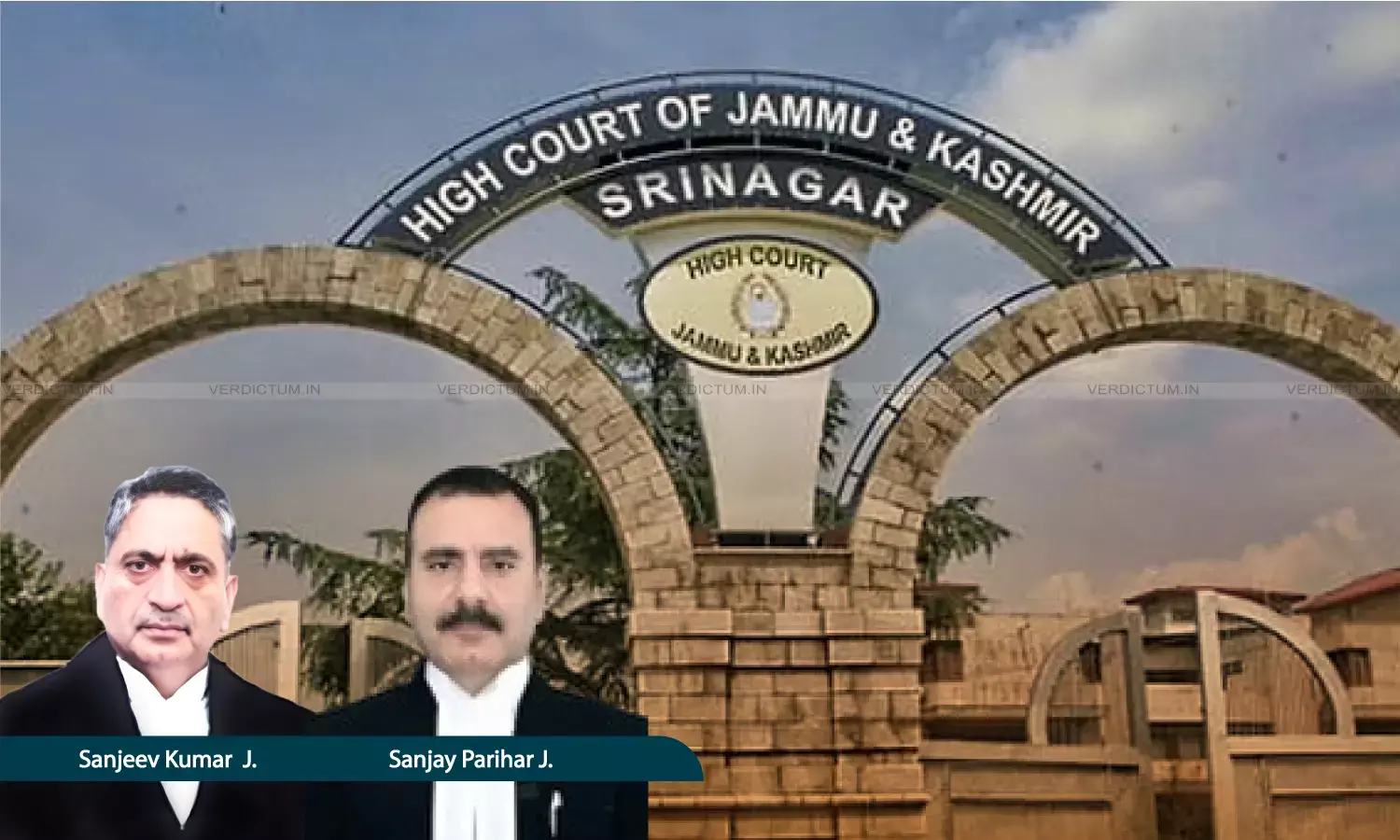
Justice Sanjeev Kumar, Justice Sanjay Parihar, Jammu & Kashmir and Ladakh High Court
The High Court of Jammu & Kashmir and Ladakh has held that a Court of Inquiry under the Border Security Force Rules, 1969, is only a preliminary, fact-finding inquiry and does not constitute the commencement of departmental or disciplinary proceedings against a delinquent officer.
The Court was hearing intra-court appeals filed by a BSF officer challenging the dismissal of his writ petitions, wherein he had questioned the initiation of a Court of Inquiry and the continuation of suspension during the pendency of a criminal trial.
A Division Bench comprising Justice Sanjeev Kumar and Justice Sanjay Parihar observed: “The Court of Inquiry under the BSF Rules 1969 is only a fact-finding inquiry ordered to collect evidence so as to facilitate the BSF authorities in deciding its future course of action. We reiterate that the findings returned by the Court of Inquiry, which is a fact-finding body, shall be in the nature of a preliminary report which shall facilitate the BSF authorities to decide as to whether the disciplinary proceedings against the delinquent are required to be initiated or not. At the stage of Court of Inquiry, there is no departmental proceeding initiated or commenced against the delinquent, though the finding of such Court of Inquiry may form the basis of taking a decision by the competent authority about future course of action.”
Background
A criminal case was registered against the appellant on the basis of a complaint lodged by a lady officer of the BSF, leading to registration of an FIR for an offence under the Indian Penal Code. Investigation was completed, a charge sheet was filed, and the appellant was granted bail, though the criminal trial remained pending.
In view of the nature of the allegations, the appellant was placed under suspension in exercise of powers under the BSF Rules. Simultaneously, the BSF authorities ordered a Court of Inquiry under Rule 173 of the BSF Rules, 1969, to examine the allegations made against him.
The appellant challenged the initiation of the Court of Inquiry and the rejection of his representation before the High Court, contending that parallel proceedings would prejudice his defence in the criminal trial. The Single Judge dismissed the writ petitions, leading to the present appeals before the Division Bench.
Court’s Observation
The Division Bench examined the scheme of the BSF Rules, 1969, particularly Rules 170, 173, and 174, which govern the constitution, procedure, and subject matter of a Court of Inquiry. The Court noted that Rule 174 expressly permits a Court of Inquiry to be held to investigate any disciplinary matter or any other matter of importance.
The Court emphasised that a Court of Inquiry is not a disciplinary proceeding but a fact-finding exercise ordered to collect material to facilitate the authorities in deciding their future course of action. The findings of such an inquiry are only preliminary in nature and may form the basis for deciding whether disciplinary proceedings are required to be initiated.
The Bench categorically held that at the stage of a Court of Inquiry, no departmental or disciplinary proceedings are initiated or commenced against the delinquent officer. Therefore, the apprehension that ordering a Court of Inquiry would prejudice the appellant’s defence in the criminal trial was held to be unfounded.
The Court further observed that the authorities had not yet taken any decision to initiate disciplinary proceedings against the appellant and that the argument regarding simultaneous conduct of criminal and departmental proceedings was premature. What had been ordered was only a Court of Inquiry, which is distinct from a disciplinary inquiry.
The Court, while stating that during a Court of Inquiry, the appellant cannot be compelled to make any self-incriminating statement and has the option to remain silent, further remarked that “it is thus evident that by ordering the court of inquiry or even asking the appellant to appear and record his statement would not prejudice him in any manner”.
The Court agreed with the learned Single Judge that there was no statutory or legal bar to ordering a Court of Inquiry during the pendency of a criminal trial. It held that since no departmental proceedings had commenced, the writ petitions were premature and without substance.
Conclusion
The High Court found no merit in the challenge to the Court of Inquiry or the continuation of suspension. Accordingly, both the appeals were dismissed, and the judgments of the learned Single Judge were upheld.
Cause Title: Akhand Prakash Shahi v. Union of India & Ors. (Neutral Citation:2025:JKLHC-SGR:343-DB)
Appearances
Appellant: Danish Majid Dar, Advocate with Mehjabeena, Advocate
Respondents: Nazir Ahmad, Advocate; Sehar Mufti, Advocate (vice Viqas Malik, Advocate)
