

Courts Duty-Bound To Examine The Question Of Limitation Suo Motu Even If Not Specifically Pleaded: J&K And Ladakh High Court
The High Court observed that the issue of limitation goes to the very root of maintainability and must be examined by a court or statutory authority on its own motion, even where the parties have neither pleaded nor argued the issue.
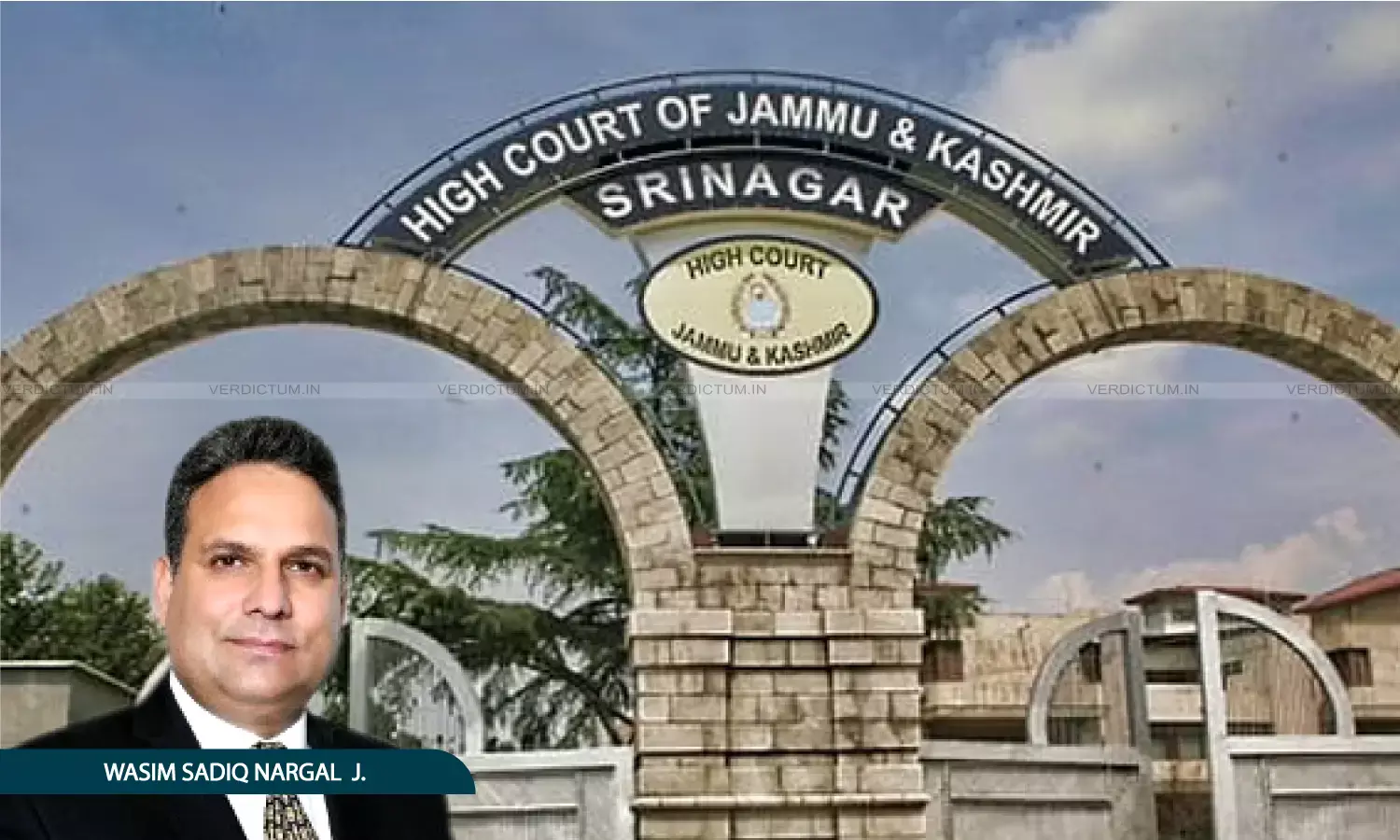
Justice Wasim Sadiq Nargal, Jammu & Kashmir & Ladakh High Court
The High Court of Jammu & Kashmir and Ladakh has held that limitation is not a mere technical plea but a pure question of law which courts and statutory authorities are bound to examine suo motu.
The Court emphasised that even where no specific issue on limitation is framed, and even if the parties have not addressed the issue, the authority adjudicating the matter is duty-bound to determine whether the proceedings are barred by delay or laches.
The Court was hearing a challenge to the dismissal of a revision petition by the Financial Commissioner (Revenue), which had been rejected on the ground of limitation despite the petitioners’ contention that the issue of delay had not been argued before the revisional authority.
A Bench of Justice Wasim Sadiq Nargal, upon hearing the matter, observed: “A court or statutory authority is not only empowered but is duty-bound to examine the issue of limitation suo motu, even if the same has not been specifically pleaded or argued by the parties”.
Advocate SH Thakur represented the petitioners, while Advocate Mir Majid Bashir represented the respondents.
Background
The dispute pertained to inheritance rights over a parcel of land. After a lapse of nearly 25 years, the petitioners approached the Financial Commissioner (Revenue) by filing a revision petition, alleging that the mutation had been attested in violation of the law of succession and without associating all legal heirs.
The revision petition was heard and subsequently dismissed on the ground of limitation. A review petition filed thereafter was also dismissed.
Aggrieved by these orders, the petitioners approached the High Court, contending, inter alia, that the Financial Commissioner could not have dismissed the revision on the grounds of limitation, since the issue had neither been pleaded nor argued before him.
Court’s Observation
The J&K and Ladakh High Court held that the petition was not maintainable under Article 226, as the primary contesting respondent was a private individual and the dispute pertained to inter se inheritance rights, private settlement, and mutation, which are matters of private law devoid of any public law element. The Court reiterated that writ jurisdiction cannot be invoked for the adjudication of purely private disputes or as a substitute for civil remedies.
Notwithstanding the finding on maintainability, the Court proceeded to examine the issue of limitation to demonstrate that no prejudice had been caused to the petitioners. The Court categorically held that the contention that limitation could not be examined in the absence of arguments was wholly misconceived. It is observed that limitation is a pure question of law which goes to the root of maintainability and must be examined by a court or statutory authority even suo motu.
The Court emphasised that where proceedings appear, on the face of the record, to be barred by delay or gross laches, the authority cannot ignore such illegality and proceed to decide the matter on the merits. Entertaining a time-barred claim would itself amount to a jurisdictional error.
Relying on the Supreme Court’s decision in R. Nagaraj (Dead)Through LRs v. Rajmani and Others (2025), the Court reiterated that even in the absence of a specific issue on limitation, courts are competent, and indeed obligated, to examine and decide the same. The Court noted that under Section 3 of the Limitation Act, 1963, it is the bounden duty of the court to consider limitation upon an examination of the pleadings and material on record.
The Court also relied on Union of India v. British India Corporation Ltd. (2003), in which the Apex Court had held that "the question of limitation is a mandate to the forum and, irrespective of the fact whether it was raised or not, the forum must consider and apply it, if there is no dispute on facts."
Relying on precedents, the Court reiterated that “the question of limitation can be subsumed within the broader issues arising from the pleadings and that failure to frame a specific issue on limitation is not fatal, so long as no prejudice is caused to the parties”, while further emphasising that “under Section 3 of the Limitation Act, 1963, it is the bounden duty of the court to examine limitation and decide the same upon consideration of the pleadings and material on record”.
Applying these principles, the Court held that the delay of nearly 25 years in challenging the mutation was apparent on the face of the record. The Financial Commissioner was therefore justified in examining and deciding the issue of limitation, even in the absence of arguments from the parties.
The Court further observed that the revisional authority had acted within its jurisdiction and in accordance with settled legal principles, while concluding that “entertaining a time-barred claim would itself amount to a jurisdictional error”.
Conclusion
The Court concluded that the writ petition was wholly misconceived and not maintainable, as it sought adjudication of a purely private dispute without any public law element. The Court further held that even on merits, the dismissal of the revision petition on limitation suffered from no illegality, perversity, or jurisdictional error.
Accordingly, the High Court dismissed the writ petition along with all connected applications.
Cause Title: Abdul Gani Ganie and Others v. Habibullah Ganie
Appearances
Petitioners: S. H. Thakur, Advocate
Respondent: Mir Majid Bashir, Advocate
