

Retaliatory Measure After Husband Contracted Second Marriage: Jammu & Kashmir and Ladakh High Court Quashes Case U/S. 498A IPC
The petitioners had approached the Jammu & Kashmir and Ladakh High Court challenging an FIR registered under Sections 498-A IPC and Section 4 of the Dowry Prohibition Act at the instance of respondent-wife.

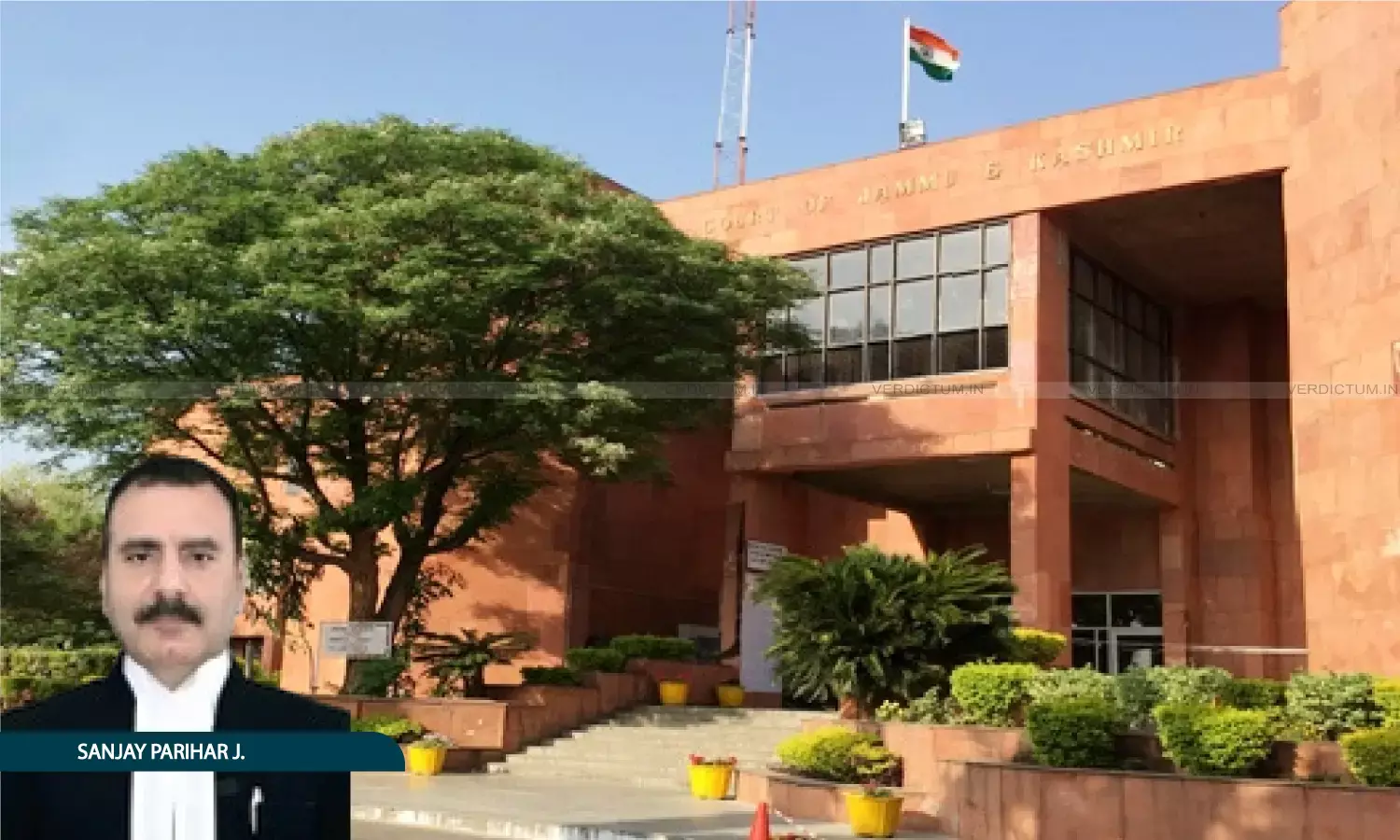
Justice Sanjay Parihar, Jammu & Kashmir and Ladakh High Court
The Jammu & Kashmir and Ladakh High Court has quashed the proceedings initiated under Section 498-A of the IPC at the instance of a woman against her husband and his family members. The High Court noted that the FIR appeared to have been lodged as a retaliatory measure after the husband contracted a second marriage.
The petitioners had approached the High Court challenging an FIR registered under Sections 498-A IPC and Section 4 of the Dowry Prohibition Act, 1961 at the instance of respondent-wife.
The Single Bench of Justice Sanjay Parihar held, “The FIR, on the face of it, appears to have been lodged as a retaliatory measure after petitioner No. 1 contracted a second marriage. Another significant aspect is that respondent No. 2 did not initially approach the officer-in-charge of the concerned police station but instead directly approached the Senior Superintendent of Police, Anantnag, who thereafter directed registration of the FIR. Such recourse ordinarily arises only when there is reluctance on the part of the police station to register a complaint.”
Factual Background
The petition came to be filed before the High Court on the ground that the impugned FIR was a clear abuse of the process of law, having been lodged with mala fide intent after the wife had already resorted to multiple civil and quasicriminal proceedings against the petitioner husband. The petitioner claimed that the respondent wife had earlier filed a petition under Section 125 CrPC seeking maintenance for herself and the minor child, and had also initiated proceedings under Section 12 of the Protection of Women from Domestic Violence Act, 2005. Both these proceedings were instituted in 2022, after the respondent wife had been divorced by the petitioner husband.
According to the petitioners, the divorce was necessitated by the conduct of the wife, who was married in the year 2016 and had a child out of wedlock. It was alleged that after some years of marriage, the respondent wife was unwilling to discharge her marital obligations and intended to ruin the matrimonial life of the man. Thus, the first petitioner went ahead with the divorce proceedings. The respondent wife alleged that her marriage with the petitioner had been solemnized and after one year of marriage, she was subjected to mental and physical cruelty and was harassed on account of dowry demands. On receipt of the complaint, the FIR under Sections 498-A IPC and 4 of the Dowry Prohibition Act was registered.
Reasoning
Referring to the decisions of the Apex Court in Dara Lakshmi Narayana (2024) and Rajesh Chaddha (2025), the High Court highlighted how the Apex Court has cautioned that vague, omnibus, generalized, and sweeping allegations against the husband and his relatives, without specifying their active role or involvement, particularly when arising out of matrimonial discord, should be curbed at the threshold.
On a perusal of the facts of the case, the Bench noted that the criminal proceedings were initiated only after the second marriage of the petitioner. It was noticed by the Bench that although the FIR contained allegations that during the subsistence of marriage, the respondent wife was subjected to cruelty and dowry demand, allegedly met by her father through a bank loan, such accusations were conspicuously absent in the earlier proceedings initiated by her.
“Notably, while allegations of cruelty and dowry demand have also been levelled against petitioner No. 2, the mother-in-law, there is not even a whisper in the proceedings under the Domestic Violence Act regarding dowry-related harassment attributable to her. The only allegations therein pertain to being beaten, abused, and eventually ousted from the matrimonial home. This material inconsistency in the allegations lends credence to the contention that the FIR is an afterthought and suffers from embellishment”, the order read.
“It may be that strict segregation of proceedings under Section 125 Cr. PC, the Domestic Violence Act, and criminal prosecution under Section 498-A IPC is not always necessary, particularly because allegations of domestic violence, dowry demand, mental cruelty, and physical harassment are often interlinked. Any domestic discord or suffering allegedly undergone by respondent No. 2 during her stay with the petitioners would ordinarily surface consistently across such proceedings”, it further added.
The Bench found that it was only after the first petitioner contracted a second marriage that, for the first time, allegations under Section 498-A IPC and the Dowry Prohibition Act were raised. Thus, holding that the continuation of proceedings arising out of the FIR against the petitioners would amount to abuse of the process of law, the Bench quashed the proceedings emanating from the impugned FIR.
Cause Title: A v. Station House Officer Women Police Station Anantnag (Case No.: Case No. CrLM No. 150/2024)