

Judicially Determined Fair Compensation In Land Acquisition Must Enure To All Landowners; Denial On Technical Grounds Impermissible: Himachal Pradesh High Court
The High Court held that once fair compensation is judicially determined in land acquisition proceedings, all similarly placed landowners are entitled to the same benefit, and denial on technical grounds would amount to discrimination and defeat the principle of just compensation.
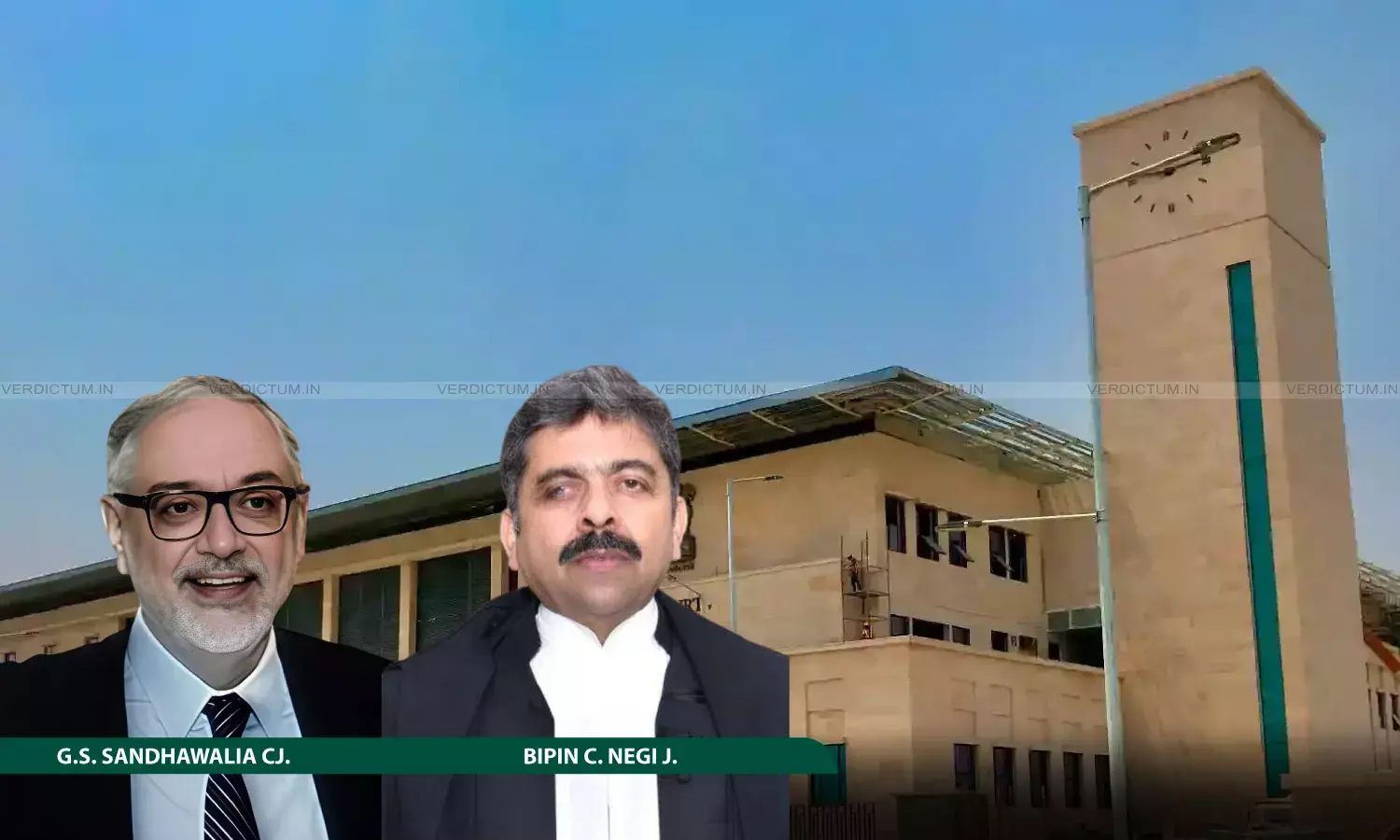
Chief Justice G.S. Sandhawalia, Justice Bipin C. Negi, Himachal Pradesh HC
The High Court of Himachal Pradesh at Shimla has held that in cases of compulsory land acquisition, the paramount consideration is to ensure substantial justice to landowners, and once fair compensation has been judicially determined, the same benefit must extend to all co-owners, without discrimination on technical grounds.
The Court was hearing a writ petition seeking the grant of enhanced compensation at par with similarly situated co-owners whose land had been acquired under the same notification for a public purpose.
A Division Bench of Chief Justice Gurmeet Singh Sandhawalia and Justice Bipin Chander Negi observed: “… compensation granted by the Land Acquisition Collector is subject to judicial scrutiny in the form of Reference to the District Judge and an appeal to the High Court. Once a fair compensation has been judicially determined, then it is an imperative of good governance that all the landowners whose lands have been acquired should get the same benefit. Discrimination in the grant of compensation on technical grounds needs to be avoided in order to give a fair treatment to all concerned”.
Senior Advocate Vinay Kuthiala appeared for the petitioners, while the respondents were represented by Balram Sharma, Deputy Solicitor General of India.
Background
The dispute arose from the acquisition of land for a public project, where compensation had initially been determined by the Land Acquisition Collector based on the classification of the land.
Aggrieved by the award, certain co-owners had sought a reference under Section 18 of the Land Acquisition Act, 1894, leading to enhancement of compensation by the Reference Court. The matter thereafter travelled in appeal, where the High Court fixed the compensation at a uniform rate.
The petitioners, who were co-owners of the acquired land, had not pursued remedies under Sections 18 or 28-A of the Act within the prescribed time. They approached the High Court contending that the denial of enhanced compensation, despite identical acquisition and ownership, was unjust and discriminatory.
The respondents opposed the petition on the grounds of delay and laches, and contended that the petitioners had failed to avail statutory remedies within the limitation period and therefore were not entitled to the enhanced compensation.
Court’s Observation
The Court examined the principles governing land acquisition and reiterated that acquisition under the Act is based on the doctrine of eminent domain, where the landowner is not a willing participant. It was observed that in such circumstances, ensuring fair and just compensation is of paramount importance.
The Court noted that compensation determined by the Land Acquisition Collector is subject to judicial scrutiny through reference proceedings and appeals, and once such judicial determination attains finality, it represents the fair market value of the acquired land.
Relying upon authoritative pronouncements of the Supreme Court in Ramphal v. Haryana State Industrial and Infrastructure Development Corporation (2026) and Jalandhar Improvement Trust v. State of Punjab (2003), the Court held that co-owners are entitled to parity in compensation, and denial of such benefit would result in unjust discrimination.
The Court further referred to Narendra v. State of Uttar Pradesh (2017), observing that the objective of the statutory framework is to ensure that all landowners receive fair compensation, even if some of them had not pursued legal remedies. It reiterated that strict rules of pleadings should not defeat substantive justice in such matters.
The Court emphasised that technical objections, such as limitation or procedural lapses, cannot be used to deny rightful compensation where similarly situated landowners have already been granted enhanced compensation. It observed that “rendering of substantial justice… is the paramount consideration” and that denial of parity would lead to inequitable treatment.
The Court also took note of the beneficial nature of provisions such as Section 28-A of the Act, as explained in Banwari v. Haryana State Industrial and Infrastructure Development Corporation (2024), and reiterated that such provisions are intended to remove inequality in compensation among similarly placed landowners.
Conclusion
The High Court held that the petitioners, being co-owners of the acquired land, were entitled to the same compensation as determined for other co-owners, and that such benefit could not be denied on technical grounds.
Accordingly, the writ petition was allowed, and the respondents were directed to grant compensation to the petitioners at par with the rate already determined for similarly situated landowners, along with all consequential benefits.
Cause Title: Sohan Lal (Deceased) Through LRs v. HP Electricity Board & Ors. (Neutral Citation: 2026:HHC:7831-DB)
Appearances
Petitioners: Vinay Kuthiala, Senior Advocate with Advocate Diwan Singh Negi
Respondents: Sunita Sharma, Senior Advocate with Advocate Mohit Sankhyan; Balram Sharma, Deputy Solicitor General of India

Next Story