

Disputed Questions Of Hereditary Pujari Rights And 'Mohtamin' Status Beyond Writ Jurisdiction: Himachal Pradesh High Court
The Court held that claims to sole hereditary Pujari and Mohtamin status involve disputed facts triable only by civil courts.

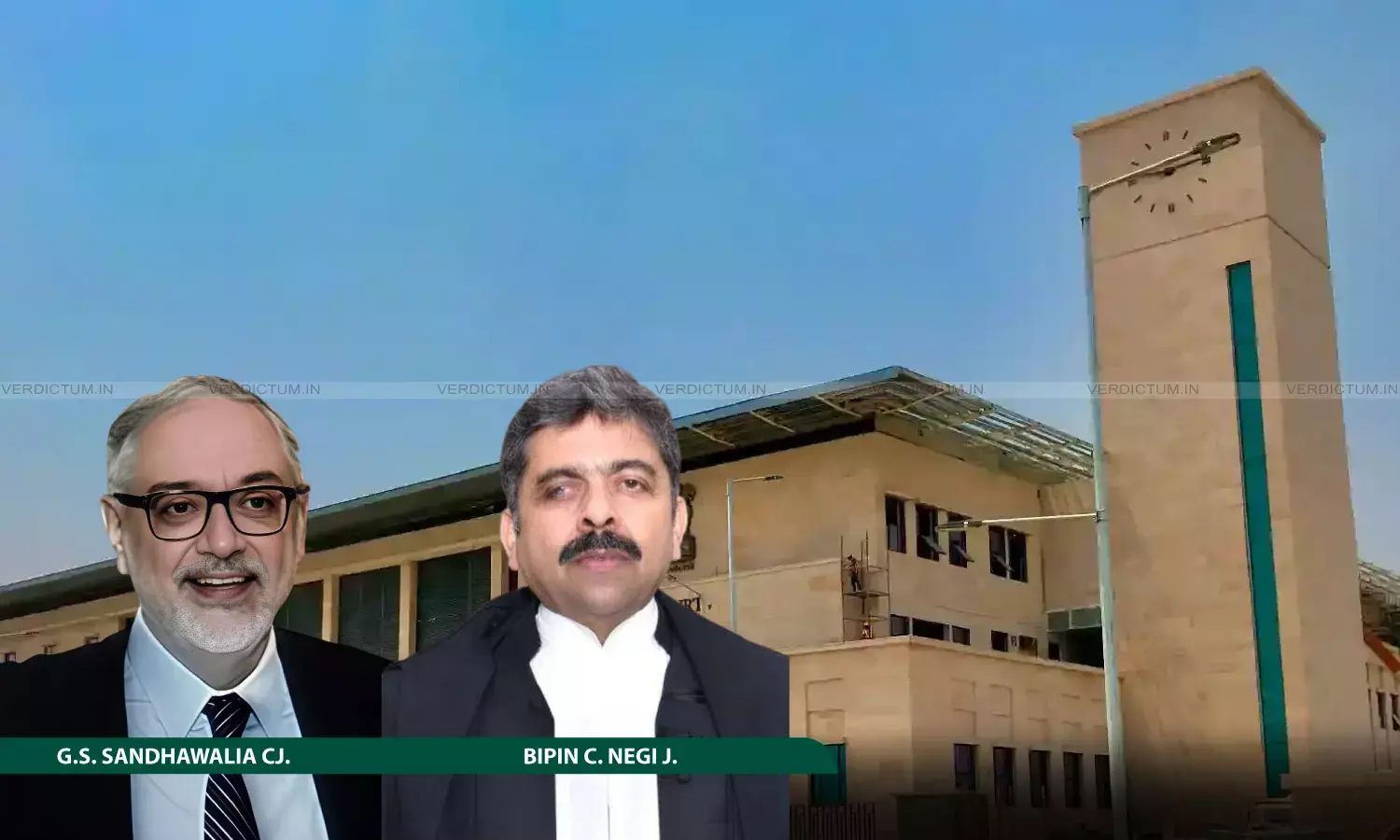
Chief Justice G.S. Sandhawalia, Justice Bipin C. Negi, Himachal Pradesh HC
The Himachal Pradesh High Court has held that complex hereditary claims, such as the exclusive right to act as a sole Pujari, cannot be adjudicated in a writ petition under Article 226 of the Constitution of India. The Court noted that such disputes hinge on questions of fact and custom which must be adjudicated by a Civil Court rather than through summary writ proceedings. Furthermore, the Court clarified that once a specific status or office is denied by state action, a challenge must be initiated within the prescribed period under the Limitation Act.
On the appellant’s belated attempt to expand the litigation, the Court held that raising new claims regarding the office of "Mohtamin" years after the cause of action arose constitutes an "academic exercise in futility". The Bench observed that allowing litigants to introduce fresh claims at the appellate stage, which were noticeably absent in prior proceedings, would lead to a "sheer waste of judicial time".
A Division Bench comprising Chief Justice G.S. Sandhawalia and Justice Bipin Chander Negi in a Letters Patent Appeal (LPA) involving a long-standing dispute over the management of Shri Shiv Mandir Nayas, Mahakal, observed, “…the claim of being the sole hereditary pujari and the exclusion of respondents 5 to 7 as co-pujaris raised in the case at hand can be only tried by a Civil Court (alternate remedy) and disputed questions of fact cannot be raised or decided in a writ petition. Now at this belated stage the attempt made to raise a claim of the writ petitioner being a Mohtamin of the temple in question, for the reasons mentioned hereinabove, cannot be allowed.In the aforesaid backdrop a reference to the nature of office of a mohtamin and the provisions of the Himachal Pradesh Hindu Public Religious Institutions and Charitable Endowments Act, 1984 made by the appellant shall be an academic exercise in futility, of no relevance and a sheer waste of judicial time”.
Senior Advocate Ajay Sharma appeared for the appellant Priyanka Chauhan, Deputy Advocate General, Senior Advocate Suneel Mohan Goel appeared for the respondents.
The litigation involved a claim by the late Hari Ram (represented by his legal heirs) asserting that he was the sole hereditary Pujari of the temple to the exclusion of his brothers, Respondents No. 5 to 7. The temple was taken over by the Government of Himachal Pradesh via a notification on March 9, 2006, under the Himachal Pradesh Hindu Public Religious Institutions and Charitable Endowments Act, 1984. Following this takeover, a rotation system for puja was established, and the previous revenue entries for "Mohtamin" and "Pujari" were replaced by the temple trust name.
For the facts, the Appellant had previously challenged the duty roster in 2016 but failed to claim the specific status of "Mohtamin" at that time. A Single Judge Bench dismissed the subsequent writ petition on October 16, 2024, finding the claims unsuitable for writ jurisdiction.
On appeal, the Appellant sought to withdraw the original writ with liberty to file a fresh one specifically asserting the "Mohtamin" claim.
The Court’s reasoning for rejecting this request was two-fold, first, it noted that the claim of being a "Mohtamin" was barred by the law of limitation. Under Article 107 of the Limitation Act, the plea should have been raised within 12 years of the status being denied in 2006. Second, the disputed questions of fact that can only be tried by a Civil Court as an alternate remedy.
The Court invoked the doctrine of constructive res judicata, noting that a party cannot litigate in instalments or raise omitted reliefs in successive petitions.
“Besides the aforesaid the principle of constructive res judicata underlying Explanation IV of Section 11 of the Code of Civil Procedure is also applicable to writ case. As the general principle underlying the doctrine of res judicata i.e to prevent an abuse of the process of court is ultimately based on considerations of public policy. Hence even on this account the plea seeking withdrawal of the writ petition wherein the impugned judgement was passed to file a fresh petition on the same cause of action cannot be permitted”, the Bench noted.
“The plea of being a Mohtamin could have only been taken within 12 years of the same having been denied in terms of Article 107 of the Limitation Act. Besides the aforesaid, as correctly noticed by the learned single judge…”, the Bench had noted.
The Court dismissed the Letters Patent Appeal, finding no merit in the challenge and no reason to interfere with the Single Judge's findings. All pending miscellaneous applications were also disposed of.
Cause Title: Hari Ram (deceased) through LRs v. State of HP and others [Neutral Citation: 2026:HHC:7726]
Appearances:
Appellant: Ajay Sharma, Senior Advocate, Atharv Sharma, Advocate.
Respondents: Priyanka Chauhan, Deputy Advocate General, Mukul Sood and Het Ram, Suneel Mohan Goel, Senior Advocate, and Paras Dhaulta, Advocates.