

Gauhati High Court: Disputes Relating To Interpretation Of GeM Contract Terms Ordinarily Not Be Agitated In Writ Petition Under Article 226
The Gauhati High Court reiterated that a Writ in the nature of Mandamus would not ordinarily be issued for enforcing terms and conditions of a Contract.
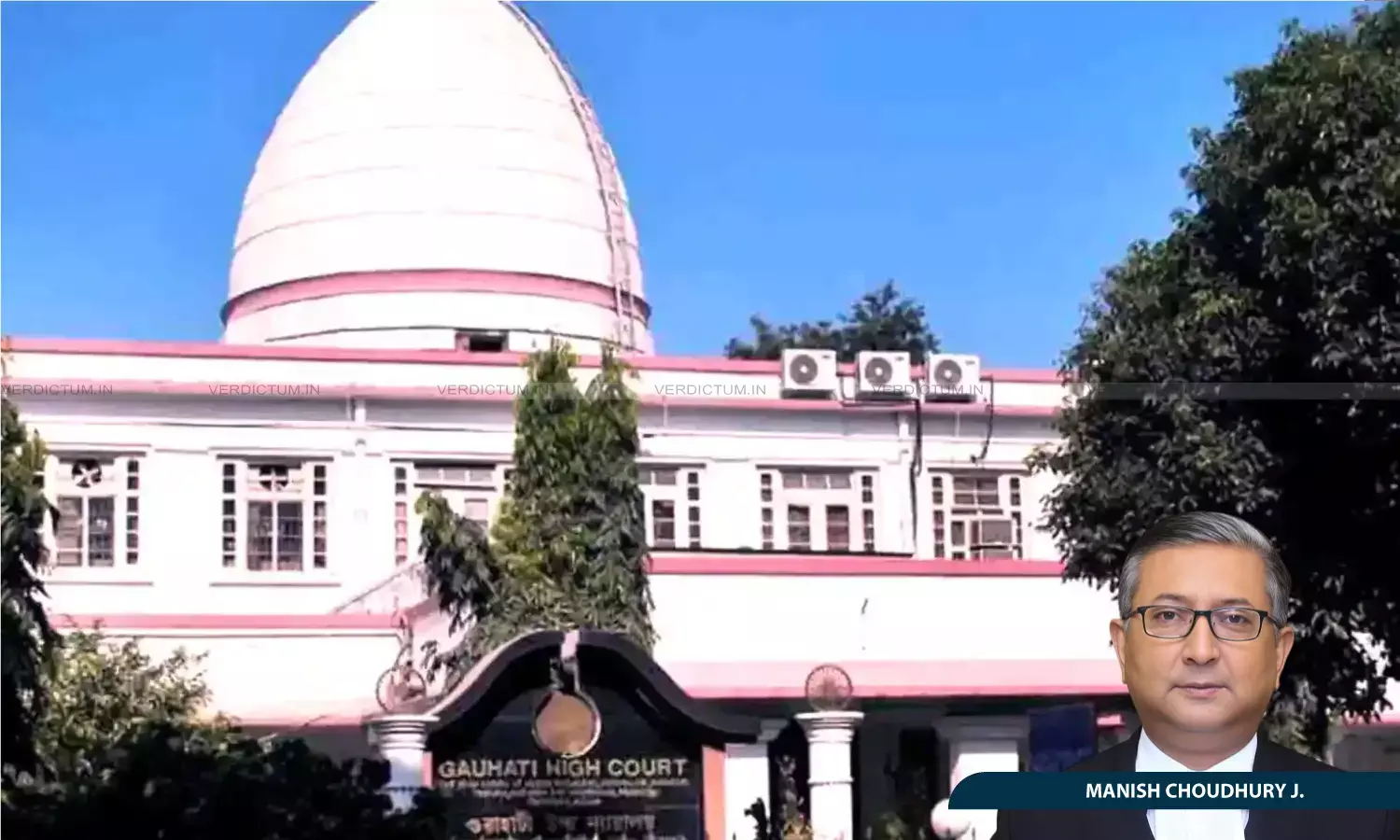
Justice Manish Choudhury, Gauhati High Court
The Gauhati High Court observed that the disputes relating to interpretation of the terms and conditions of a Government e-Marketplace (GeM) contract are ordinarily not to be agitated in a Writ Petition under Article 226 of the Constitution of India.
The Court observed thus in a Writ Petition preferred by Lokopriya Gopinath Bardoloi Regional Institute of Mental Health.
A Single Bench of Justice Manish Choudhury explained, “The GeM Contract in question is not a statutory contract. … The disputes about the meaning of a term of such a contract or its enforceability has to be determined according to the usual principles of the Contract Act. The disputes relating to interpretation of the terms and conditions of such a contract are ordinarily not be agitated in a writ petition under Article 226 of the Constitution of India and such matters are to be adjudicated by a civil court having jurisdiction or in arbitration, if there is existence of an arbitration agreement as per Section 7 of the Arbitration and Conciliation Act.”
The Bench reiterated that a Writ in the nature of Mandamus would not ordinarily be issued for enforcing terms and conditions of a Contract.
Advocate A.K. Dutta appeared on behalf of the Petitioner.
Factual Background
The Petitioner Institute was a tertiary mental health care institute, which is fully funded by the Ministry of Health & Family Welfare, Government of India. It was stated that the Petitioner Institute, established in Tezpur, Assam, is dedicated to providing specialized mental health care, research and training to advance mental health services in the region. For the purpose of outsourcing manpower services, the Petitioner Institute entered into a GeM Contract with the Respondent-M/s Green Alliance Engineering Services Pvt. Ltd. The GeM Contract was awarded to the Respondent after a tender process wherein a bid was submitted. The Respondent was mandatorily required to comply with the provisions of the relevant labour laws including the Minimum Wages Act, 1948 [Section 12], the Payment of Wages Act, 1936 [Section 5(1)(a)] and the Contract Labour [Regulation and Abolition] Act, 1970 [Section 21(4)].
It was the Petitioner’s case that during the GeM contract, the Respondent committed multiple breaches of the terms and conditions of the contract, as it made delayed wage payments. In view of failure in the amicable settlement process, the Respondent requested the Petitioner to proceed for resolution through Arbitration as per the mechanism set in Clause 16 of the GeM Contract. However, the Respondent did not appoint an Arbitrator from its end, and approached the Micro and Small Enterprises Facilitation Council constituted under the Micro, Small and Medium Enterprises Development Act, 2006 (MSMED Act). The said Council referred matter to Delhi International Arbitration Centre (DIAC), which initiated proceedings. Challenging the jurisdiction of DIAC, the Petitioner was before the High Court.
Court’s Observations
The High Court in the above context of the case, said, “Once the respondent no. 1, located in Delhi, claiming to be a supplier as per Section 2[n] of the MSMED Act has invoked the jurisdiction of the Facilitation Council, Delhi, the statutory provisions contained in Section 18 of the MSMED Act would override the Arbitration Clause contained in 16.2 of the GeM Contract. Though as per Clause 16.2[vi] of the GeM Contract has provided for the Seat of Arbitration at the place where the principal place of business of the buyer is located, such Seat of Arbitration would no longer held sway in view of the overriding provisions contained in Section 18[4] of the MSMED Act which provides that a Facilitation Council would have the jurisdiction to decide a dispute if the supplier is located within its jurisdiction and a buyer located anywhere in India.”
The Court noted that the direction sought for in the form of restraining the Respondents from proceeding further with the arbitration proceedings until the jurisdictional issue is finally adjudicated is found to be of no substance.
“Even assuming that the petitioner Institute is an instrumentality of the State or a public utility, thereby, coming within the ambit of Article 12 of the Constitution of India, the GeM Contract in question would not become statutory. The GeM Contract executed between the petitioner Institute and the respondent no. 1 providing for manpower services does not raise any issue of public law and the contract between the parties comes in the realm of private law. Disputes arising out of such the terms of such a contract or alleged breaches have to be settled by the ordinary principles of law of contract”, it observed.
The Court further reiterated that a Writ in the nature of Mandamus would issue when a question involving public law character arises for consideration and if an action which is challenged, does not have any public element, a Writ of Mandamus could not be issued as the action would then essentially be of a private character.
“It may be true that the functions discharged by the petitioner Institute in the mental healthcare segment may amount to public functions, but the GeM Contract in question entered into by the petitioner Institute with the respondent no. 1 for manpower outsourcing services, which it had voluntarily undertaken, is not a public duty cast upon the petitioner Institute by any statute to make it public function. From such standpoints, the decisions are not applicable in the facts and circumstances of the case”, it added.
Conclusion
The Court was of the view that the Writ Petition is not to be entertained in the facts and circumstances of the case and such non-entertainment does not mean that the Petitioner is to be left without remedy.
“It needs iteration that this Court has only ruled about entertainability or otherwise of the writ petition under Article 226 of the Constitution of India before this Court. Therefore, this decision should not in any way prejudice any rights, claims and contentions that the petitioner Institute can raise and contest before the Arbitral Tribunal”, it also said.
The Court, therefore, concluded that the rejection of objection as regards lack of jurisdiction by the Arbitral Tribunal would not preclude the Petitioner Institute to question the competence of Arbitral Tribunal as per Section 16 read with Section 34 of the Arbitration and Conciliation Act, 1996 (A&C).
Accordingly, the High Court refused to entertain the Writ Petition.
Cause Title- Lokopriya Gopinath Bordoloi Regional Institute of Mental Health v. M/s Green Alliance Engineering Services Pvt. Ltd. & Ors. (Neutral Citation: 2025:GAU-AS:15803)
