

NI Act| Court May Refuse Interim Compensation If Accused’s Defence Is Prima Facie Plausible: Gauhati High Court
The Court reiterated that the court must be satisfied with a prima facie case before granting interim compensation.

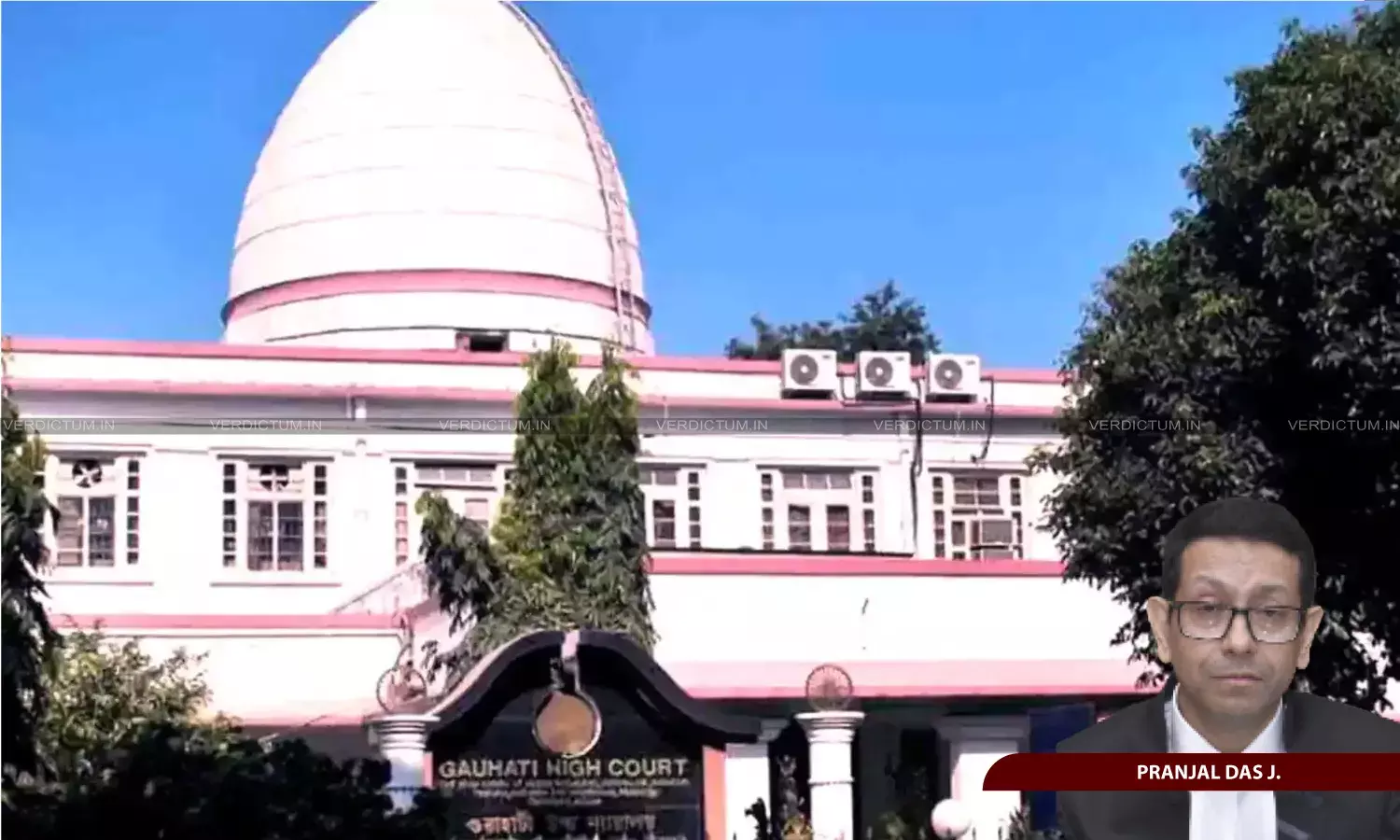
The Gauahti High Court observed that in cases related to the Negotiable Instruments Act, 1881 (NI Act), if the defence of the accused is prima facie found to be plausible, the court may exercise discretion in refusing interim compensation.
The Bench of Justice Pranjal Das, while relying on the landmark judgment of the Supreme Court in Rakesh Ranjan Shrivastava v. State of Jharkhand (2024 SC), observed, “Thus, I find that with regard to this statutory provision, the aforesaid decision of the Hon’ble Apex Court lays down the broad parameters for exercising powers there under. The most important consideration is that the court has to be satisfied about a prima facie case before granting interim compensation. The court to make such prima facie determination has to see the merits of the case put forth by the complainant and the merits of the defence put forth by the accused. It is also stated that if the defence of the accused is prima facie found to be plausible, the court may exercise discretion in refusing interim compensation.”
Advocate S Parashar appeared for the Petitioner, while Advocate Firuz Khan appeared for the Respondents.
Factual Background
The Complainant/Respondent No. 2 filed a petition before the Chief Judicial Magistrate under Section 138 of the NI Act, alleging commission of an offence under said provision of the NI Act, with regard to a cheque issued by the Petitioner/Accused.
The petition was allowed by the trial court, directing the Petitioner/Accused to pay interim compensation in terms of Section 143-A of the NI Act, to the extent of 20% of the cheque amount. The Petitioner/Accused, aggrieved by the order directing interim compensation, filed a criminal revision, seeking interference with the said impugned order.
Contention of the Parties
The Petitioner/Accused challenged the trial court's order for interim compensation, primarily contending that he never issued the cheques nor signed them. He argued that the cheques were drawn on a bank branch where he did not hold an account and claimed his signatures were forged, leading him to file a separate police case for fraud and forgery. To support this, he presented testimony from the bank manager, who confirmed that the account associated with the dishonoured cheques actually belonged to a different individual and had no legal connection to the accused. Based on these points, the petitioner argued that the essential legal requirements for an offence under Section 138 of the Negotiable Instruments Act were not met.
Conversely, the Complainant/Respondent No. 2 maintained that the cheques were validly issued to fulfil a legally enforceable debt arising from a land sale agreement. He explained that after the accused facilitated the sale of family property, the cheques were provided to cover a remaining balance of Rs. 36 lakhs from the agreed price. The Complainant/Respondent No. 2 asserted that the trial court acted within its rights to grant interim compensation to alleviate his financial hardship. He further argued that the court's power to interfere with such orders during a revision was limited, emphasizing that the transactions were part of a legitimate business arrangement that the accused failed to honour.
Observations of the Court
The Court observed, “On the subject of offence u/s 138 NI Act, the law is now crystallized that once the accused acknowledges his signature of the cheque, the burden shifts to him to rebut the statutory presumptions provided under the cheque bouncing law. Thus, the accused in such a situation has to rebut the presumption that the cheque was issued in the charge of a legally enforceable debt.”
It was also said that there are disputed questions which will necessitate proper adjudication through evidence, and only then would it be possible to answer the question as to whether the accused petitioner incurred criminal liability under section 138 of the NI Act.
“So, in such a situation and keeping in mind the principles laid down in Rakesh Ranjan Shrivastava (supra)- I come to the considered opinion that it may not be prudent to grant interim compensation at this stage, invoking the powers under section 143-A of NI Act. This is despite the projected financial difficulties of the respondent no. 2/complainant”, the Court observed.
Consequently, the Court set aside and quashed the Impugned Order directing interim compensation and accordingly allowed the criminal revision petition.
Cause Title: Sri Madhu Ram Deka v. State of Assam & Anr. [Neutral Citation:2026:GAU-AS:761]
Appearances:
Petitioner: Advocate S Parashar
Respondents: Advocate Firuz Khan