

Police & Parents Failed to Protect Girl in Distress: Gujarat High Court Acquits Two in Kidnapping & Atrocity Case Under SC/ST Act; Calls them ‘Good Samaritans’
Court Finds No Proof of Minority, Force or Enticement; Warns Youth About Legal Risks in Assisting Minor Girls

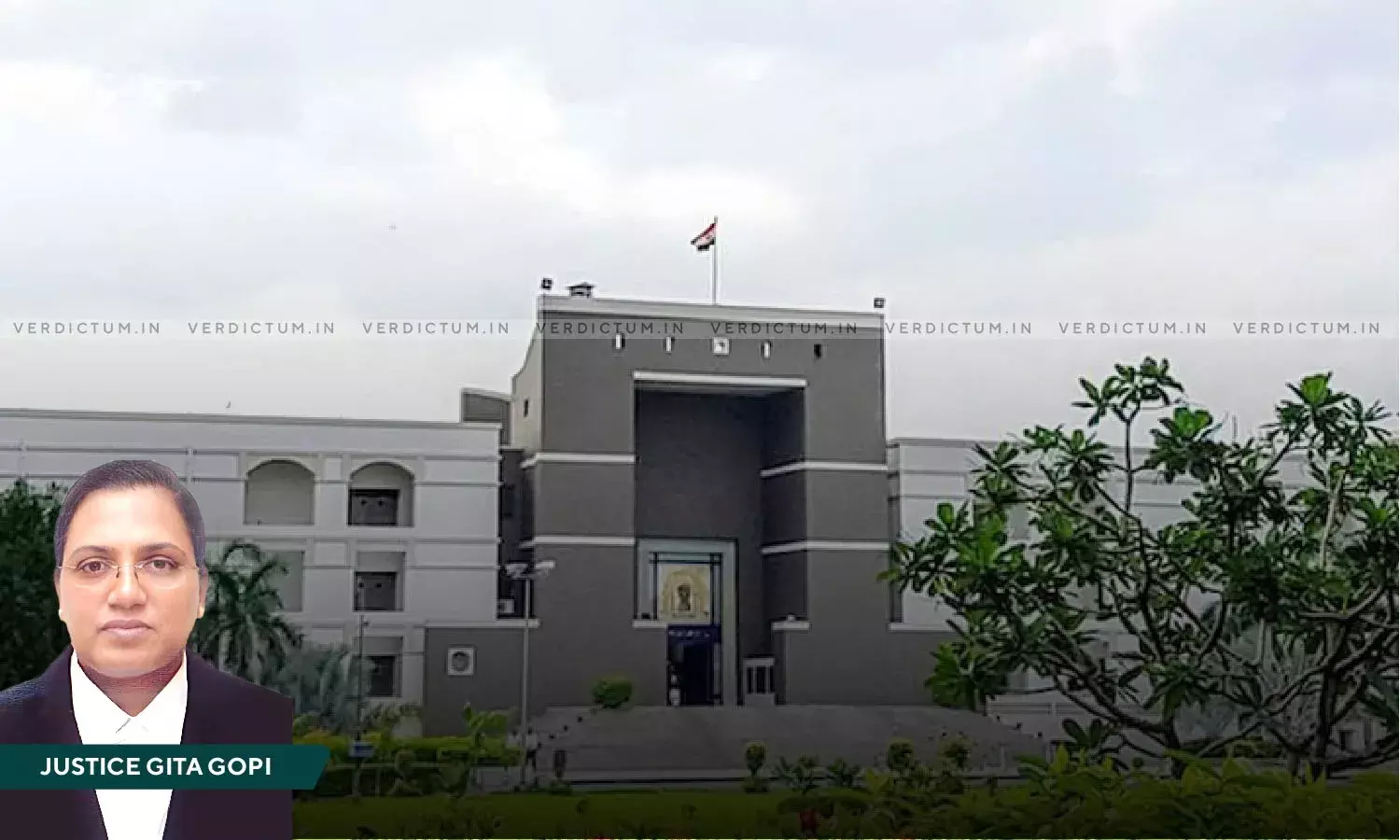
Justice Gita Gopi, Gujarat High Court
The Gujarat High Court has acquitted two accused who were earlier convicted under Sections 363 and 366 of IPC and under Section 3(1)(xi) of the of the Scheduled Castes and Scheduled Tribes (Prevention of Atrocity) Act, 1949 (Atrocity Act) as the prosecution failed to establish guilt beyond reasonable doubt. The Court observed that in the matter, the Police and her family in fact failed to protect the victim, whereas the accused appeared to have acted more like "Good Samaritans" who helped a distressed girl, without realising the legal consequences.
The Court said parents must educate young boys and minor girls that adolescent friendships or consensual relationships are not legally protected, and the law can place the burden on young adults to prove they committed no offence.
A bench of Justice Gita Gopi, upon examination of witnesses came to a conclusion that when the victim had gone to commit suicide at Narmada Canal, the police which met her were required to entrust the girl to her parents. The bench observed, “Young girls are not free to express their opinion and take decision where probably the girl would have wanted to take the responsibility of her decision, but parents, would not have allowed her to do so. Here in the case at hand, the girl would have certainly informed the police that she had on her own, left the parents’ house, she was to commit suicide. But the parents must have forced her to give contrary version forcing her to give testimony against the accused. The victim girl may not be aware of the consequences that her tutored version would subject the accused to arrest, prolonged pretrial incarceration, exposing to lasting social stigma”.
“Late adolescence as young adult requires to teach them a lesson that assisting or helping a maiden in distress-adolescence girls below 18 years of age would make them face trial under the Indian Penal Code or Prevention of Children from Sexual Offences Act, 2012. Lots of young adults are languishing in jail, because of the stringent laws which do not approve relation with the girl below 18 years, be it in a friendly manner”, the bench further observed.
Advocate Vijay Patel appeared for the appellant, Rohan Kumar H Raval, APP appeared for the respondent.
In the present matter, the prosecution alleged that on 23-03-2004, the accused kidnapped the complainant’s daughter near Gandhinagar ‘Ch’ Circle Bus Stand on a false promise of marriage and took her to various places including Gandhinagar, Ahmedabad, Vadodara, Surat and Mumbai, where the said offences were said to have been committed till 9-04-2004.
Challenging the conviction, the defence argued that the trial court ignored key evidence showing the girl was an adult and had left home voluntarily.
Upon reappreciation of the evidence, the High Court found no material to show that the accused had forcibly removed or enticed the girl from her parents’ guardianship through deceit or inducement.
The Court made strong observations on the surrounding circumstances, stating that the police had failed to properly protect the girl when she was in distress and had even contemplated suicide. It remarked that the situation reflected lapses on the part of authorities and family rather than criminal conduct by the accused.
The victim had multiple opportunities to complain, including when intercepted by police while travelling in a rickshaw, but introduced one of the accused as her brother, it further noted.
The bench said that a crucial factor was the prosecution’s failure to conclusively establish that the girl was below 18 years of age at the relevant time.
The Court held that the alleged fact that the girl was a minor was not proved, and with no convincing evidence of kidnapping, confinement, or the ingredients required under the Atrocity Act, the accused were entitled to the benefit of doubt.
It also noted that the law in such offences does not create any statutory presumption of guilt, and the burden remained on the prosecution to prove the case beyond reasonable doubt, a burden it failed to discharge.
Allowing the appeals, the High Court set aside the 23-02-2006 impugned conviction order, acquitting both appellants of all the charges, and discharged their bail bonds.
Cause Title: Rohan Kiritbhai Desai v. State Of Gujarat [Neutral Citation: 2026:GUJHC:6122]
Appellant: Vijay Patel For M/S. Hl Patel Advocates, and Saurabh J Mehta, Advocates.
Respondent: Rohan Kumar H Raval, APP, Advocate