Title Prevails Over Possession Once Ownership Is Established: Gujarat High Court Dismisses Two-Decade-Old Appeal In Forest Land Dispute
Where documentary title and official records establish ownership, title must be given primacy over mere possession, and possession cannot be considered in isolation, the Gujarat High Court held while dismissing a second appeal arising from a dispute over forest settlement land.
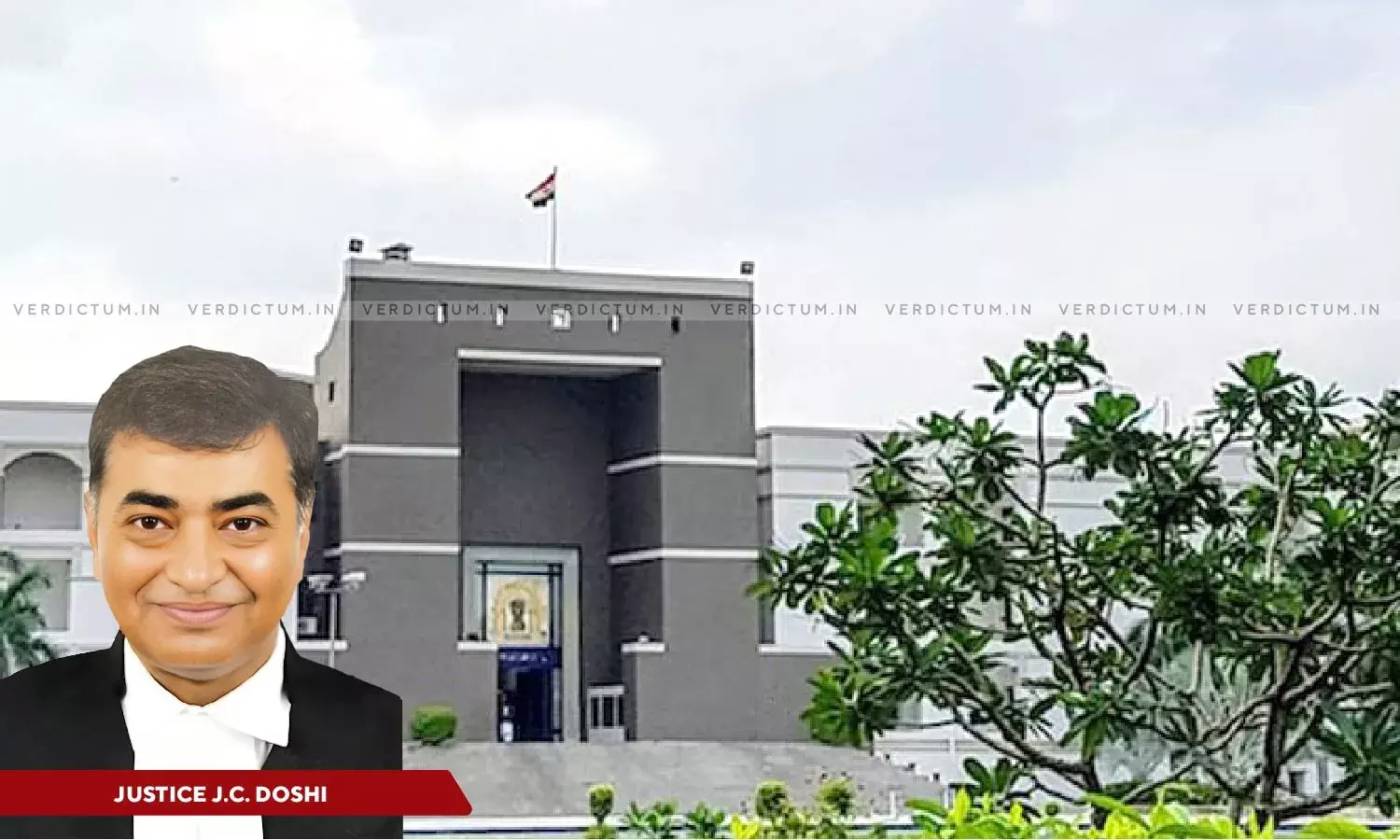
Justice J.C. Doshi, Gujarat High Court
The Gujarat High Court has held that once legal title to immovable property is established on record, it is the title that must be given primacy, and mere possession cannot be considered in a vacuum. The Court held that a person in possession under subordination to the title holder must establish a legal right to continue in possession, failing which such possession cannot be protected.
The Court was hearing a second appeal challenging concurrent findings of the trial court and the first appellate court dismissing a suit seeking protection of possession and declaration against resumption of forest settlement land.
A Single Judge Bench of Justice J. C. Doshi, while dismissing the appeal, observed: “Possession is important when there are no title documents and other records, but once the document and records of title are with the party, it is the title which has to be looked at first and due weightage be given to it”.
Background
The dispute related to land situated in the Jasadhar Range of Gir Reserve Forest. The land had been allotted under forest settlement to the original settler on leasehold terms.
The plaintiff claimed possession of the disputed land based on a registered agreement to sell executed in 1965 by persons claiming to be heirs of the original settler. The plaintiff asserted that possession had been handed over pursuant to the agreement and that he had been cultivating the land and maintaining constructions on the property.
The plaintiff filed a civil suit seeking a permanent injunction restraining the State and Forest Department from dispossessing him without due process of law. The plaint was later amended to challenge an order of the Forest Department resuming possession and to seek a declaration that the said order was null and void.
The State of Gujarat and Forest Department contested the suit, contending that the land formed part of a reserved forest and wildlife sanctuary, that the original settler had no right to transfer the land without State sanction, and that the alleged agreement to sell did not confer any legal right on the plaintiff.
The trial court dismissed the suit. The first appellate court confirmed the dismissal. The plaintiff then filed the present second appeal under Section 100 of the Code of Civil Procedure.
Court’s Observation
The High Court first recorded undisputed facts, including that the disputed land fell within a reserved forest and wildlife sanctuary, that the land had been granted under settlement on leasehold terms, and that the terms of settlement did not permit transfer of leasehold rights.
The Court noted that the agreement to sell relied upon by the plaintiff was not executed by the original settler and that the persons who executed the agreement failed to establish that they were legal heirs of the settler. The Court held that no documentary or revenue record evidence was produced to prove their heirship.
The Court examined the agreement to sell and noted that it expressly acknowledged that the land was forest settlement land and that the transfer was subject to permission from the State Government. The Court found that no such permission was ever granted.
The Bench further noted admissions made by the plaintiff in cross-examination, including that the land belonged to the Government, that it had been allotted under settlement, and that transfer required State permission. The Court held that these admissions undermined the plaintiff’s claim of lawful possession.
The High Court held that an agreement to sell does not create any right, title, or interest in immovable property under Section 54 of the Transfer of Property Act. Relying on Supreme Court precedent, the Court reiterated that an agreement to sell does not confer ownership or title.
On the plea of part performance under Section 53A of the Transfer of Property Act, the Court held that the doctrine confers only a limited protective right against the transferor and does not create title. The Court further held that such protection cannot be claimed against a third party having an independent title, particularly where the State is the owner.
The Court also noted that the agreement to sell was conditional upon sanction from the State Government and that, in the absence of such sanction, the agreement could not be relied upon to claim lawful possession.
On the issue of possession versus title, the Court held that where documentary title and official records establish ownership, possession must be presumed to be subordinate to title. The Court held that “if a person is seeking protection of his possession under subordination of title lying with a third party has to establish that he has the right to continue possession”.
The Court further examined the statutory framework under the Indian Forest Act, 1927, the Forest (Conservation) Act, 1980, and the Wildlife (Protection) Act, 1972. The Court held that these statutes prohibit accrual and alienation of rights in reserved forest and sanctuary land without sanction, and that no such sanction existed in the present case.
The Court held that concurrent findings of the courts below did not give rise to any substantial question of law and that the second appeal amounted to an impermissible reappreciation of facts.
Conclusion
The Gujarat High Court held that the plaintiff had no right, title, or interest in the disputed land and that possession, if any, was subordinate to the title of the State Government.
Accordingly, the High Court dismissed the second appeal, affirmed the concurrent findings of the courts below, and vacated interim relief, if any.
Cause Title: Rambhai Madhubhai Rajput (Since Deceased) Through His Heirs & Ors. v. State of Gujarat & Ors.
Appearances
Appellants: M. B. Parikh, Advocate
Respondents: Nidhi Vyas, Assistant Government Pleader