

Imported Cargo Can’t Be Seized Based On Parameter Of Cloud Point: Gujarat High Court
The Gujarat High Court clarified that if the Distillate Oil is a marine fuel used in ships operating in colder weather conditions, the cloud point becomes relevant.
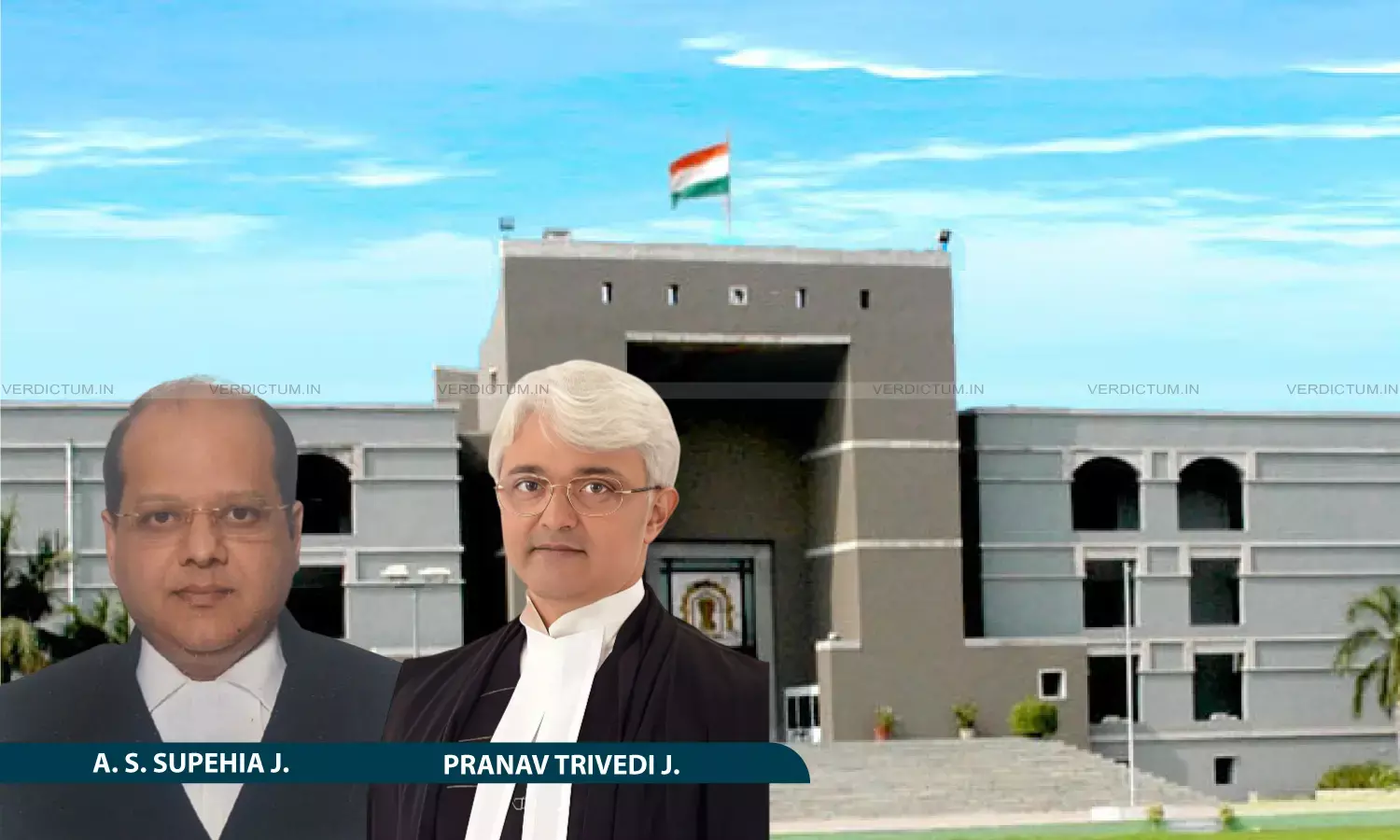
Justice A.S. Supehia, Justice Pranav Trivedi, Gujarat High Court
The Gujarat High Court held that the cargo imported cannot be ordered to be seized on the basis of the parameter of cloud point.
The Court held thus in Civil Applications challenging the seizure memo issued by the Intelligence Officer, DRI wherein it was stated that the test report in respect of sample drawn from the imported goods reveals that the sample does meet the requirements of Distillate Oil.
A Division Bench comprising Justice A.S. Supehia and Justice Pranav Trivedi observed, “The table annexed to the pour point/cloud point/cold filter plugging point for vessels operated by Distillate Marine Fuel stipulates that “Pour point cannot guarantee operability for all ships in all climates,” and the purchaser should confirm that the cold flow characteristics (pour point, cloud point, cold filter plugging point) are suitable for the design of the ship and the intended voyage. Thus, the cargo imported by the petitioner cannot be ordered to be seized on the basis of the parameter of cloud point, as it will be relevant only at the place, vessel, and time of use, and will depend on the end user.”
The Bench clarified that if the Distillate Oil is a marine fuel used in ships operating in colder weather conditions, the cloud point becomes relevant, and for other usages, the Cloud Point is not a significant parameter, and hence, the end use of the sample under reference may be ascertained.
Senior Advocates S.N. Soparkar and Mihir Joshi appeared for the Petitioners, while Senior Standing Counsel (SSC) Anurag Oza appeared for the Respondents.
Case Background
On the basis of the report, the Distillate Oil was seized, and accordingly, the Petitioners were praying for directions to set aside the action of the Respondent authorities in detaining the imported bulk liquid cargo oil. The Petitioners were involved in trading of industrial oil and other allied pursuits and were engaged in importing bulk liquid cargo being Distillate Oil in various quantities from tank vessel viz. MT-Vayu, vide Bills of Entry at Pipavav Port, Amreli (Gujarat).
The Petitioners had a certificate of analysis issued by the company from which they had purchased the material i.e. Chevron General Trading LLC, which showed that the imported product is Distillate Oil. When the liquid was transferred from MT-Vayu into Customs Bonded Storage Tank, such cargo was placed under investigation for the alleged mis-declaration, and the officers of the Directorate of Revenue Intelligence (DRI), Delhi Zonal Unit, recorded panchnama and drew representative samples in triplicate from the said Tank in the presence of the Petitioners’ representatives, customs brokers, and independent surveyors.
On completion of the sample collection process, the cargo was detained under Section 110 of the Customs Act, 1962 on the information of possible mis-declaration, vide a Detention Memo. It was the case of the Petitioners that despite completion of discharge operations, as well as drawal of test samples, and despite there being Public Notice issued by the New Customs House, Mumbai as well as Public Notice issued by the Office of the Commissioner of Customs, Kandla, the Customs authorities have neither released the cargo nor furnished any test results of the samples.
Reasoning
The High Court after hearing the contentions of the counsel, noted, “The petitioners cannot be discriminated in view of the communication dated 28.10.2025 written by the CRCL, Delhi, to the Assistant Commissioners of Kandla authorities relating to the similar parameters/characteristics which were found in the tests of the samples of Distillate Oil. However, at this stage, we may clarify that so far as the parameters/characteristics of Distillate Oil relating to cloud point are concerned, the Director of CRCL has already clarified that the relevance of cloud point would depend upon the climatic conditions of the area in which the same is used.”
The Court said that there is no definite conclusion with regard to the cloud point, and it depends upon the vessel being operated in specific areas.
“During the course of the hearing, the respondents have also tried to impress this Court by pointing out the infringement of other parameters also, viscosity, i.e. density, distillation-IBP, kinematic distillation recovery, distillation final boiling point, and flash point”, it added.
The Court remarked that so far as the parameter of density at 15°C is concerned, the same is satisfied by the Petitioners’ cargo, including kinematic viscosity, distillation-IBP, distillation recovery, distillation final boiling point, and flash point, since the Test Report does not indicate any violation of other parameters and is confined only to two characteristic, as mentioned hereinabove, i.e. Cloud Point parameter and observations that the Distillate oil has the characteristics of a diesel fraction with a small amount of heavier fraction of hydrocarbons and hence, it is not inclined to further delve into the other parameters.
“The action of the respondent authorities in detaining the imported bulk liquid cargo of Distillate Oil through the respective vessels of the petitioners, which is presently stored in Customs Bonded Storage at Pipavav Port, Amreli (Gujarat) is hereby quashed and set aside. We further direct the respondents to release the bulk liquid cargo of Distillate Oil imported through the vessels. We further clarify that, as done in the case of the cargo of Distillate Oil seized by the Kandla Customs authorities, the traders shall file an end-use certificate before the Custom authority”, it directed and concluded.
Accordingly, the High Court allowed the Writ Petitions and quashed the impugned seizure memos.
Cause Title- Noya Infrastructure LLP & Ors. v. Union of India, Ministry of Finance & Ors. (Neutral Citation: 2025:GUJHC:70391-DB)
Appearance:
Petitioners: Senior Advocates S.N. Soparkar, Mihir Joshi, Advocates Amir S. Pathan, Virat G Popat, Kunal Nanavati, and Kaustubh Shrivastav.
Respondents: SSC Anurag Oza, Advocate Pradip D. Bhate, and C.B. Gupta.
