

Before Issuance Of Notice U/S.148A(1) Income Tax Act, AO Has To Verify Whether Income Chargeable To Tax Has Escaped Assessment: Gujarat High Court
The Petitioner had approached the Gujarat High Court assailing the notice issued under section 148A(1) of the Income Tax Act.

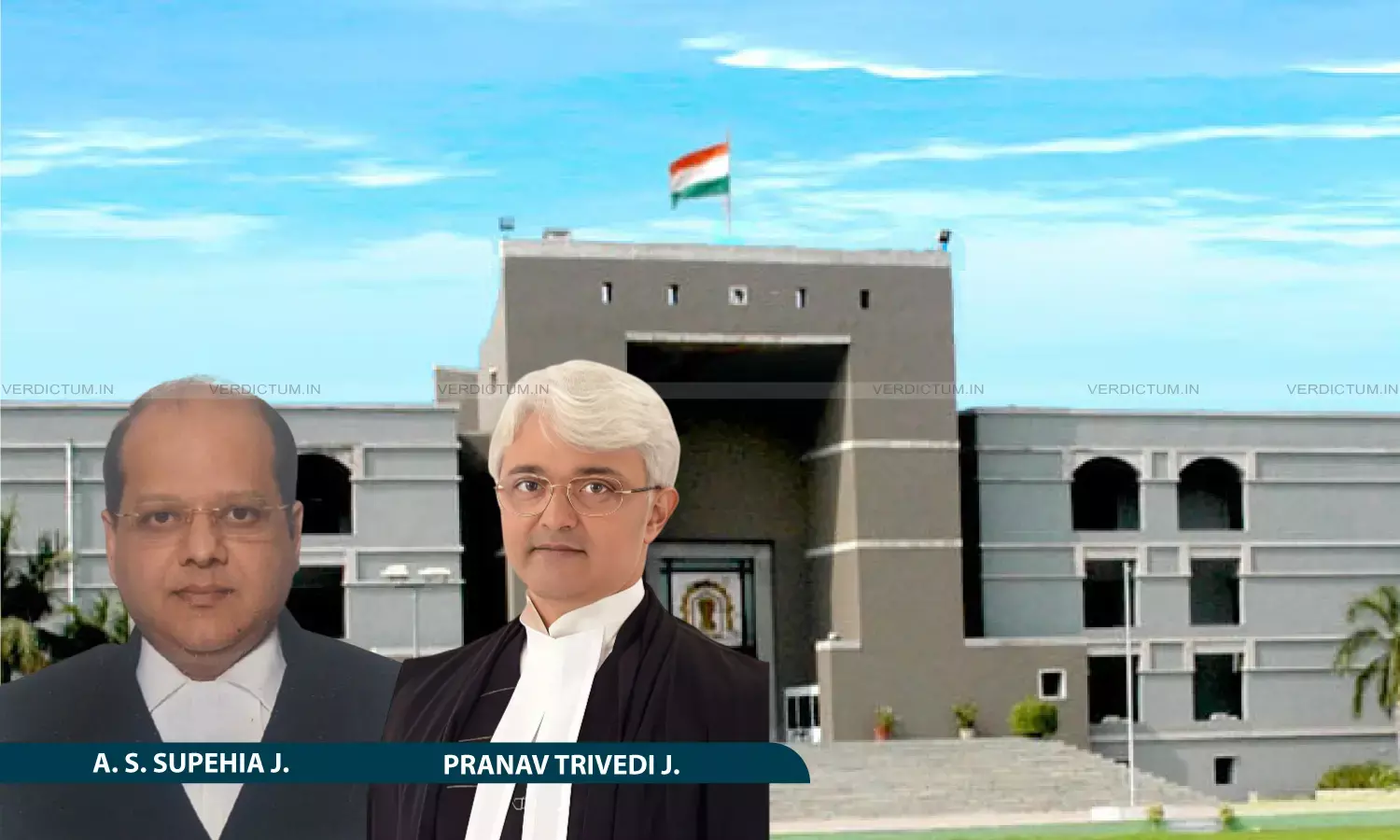
Justice A.S. Supehia, Justice Pranav Trivedi, Gujarat High Court
While quashing an order reopening the assessment under the Income Tax Act, the Gujarat High Court has reiterated that before issuance of notice under section 148A(1), the jurisdiction of the AO is to verify the information made available on the insight portal, which suggests that the income chargeable to tax has escaped the assessment.
The Petitioner had approached the High Court assailing the notice issued under section 148A(1) of the Income Tax Act, 1961, and the order passed by the respondent under section 148A of the Act along with a consequential notice reopening the assessment for the Assessment Year (AY) 2019-20.
Referring to the judgment in Vasuki Global Industrial Ltd. vs. Principal Chief Commissioner of Incometax, (2025), the Division Bench of Justice A. S. Supehia and Justice Pranav Trivedi held, “Thus, it is settled legal precedent that before issuance of notice under section 148A(1) of the Act, the jurisdiction of the AO is to verify the information made available on the insight portal, which suggest that the income chargeable to tax has escaped the assessment. The provisions of section 148A(1) of the Act is selfexplanatory and expression used in the provisions is that “information which suggests that income chargeable to tax has escaped assessment”, and the same has to be taken in its literal sense, and no roving inquiry is permissible.”
Advocate B S Soparkar represented the Petitioner, while Advocate Varun K. Patel represented the Respondent.
Factual Background
The petitioner is the Managing Director of a data processing firm which is in the business of security printing. He is also a partner in three other firms. He filed his return of income for AY 2019-20, declaring his total income at Rs 33,98,400. Thereafter, a summons under section 131(1) of the Act was issued upon him for the FY 2018-19 to 2020-21, to which a reply was filed. Subsequently, another summons was issued. The respondent authority issued the impugned notice under section 148A(1) of the Act, stating that the information was received, suggesting that during the FY 2018-19, the petitioner had undertaken transactions of Rs.37,40,31,604 (Rs.18,70,59,704/- debit and Rs.18,69,71,900/- credit).
The petitioner sought a short adjournment to supply the details called for, which was granted. The respondent authority thereafter passed the impugned order rejecting the objections of the petitioner and also issued the impugned notice.
Reasoning
On a perusal of the facts of the case, the Bench noted that the amounts, which were borrowed, had been repaid by the petitioner, and the AO had considered both debit as well as credit entries, though the petitioner had fully complied with the provisions of the Act and disclosed the details of the transactions with all the parties.
On a perusal of the facts of the case, the Bench noted that the genesis of issuance of the notice and the order lay only in the debit and credit entries, which were supplied by the bank. Except that, there was nothing with the AO to reopen the assessment. “Debit and credit entries are also consolidated into single amount, as mentioned hereinabove. The petitioner has not conducted transactions through cash and all the transactions are made through banking channels, explaining details of each and every party.”, it further noticed.
The Bench thus stated, “ Hence, in the considered opinion of this Court, the AO has travelled beyond the provisions of section 148A(1) of the Act and after the bank has tendered the information of debit and credit entries, roving inquiry is sought to be made by calling upon the petitioner to give all the details of transacting parties, which were already available with them.”
Thus, allowing the petition, the Bench quashed the notice passed by the respondent under section 148A of the Act, along with the consequential notice reopening the assessment for the AY 2019-20.
Cause Title: Mukesh Manubhai Shah v. Assistant Commissioner of Income Tax Circle Ahmedabad (Neutral Citation: 2025:GUJHC:74067-DB)