

Assessee Filed Objections Before JAO Instead Of Faceless Assessing Officer Due To Bona Fide Error: Gujarat High Court Quashes Final Assessment Order Under Income Tax Act
The Gujarat High Court was considering a petition whereby the petitioner sought quashing of the final Assessment Order passed under the Income Tax Act for the Assessment Year 2022-23.

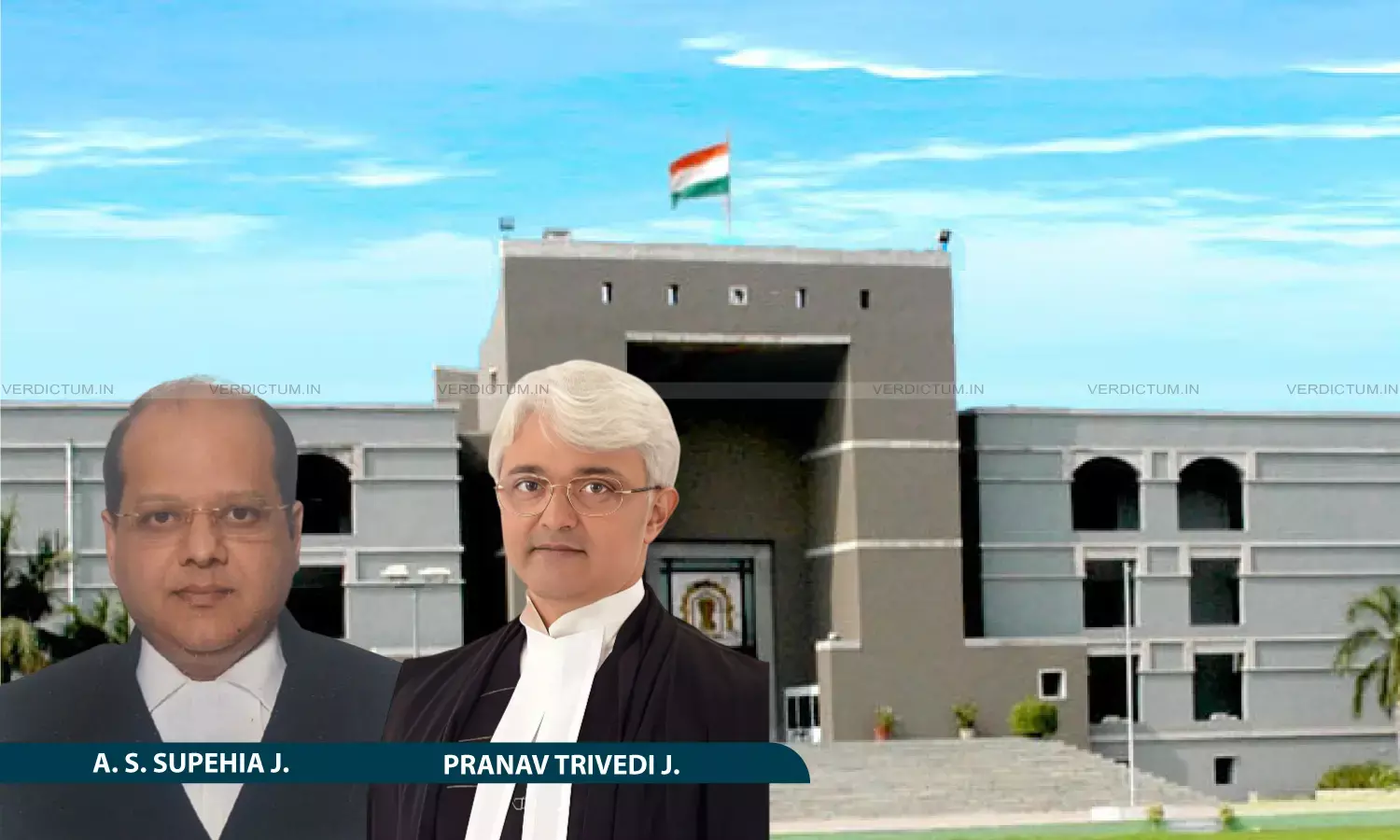
Justice A.S. Supehia, Justice Pranav Trivedi, Gujarat High Court
The Gujarat High Court has quashed a final assessment order passed under the Income Tax Act, 1961, after noting that, due to bona fide error, the assessee had filed objections within the prescribed period of limitation before the Jurisdictional Assessing Officer (JAO) instead of the Faceless Assessing Officer.
The High Court was considering a petition whereby the petitioner sought quashing of the final Assessment Order passed under Section 143(3), read with Section 144C (3) and Section 144B of the Income Tax Act, 1961, for the Assessment Year 2022-23.
The Division Bench of Justice A.S. Supehia and Justice Pranav Trivedi held, “It is not in dispute that due to bona fide error, the petitioner filed objections within prescribed period of limitation before the JAO instead of Faceless Assessing Officer and accordingly the Faceless Assessing Officer passed the Final Assessment Order. Pursuant to which the DRP also passed the impugned order as having become functus offico in adjudicating the dispute.The respondents has not denied the aforesaid aspect. This the petitioner has carved out a case for interference as it is not in dispute that the petitioner due to inadvertence instead of filing objections before the Faceless Assessing Officer filed the same before the JAO within limitation period of 30 days and the Faceless Assessing Officer proceeded to pass the Final Assessment Order.”
Advocate Dhinal A Shah represented the Petitioner, while Advocate Dev Patel represented the Respondent.
Factual Background
The petitioner filed its return of income for the Assessment Year 2022-23 under Section 139(1) of the Act, declaring a total income of Rs 2,38,68,25,940. The case of the petitioner was selected for scrutiny assessment under the Computer-Aided Scrutiny Selection (CASS) parameters, for the issues involving significant international transactions and transfer pricing risk parameters. It was the case of the petitioner that, consequently, the matter was referred to the Transfer Pricing Officer (TPO) under Section 92CA (1) of the Act for the determination of the arm’s length price. The TPO proposed an upward adjustment of Rs 12,68,130 in respect of notional interest imputed on alleged delayed realisation of sale invoices from Associated Enterprises beyond the normal credit period extended by the petitioner Company. Pursuant thereto, the draft Assessment Order under Section 144C(1) came to be passed by the respondent Assessment Unit incorporating the above proposed adjustment.
Being aggrieved by the proposed variation, the petitioner filed its objections in Form 35A of the Act before the respondent – Dispute Resolution Panel (DRP), which was filed within the prescribed period of limitation of 30 days. The same was acknowledged by the third respondent – DRP and the second respondent – Jurisdictional Assessing Officer (JAO). Despite the pendency of the said objections before the respondent DRP, and without awaiting issuance of directions under Section 144C(5), the Faceless Assessing Officer (NFAC) passed a final Assessment Order. The petitioner submitted a detailed letter to the JAO reiterating that the final Assessment Order had been passed prematurely despite the pendency of the objections before the respondent – DRP. The petitioner's grievance was that the respondent DRP dismissed the objections on the ground that the Assessing Officer had already passed the final Assessment Order, and therefore, the respondent Jurisdictional Assessing Officer (JAO) did not have the jurisdiction to adjudicate the appeal.
Reasoning
The Bench noticed that the case of the parties hinged on the noncompliance of the provision of Section 144C(2) (b)(ii) of the Act, i.e. before the Assessing Officer. The Bench noted that the petitioner had carved out a case for interference as due to inadvertence instead of filing objections before the Faceless Assessing Officer, the petitioner filed the same before the JAO within the limitation period of 30 days, and the Faceless Assessing Officer proceeded to pass the Final Assessment Order.
“In our considered opinion, the JAO on acknowledging the objections filed by the petitioner on 21.04.2025 ought to have communicated to the petitioner to approach the Faceless Assessing Officer as the limitation period would be running against the petitioner more particularly, when the Jurisdictional Assessing Officer did not have any jurisdiction to entertain such objections. Be that as it may, the assessment was further undertaken by the Faceless Assessing Officer and ultimately an order was passed which led to the consequential order passed by the DRP”, it added.
Thus, allowing the petition, the Bench quashed the impugned orders passed by the respondents. “The petitioner shall file objections within a period of two weeks from the date of receipt of writ of this order, and the period of limitation of 30 days would start from the date of filing such objections before the Faceless Assessing Officer”, it ordered.
Cause Title: Milacron India Private Limited v. The Assessment Unit, Income Tax Department (Neutral Citation: 2025:GUJHC:74470-DB)
Appearance
Appellant: Advocate Dhinal A Shah
Respondent: Advocates Dev Patel, Varun K. Patel