

Civil Disputes Needs Adjudication By Court of Law: Gujarat HC Quashes Human Rights Commission Proceedings, Issues Guidelines
State Human Rights Commission cannot assume jurisdiction over civil disputes or run parallel to pending suits

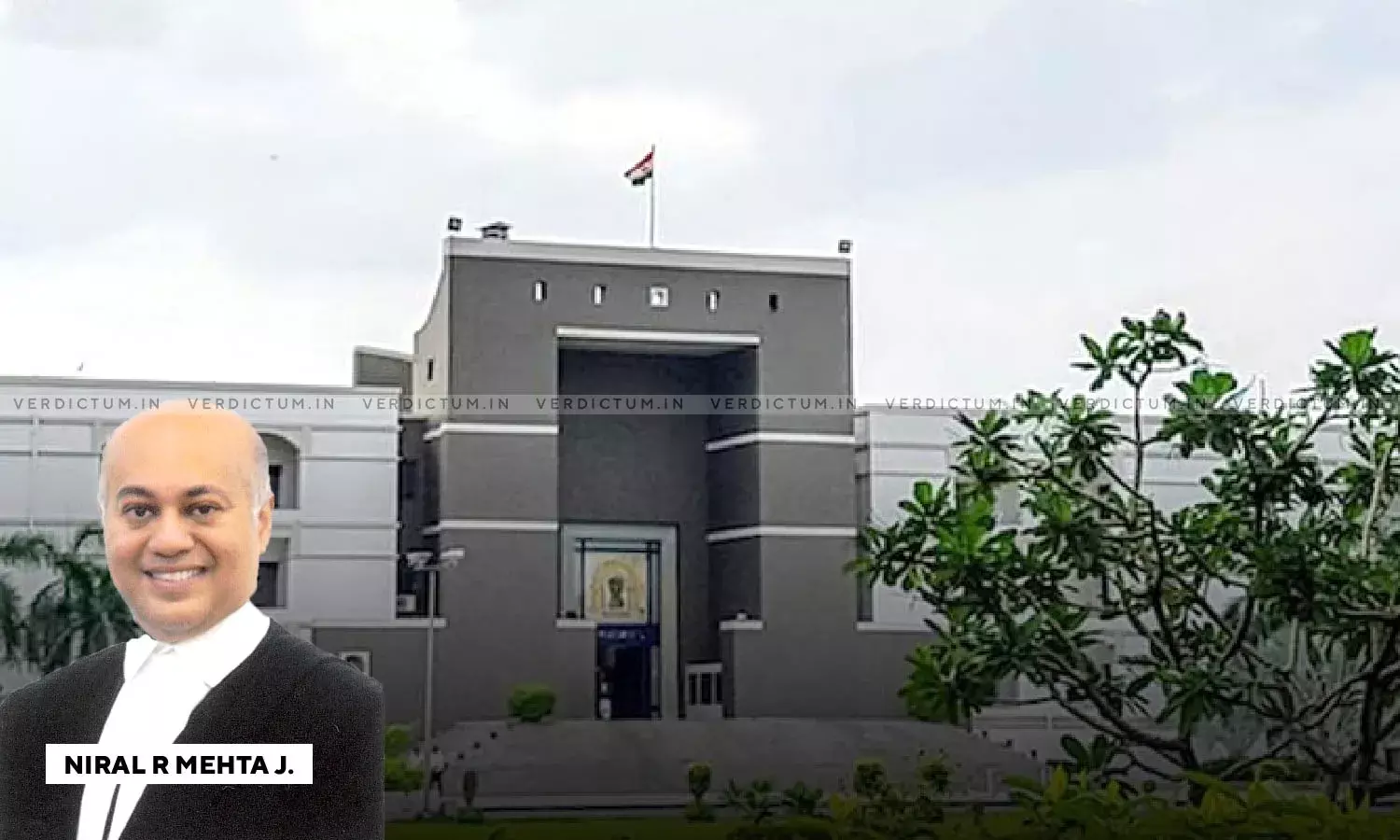
Justice Niral R. Mehta, Gujarat High Court
The Gujarat High Court has held that a private dispute concerning share in immovable property cannot be converted into a human rights complaint under the Protection of Human Rights Act, 1993. The Court quashed the proceedings initiated by the State Human Rights Commission, observing that it acted beyond its statutory mandate, and that such matters fall exclusively within the domain of civil courts.
Furthermore, clarifying the limits of the Commission’s jurisdiction, the Court observed that the Commission cannot conduct parallel inquiries, issue summons or warrants, or facilitate settlement in disputes that are essentially civil in character and already sub judice before a competent court.
It also issued guidelines directing the Commission to conduct primary scrutiny before taking cognizance, refrain from entertaining predominantly civil disputes, avoid parallel proceedings in sub judice matters, and exercise restraint in issuing summons or warrants.
Justice Niral R. Mehta observed, “…The Commission cannot conduct inquiries or proceedings in a casual manner that defeats the object and intent of the legislature. It is expected to exercise its powers with due caution and circumspection. Before initiating any proceedings, the Commission must form at least a prima facie opinion regarding the existence of a human rights violation. The Commission is also required to be vigilant, particularly where the complaint itself discloses that the dispute is predominantly civil in nature and requires adjudication by a court of law. In the present case, the dispute is admittedly a private property dispute between individuals. Therefore, the Commission ought to have applied its mind before initiating proceedings under the Act as to whether the dispute fell within the scope of the Human Rights Act. Entertaining such a complaint, issuing summons, and taking cognizance can have serious consequences.
“…In the present case, no such due consideration was shown, and the proceedings were initiated in a casual manner, which, in the opinion of this Court, amounts to usurpation of the jurisdiction of the Civil Court. A grievance relating to share in property cannot, by any stretch of imagination, be treated as a violation of human rights. Even assuming that the Commission was of the view that there was a human rights violation, it was still incumbent upon it to first ascertain whether any civil proceedings were pending before a court of law and, if so, to obtain prior permission from the concerned court before proceeding further, as mandated by law” .
Advocate Tattvam K. Patel appeared for the petitioner and Kanva Antani, AGP appeared for the respondent.
In the present matter, a relinquishment deed was executed on 15-12-2015 by respondent No. 4 in favour of the petitioners in respect of ancestral property situated at village Zundal, District Gandhinagar.
Pursuant to which, nearly ten years later, respondent No. 4 instituted a civil suit seeking cancellation of the relinquishment deed along with reliefs of declaration, injunction and partition, where the civil suit remains pending before the competent court.
During the pendency of the suit, respondent No. 4 approached the State Human Rights Commission alleging violation of her human rights on the ground that she had not been granted her share in the property.
Therefore, acting on the complaint, the Commission issued notices to the petitioners and also to senior revenue officials, including the District Magistrate and Mamlatdar. The Commission directed the parties to explore settlement and subsequently issued summons and warrants, which ultimately led to a compromise between the parties.
Accordingly, challenging the Commission’s actions under Articles 226 and 227 of the Constitution of India, the petitioners contended that the dispute was purely civil in nature and did not involve any violation of human rights as defined under Section 2(d) of the Act. They also argued that the complaint was barred by limitation under Section 36(2), as the alleged cause of action related to a deed executed in 2015.
The Court while examining the statutory framework, analysed Sections 2(d), 12, 17, 18, 29 and 36 of the Protection of Human Rights Act, 1993, along with Regulation 9 of the National Human Rights Commission (Procedure) Regulations, 1994.
The Court said that “human rights” under the Act are confined to rights relating to life, liberty, equality and dignity guaranteed by the Constitution or embodied in international covenants and enforceable by courts in India.
“…this Court is firmly of the opinion that the initiation of inquiry by respondent No.3 in a private dispute between two private individuals not only exceeded its jurisdiction but also amounted to usurpation of the powers of the Civil Court. The Human Rights Commission is a statutory body constituted under the Act and is expected to function strictly within the limits of its statutory authority. Proceedings under the Act are not meant for settlement of private property disputes”, it noted.
Cause Title: Mahendra Shanabhai Patel & Ors. v. The District Magistrate & Ors. [Neutral Citation: 2026:GUJHC:2718]
Petitioner: Tattvam K. Patel, Advocate.
Respondents: Kanva Antani, AGP, G.H. Virk, Government Pleader, Dharitri Pancholi, AGP, R.P. Patel, Advocates.