

Institute For Plasma Research Falls Within Meaning Of State Under Article 12 Of Constitution: Gujarat High Court Overturns Earlier Ruling
The Gujarat High Court was considering the issue of whether the respondent Institute for Plasma Research can be said to be a ‘State’ within the meaning of Article 12 of the Constitution.

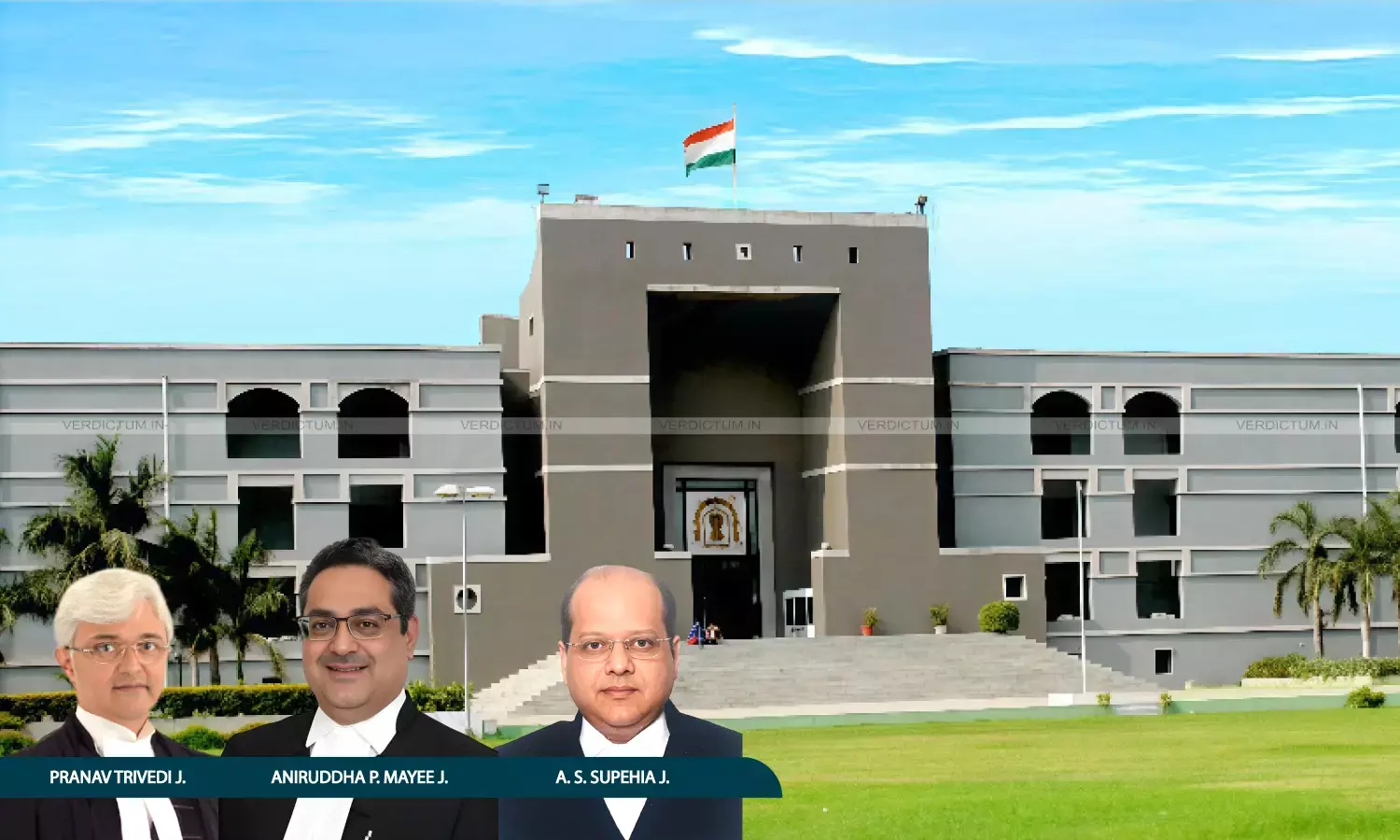
Justice Aniruddha P. Mayee, Justice Pranav Trivedi, Justice A. S. Supehia, Gujarat High Court
The Gujarat High Court has held that the Institute for Plasma Research (IPR) falls within the meaning of “State” under Article 12 of the Constitution. The High Court also overturned an earlier ruling which held that the Institute is not a State.
The High Court was considering the issue of whether the respondent Institute for Plasma Research can be said to be a ‘State’ within the meaning of Article 12 of the Constitution of India. This question of law emanated from the decision of the Division Bench judgment in the case of Himanshu Dineshchandra Parekh vs. Institute for Plasma Research and Ors (2025) wherein it was held that the Institute for Plasma Research (IPR) is not a “State” under Article 12 of the Constitution.
The Larger Bench of Justice Aniruddha P. Mayee, Justice Pranav Trivedi and Justice A. S. Supehia held, “The Division Bench, while referring to the aforesaid decision in Pradeep Kumar Biswas (supra), has not delved into the foregoing discussion and conclusions. Thus, from the established facets of the respondent-IPR and distinguishing features from the CSIR, we find that IPR falls within the meaning of “State” under Article 12 of the Constitution of India. The declaration of the Division Bench to the contrary in the case of Himanshu Dineshchandra Parekh (supra) is annulled. The reference stands answered accordingly.”
Reasoning
The Bench noted that the respondent-IPR is 100% funded by the DAE, Government of India, and the Institute is also an integral part of the DAE, Government of India. It was noticed that the vesting of properties is with the DAE, Government of India. The Bench noted that the creation of the Institute was undertaken by the Department of Science and Technology of the Central Government, and by Resolution dated October 30, 1996, published in the official gazette, the DAE acquired administrative control of the respondent-IPR and transferred the same from the Department of Science and Technology.
The Bench explained that an authority is deemed the State because "one who enjoys the powers or privileges of the State must also be subjected to the limitations and obligations of the State." “This strong statutory character and clear indicia of power (constitutional or statutory) and its potential to infringe the fundamental rights is what qualifies an entity as an 'authority,' although they may overlap with instrumentalities or agencies in certain factual scenarios”, it added.
On a perusal of the facts of the case, the Bench noted that the respondent-IPR is an entity created under a statute having its roots in the Atomic Energy Act, 1962. It is 100% funded by the Government. The inventions and patents by the respondent-IPR are subject to the restrictions of Section 20 of the Act and have liabilities and obligations to the public. The DAE has full control over the respondent-IPR and can issue directives as it deems necessary for the respondent-IPR to follow.
“Since the respondent IPR is established by the DAE, which is formed for the development, control, and use of atomic energy for the people of India, the IPR, in furtherance thereof, serves the public by advancing fusion energy, developing plasma technologies for industry, offering Ph.D. programs, and engaging in Research and Development for societal benefit. It also satisfies the test of being vested with the power to issue binding directions amounting to law under Article 13(2), governing rights, duties, and liabilities of individuals”, the Bench held.
“The respondent IPR also enjoys the powers and privileges of the State and is subject to its obligations. It follows the reservation policy of the Government, and pay revisions promulgated by the Government are applicable to its employees”, it added. The Bench, thus, concluded the matter by holding that IPR falls within the meaning of “State” under Article 12 of the Constitution.
Cause Title: Dr. Indranil Bandyopadhyay v. Institute for Plasma Research & Ors. (Case No.:R/Letters Patent Appeal No. 1148 of 2025)
Appearance
Appellant: Senior Advocate Asim Pandya, Advocate Alok M Thakkar
Respondent: Advocates Munjaal M Bhatt, Khushi Mehta, M R Bhatt & Co., Advocate Harsheel D Shukla