

A Slap Over Wife Staying At Paternal Home Without Informing Husband Not ‘Cruelty’: Gujarat High Court Acquits Husband In Wife’s Suicide Case
One incident of husband slapping the wife not sufficient; no cogent evidence of persistent cruelty or proximate cause established

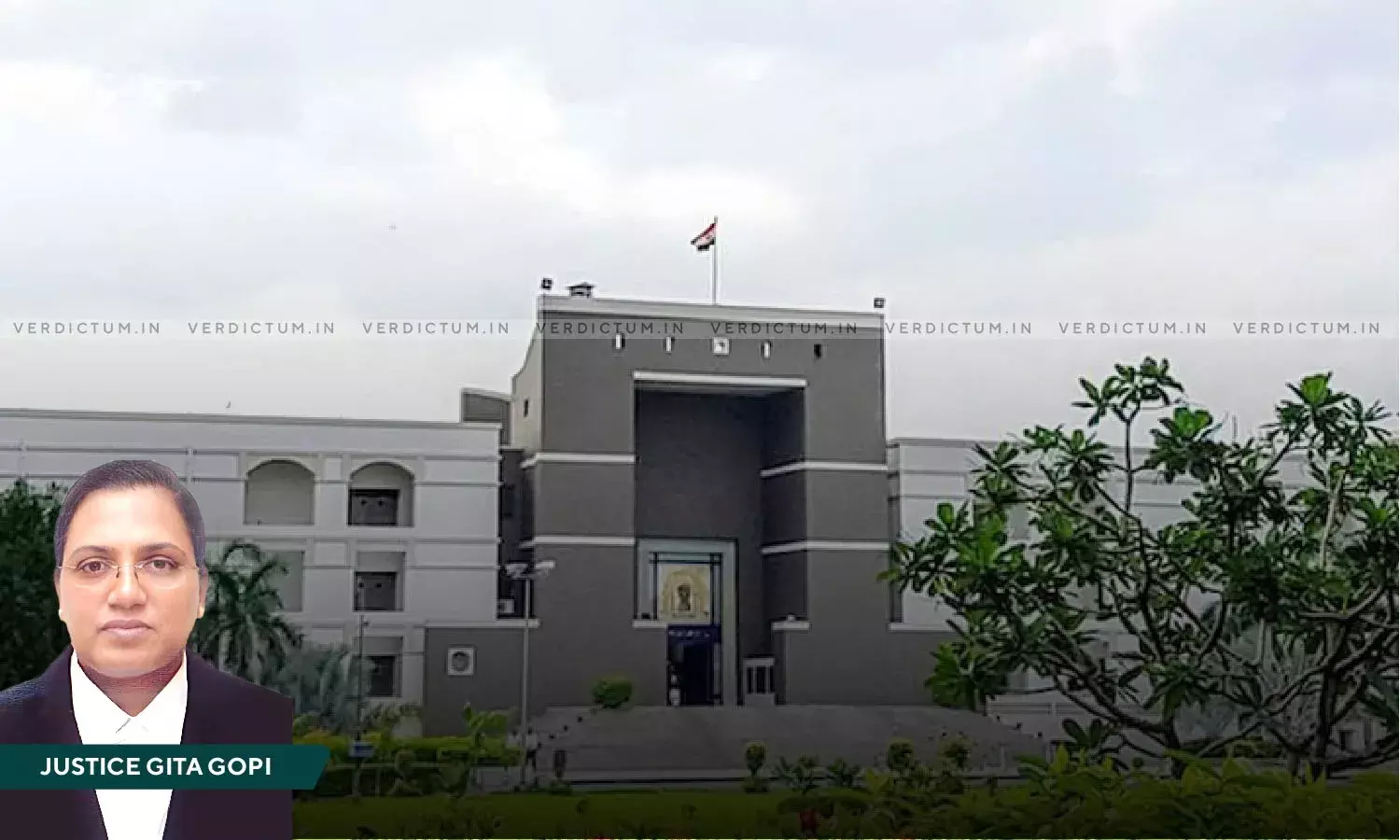
Justice Gita Gopi, Gujarat High Court
The Gujarat High Court has set aside the conviction of a husband under Sections 498A and 306 of the IPC, holding that a single incident of the husband slapping his wife on the issue of her staying at her parental home without informing him would not, by itself, constitute “cruelty” under Section 498A IPC.
The Court noted that all witnesses consistently stated that the primary source of dispute between the couple was the husband’s late-night return after playing the banjo, which the wife disliked. The Court observed that such quarrels, occurring after the husband returned home at night, were part of ordinary matrimonial discord and could not be elevated to the level of legal cruelty.
Justice Gita Gopi observed, “…One incident of husband slapping the wife on the ground of staying overnight at parental home without informing him would not be counted as cruelty. The proximate cause to suicide was not proved. And persistent, unbearable continuous beatings, would require cogent evidence to be considered as proved, for the same to be believed as cruelty that drove the daughter to commit suicide by hanging herself to death finding no other alternative. The witnesses failed to prove the case of cruelty and of abetment for the commission of suicide. The conclusion reached by the trial Court becomes erroneous. The conviction and sentence thus cannot sustain”.
“On overall analysis of the evidence, it appears that the quarrel was only on the ground as the husband was going out at night to play ‘banjo’ in marriage ceremonies and after returning late, there would be quarrel between the husband and wife. All the witnesses consistently stated that the deceased as a wife was not liking the accused returning late in the night after playing ‘banjo’. The quarrels were specifically stated to have occurred after accused returning back home at night, after his performance on the ‘banjo’”, the bench had observed.
Dhaval Vyas, Senior Counsel appeared for the appellant and Jyoti Bhatt, Additional Public Prosecutor appeared for the respondent.
As per the facts, the victim-wife died within a year of marriage in 1996, where the accused-husband had been convicted for subjecting her to cruelty and abetting her suicide. The prosecution alleged that the husband would frequently quarrel with his wife, return late at night after playing banjo at marriage functions, and had on one occasion slapped her for staying overnight at her parental home without informing him.
The husband was convicted by the trial court through an order dated 20-05-2003 under Section 498A of Indian Penal Code (IPC) with a sentence of one year rigorous imprisonment and fine of Rs.100/- and in case of default of fine, to further undergo 7 days simple imprisonment. The conviction was also under Section 306 of IPC with sentencing of the appellant-accused for 7 years rigorous imprisonment and a fine of Rs.500/- and in the event of default in payment of fine, to undergo further one month imprisonment.
However, the High Court reiterating settled principles on abetment of suicide, observed that mere harassment or marital disagreements are insufficient unless there is clear evidence of instigation, mens rea, or a direct act leading the deceased to commit suicide. In the absence of such evidence, the essential ingredients of Section 306 IPC were held to be unfulfilled.
Importantly, the Court emphasised that to attract criminal liability, the conduct must be of such gravity and continuity as is likely to drive a woman to commit suicide.
The Court further found that there was no cogent evidence on record to establish persistent or unbearable cruelty, nor was there any material to show a proximate link between the husband’s conduct and the wife’s decision to take her own life. Allegations of continuous beatings remained unsubstantiated, and no independent or medical evidence was produced to support claims of sustained physical abuse.
“The main dispute which appears from the testimony of father and mother between the accused and the deceased was that she was not liking the accused going out at night to play ‘banjo’. The dispute was about the accused returning late at night. The parents of the deceased had never complaint about beatings by the accused to accused parents. The dispute appears to be of each other’s possessiveness in their emotional ties. The mother stated that they had also gone for medical treatment since the husband was beating the wife, but no such documents have been placed on record. The father is not corroborating such a fact”, the Bench observed.
Therefore, after examining the facts and circumstances, the Court concluded that the prosecution had failed to prove its case beyond reasonable doubt, and holding the trial court’s findings to be erroneous, it set aside the conviction and sentence and acquitted the husband of all charges.
Cause Title: Dilipbhai Manglabhai Varli v. State Of Gujarat [Neutral Citation: 2026:GUJHC:10136]
Appearances:
Appellant: Dhaval Vyas, Senior Counsel, Yukta Pandey & DA Sankhesara, Advocates.
Respondent: Jyoti Bhatt, Additional Public Prosecutor.