

Intimation U/S 143(1) Income Tax Act Not Equivalent To Assessment Order For Purposes Of Reopening Assessment: Delhi High Court
The Court clarified that in cases where only a Section 143(1) intimation has been issued, the AO is not precluded from invoking reassessment proceedings.

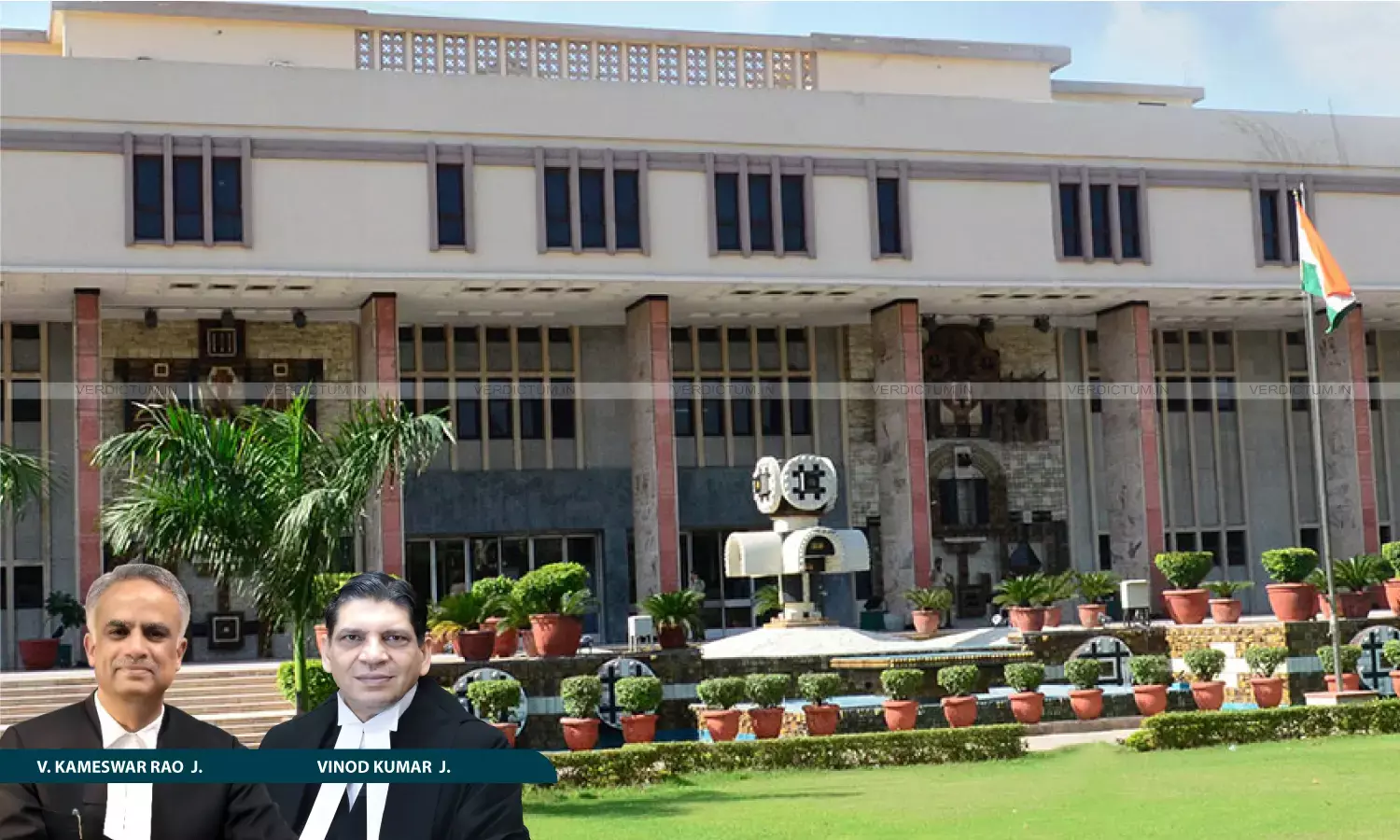
Justice V. Kameswar Rao, Justice Vinod Kumar, Delhi High Court
The Delhi High Court has affirmed that an intimation generated under Section 143(1) of the Income Tax Act, 1961 cannot be equated to a formal assessment order passed under Section 143(3), as the former does not involve the formation of an adjudicatory opinion by the Assessing Officer (AO). The Court, accordingly, upheld the validity of reassessment proceedings as affirmed by the ITAT, but set aside its conclusion on merits.
Recognising the fundamental conceptual distinction between these two provisions, the Court clarified that in cases where only a Section 143(1) intimation has been issued, the AO is not precluded from invoking reassessment proceedings. Consequently, the requirement of "change of opinion", which often bars the reopening of a case, does not apply, allowing the Revenue to reopen an assessment provided there is a tangible reason to believe that income has escaped assessment.
Justice V. Kameswar Rao and Justice Vinod Kumar while adjudicating appeals, challenging the order of the Income Tax Appellate Tribunal (ITAT), noted, “…The initiation of assessment under Section 143(1) of the Act cannot be treated to be an ‘assessment order’ where the AO has formed an opinion and passed an order. In view of the conceptual difference between Section 143(1) and Section 143(3) of the Act, when no order under the latter provision has been passed, the AO is not precluded from re-opening the assessment, provided he has reasons to believe income has escaped assessment. Thus, the ITAT has rightly reached this conclusion”.
Advocate Satyen Sethi appeared for the appellant and Abhishek Maratha, SSC appeared for the respondent.
The appellant company, incorporated in 1992 for manufacturing ecological brake-shoes, had raised funds through share capital and director loans for acquiring technical know-how, land, and machinery. Pending deployment, a portion of these funds was temporarily deposited in banks, yielding interest, which the assessee adjusted against pre-operative expenses.
The Assessing Officer reopened the assessments under Section 148 of the Income Tax Act, 1961, relying on Tuticorin Alkali to treat such interest as taxable income. While the Commissioner of Income Tax (Appeals) allowed the assessee’s claim, the ITAT reversed this finding, holding the interest taxable as 'income from other sources'.
On appeal, the High Court first upheld the validity of reassessment, observing that an intimation under Section 143(1) of the Act does not constitute an 'assessment', and therefore reopening could not be invalidated on the ground of change of opinion.
On noting that the facts in the present matter would be covered by the Supreme Court judgments in Tuticorin Alkali Chemicals & Fertilizers Ltd. v. CIT, (1997) 227 ITR 172 (SC) and CIT v. Bokaro Steel Ltd. 236 ITR 315 (SC), the Court held that the determinative test is whether the funds are “surplus” or intrinsically connected to project implementation. Where a direct nexus exists with the setting up of business, the Bench noted that the latter principle applies.
However, on merits, the Court found that the ITAT erred in treating the funds as surplus. It held that the deposits were integrally linked to meeting committed obligations such as payment for machinery, technical know-how, and project development. The temporary parking of funds did not alter their character.
While relying on Bokaro Steel and subsequent jurisprudence, the Court reiterated that where interest income arises from funds directly connected to project establishment, it assumes the character of a capital receipt and must be set off against pre-operative expenditure rather than taxed separately.
Accordingly, while answering the jurisdictional issue in favour of the Revenue, the Court held on the substantive issue in favour of the assessee, setting aside the ITAT’s order.
Cause Title: VNG Automotive Pvt. Ltd. v. Assistant Commissioner of Income Tax (Neutral Citation: 2026:DHC:2975-DB)
Appearances:
Appellant: Satyen Sethi and Arta Trana Panda, Advocates.
Respondent: Abhishek Maratha, SSC, Apoorv Aggarwal, Parth Samwal, JSCs, Nupur Sharma, Gaurav Singh, Bhanukaran Singh Jodha, Muskan Goel, Himanshu Goel and Nischay Purohit, Advocates.