

Long Trial Must Have Wisened & Tired Him: Delhi High Court Converts Husband’s Conviction U/S 304-B to 306 IPC, Ends Further Imprisonment
Court in categorically observations, notes that suicide arises when compelling circumstances overpower the instinct to survive.

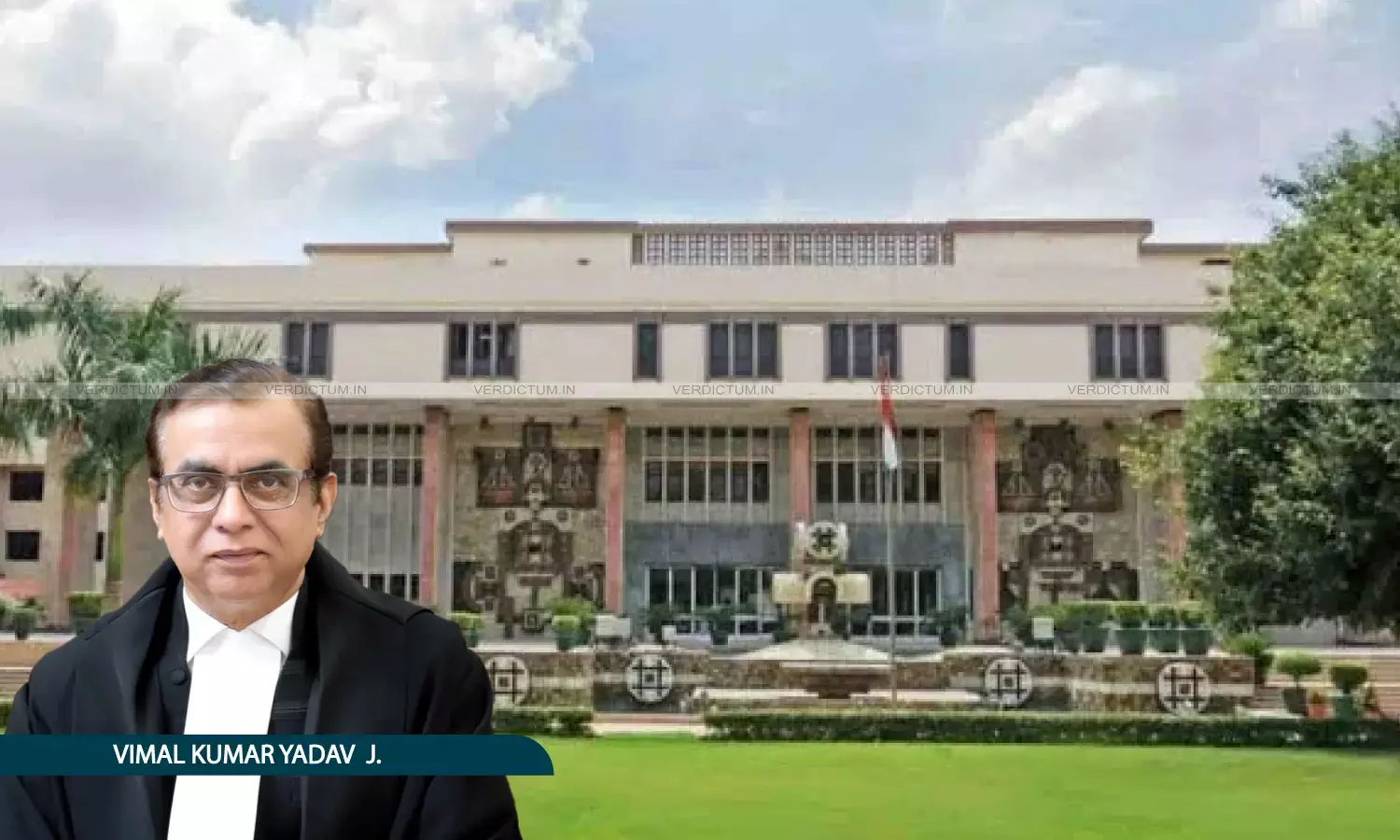
The Delhi High Court has modified the conviction of a husband by converting the offence from Section 304-B IPC (dowry death) to Section 306 IPC (abetment of suicide), while maintaining his conviction under Section 498-A IPC, and limited the sentence to the period already undergone after over two decades of trial. The Bench considering the age, and the long trial remarked that the appellant-husband is ‘heading towards the evening of his life’, and ‘the long drawn criminal trial and proceedings, must have not only wisened him but tired him out too’.
Opening with a broader observation on human nature, the Court noted that all living beings instinctively cling to life, driven by a survival mechanism that triggers resistance even in the face of grave danger. However, it observed that suicide represents a tragic departure from this instinct, one that occurs only when circumstances become so overwhelming that they eclipse the will to live.
Justice Vimal Kumar Yadav observed, “…In the fitness of circumstances, the sentence needs to be modified, inasmuch as the punishment is to be considered for a different offence now. Additionally, the kids of the Appellant, who were 03 and 06 years in the year 2002, would now be 27 and 30 years of age having their families and relatives. The fallout of the punishment would not be confined to the Appellant alone. The Appellant is heading towards the evening of his life. The long drawn criminal trial and proceedings thereafter, must have not only wisened him but tired him out too. And when he has spent nearly 04 years in custody at the pre-trial and post conviction stage put together, then it seems further incarceration would not be appropriate, positive and productive, and would not serve any purpose. As such, considering the otherwise clean antecedents; it seems that the period of custody already undergone by the Appellant would be sufficient to meet the ends of justice; ordered accordingly”.
On suicide, the Bench noted, “If someone commits suicide then there are bound to be very compelling circumstances, where the suicidal tendencies overtake the survival instinct and the result is death. The circumstances cannot be put in a particular frame; it varies from person to person, situation to situation society to society, region to region and nation to nation. An oversensitive person needs a small trigger to end his life. Whereas another one would survive and fight back in those very circumstances or even worse. Nevertheless, there are bound to be reasons and compelling one, which drive a person to end his life and even normally strong persons finding no ray of hope, no way-out, no options and resultant no will to survive, may at times resort to suicide”.
Advocate Aashaa Tiwari appeared for the appellant and Advocate Kiran Bairwa appeared for the respondent.
The case arose from the death of the second wife of the appellant-husband on July 4, 1999, within a few years of her marriage (solemnised in 1996), under unnatural circumstances. The prosecution alleged that she was subjected to persistent harassment over dowry demand.
On the intervening night of July 03–04, 1999, the woman fell critically ill after consuming tea suspected to be laced with poison. She was taken to a local doctor and thereafter to multiple hospitals, where she succumbed.
Following the incident, an FIR was registered and the trial court, by judgment dated December 19, 2002, convicted the husband under Sections 498-A and 304-B IPC, sentencing him to rigorous imprisonment.
Considering the facts and the life of the accused, the Bench in the judgment remarked, "...the Appellant herein was unlucky for second time also in his matrimonial alliances inasmuch as the second wife died prematurely under unusual/unnatural circumstances, whereas the first had already left this mortal world due to Tuberculosis...".
Upon reappreciation of evidence, the Court found that while cruelty and dowry-related harassment were clearly established through the testimonies of the victim’s family, there was no conclusive proof that the accused had administered poison or directly caused her death.
The Court also disbelieved the alleged dying declaration made to the victim’s brother, noting inconsistencies and medical evidence indicating that the deceased was not in a condition to make any statement.
The opening paragraph of the judgment read, “Humans rather all living beings immensely value and cling to the life in such a manner that nothing else is more important. Humans and animals behave, more or less, alike when existence itself is in jeopardy. All out effort is put in to survive, so much so that survival instinct triggers “fight or flight mode”. And if driven to the wall, then even a deer turns back and resist, if not attack, on a predator, from whom the deer invariably tries to escape”.
“The life which is so precious would be taken away by one’s own self and commit suicide. Suicide seems to be civilized world’s problem as in the Tribal societies it was kind of unheard. However, it has entered in the Tribal societies with the entry of civilized world. Strength of the Tribal or so called uncivilised societies i.e. strong, social and familial ties is being taken over by the stress, strains, tensions, etc. giving foothold to suicides there too”, the Bench observed further.
Finding a “grey area” as to whether the poison was self-administered or introduced by someone else, the Court held that the essential ingredients of Section 304-B IPC were not satisfied. However, it observed that the continued harassment and financial pressure created circumstances that could have driven the deceased to take her own life.
Accordingly, the conviction under Section 304-B IPC was set aside and altered to Section 306 IPC, while the conviction under Section 498-A IPC was upheld.
Cause Title: Veer Pal v. State N.C.T. Of Delhi [Neutral Citation: 2026:DHC:2149]
Appearances:
Appellant: Aashaa Tiwari, alongwith Puneet Narula, Advocates.
Respondent: Kiran Bairwa, APP for State with SI Preeti, PS SP Badli.