

A&C Act| Appeal U/S 50 Maintainable Where Court Refuses Enforcement Of Foreign Arbitration Award U/S 48: Delhi High Court
The High Court clarified that Section 50 of the Arbitration and Conciliation Act constitutes a self-contained appellate mechanism, permitting appeals only where a court has refused enforcement of a foreign award under Section 48.
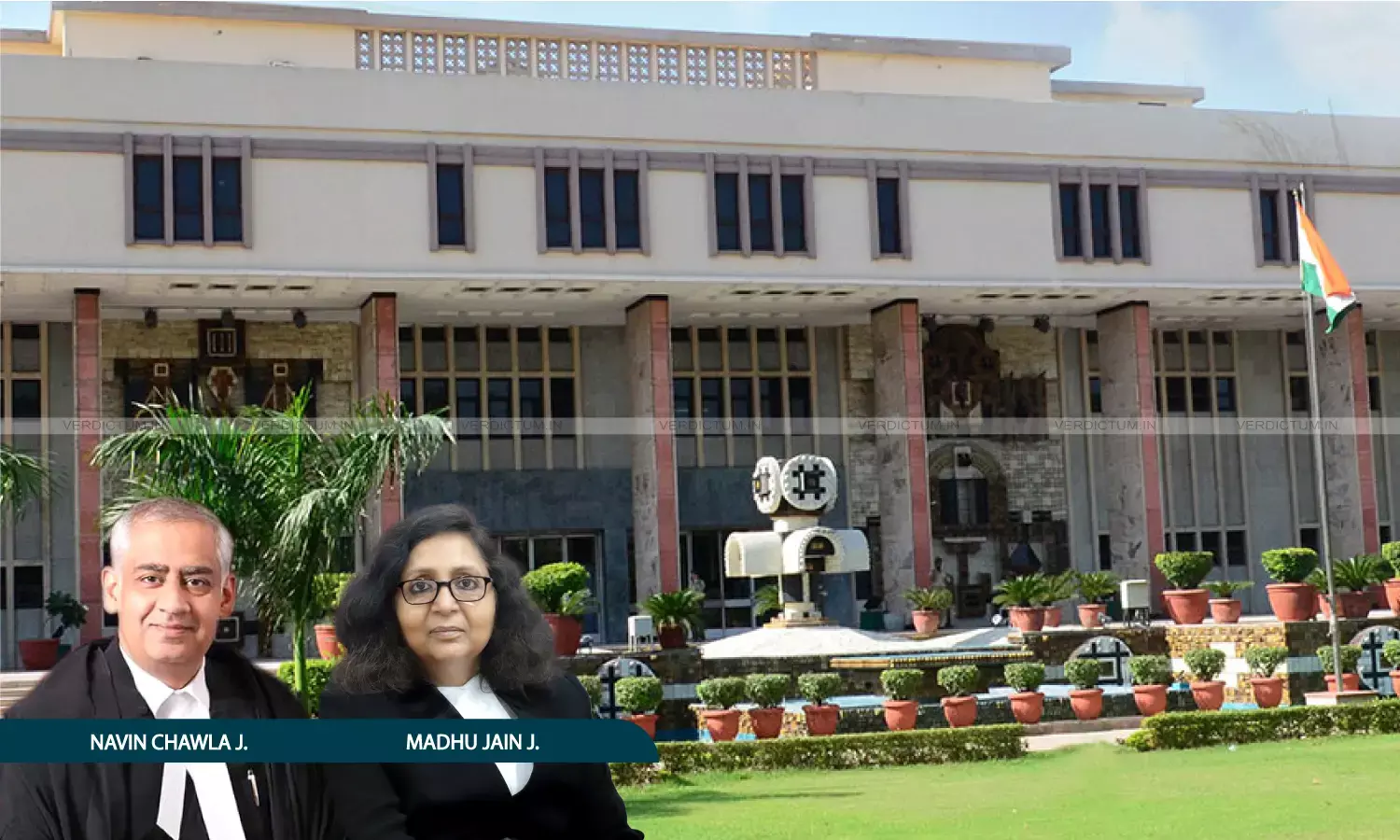
Justice Navin Chawla, Justice Madhu Jain, Delhi High Court
The Delhi High Court has held that an appeal under Section 50(1)(b) of the Arbitration and Conciliation Act, 1996, lies only from an order refusing enforcement of a foreign arbitral award under Section 48 of the Act.
The Court was hearing an appeal filed by the Union of India challenging an order of a Single Judge which had dismissed the Union’s execution petition seeking enforcement of a foreign arbitral award arising out of Production Sharing Contracts relating to the Tapti and Panna Mukta oil and gas fields.
A Bench comprising Justice Navin Chawla and Justice Madhu Jain emphasised the statutory structure governing the enforcement of foreign awards and observed that “in terms of Section 50(1)(b) of the A&C Act, an appeal shall lie only from an order refusing to enforce of a Foreign Award under Section 48 of the A&C Act.”
R Venkataramani, Attorney General of India, represented the appellants, while Senior Advocate Harish Salve represented the respondents.
Background
The dispute arose from a foreign arbitral award connected to the Tapti–Panna Mukta offshore oil and gas fields. The Union of India sought enforcement of the award before the High Court. The learned Single Judge declined enforcement, leading to the present appeal.
Reliance Industries Limited objected to the maintainability of the appeal, arguing that the impugned order did not fall within the limited grounds under Section 48 and therefore did not attract the appellate provision under Section 50. According to the respondents, the refusal was based on issues outside the statutory refusal framework and hence not appealable.
The Union contended that once enforcement was declined, the order necessarily operated as a refusal under Section 48, bringing the appeal squarely within Section 50.
Court’s Observation
The Court undertook a structured reading of Chapter I of Part II of the Arbitration and Conciliation Act, describing it as a complete code for the enforcement of New York Convention awards. It noted that Section 46 recognises the binding character of foreign awards, Section 47 prescribes evidentiary requirements, Section 48 enumerates exhaustive grounds for refusal, and Section 49 confers decree status upon enforceable awards.
Against this backdrop, Section 50 was interpreted as a narrowly tailored appellate provision. The Bench reiterated that the statute expressly limits appeals to specified situations, reflecting legislative intent to avoid expansive appellate intervention.
Relying on precedent and statutory construction, the Court observed that Section 50 is a self-contained appellate mechanism. It excludes appeals not expressly provided. The Bench underscored that the provision must be read in its natural meaning without importing external remedies.
The Court stated that permitting objections to maintainability based on how parties characterise the grounds of refusal would undermine the statutory structure. It observed: “These grounds cannot be urged to contend that the appeal itself will not be maintainable… the challenge to an order refusing to enforce the Foreign Award will get highly restricted. The same cannot be the intent of the legislature.”
The Bench clarified that Section 48 confers limited power on enforcement courts to refuse awards only on enumerated grounds. Even where the refusal is articulated through broader reasoning, its operative effect must be examined. If enforcement is declined, the order attracts Section 50.
The Court emphasised that appellate scrutiny concerns the substance of the order rather than formal labelling. A refusal to enforce, whether framed as maintainability or enforceability, engages Section 48 and therefore triggers the appellate right.
Further, while restating the principles of statutory interpretation, the Bench highlighted that “it is the cardinal principle of statutory interpretation that the words of the legislature must be constructed in their natural meaning, without adding or subtracting therefrom… Therefore, the present appeal is maintainable.”
The Court rejected the argument that the appellant must concede the correctness of Section 48 reasoning before invoking Section 50, describing such a position as contrary to legislative intent.
Conclusion
The Delhi High Court held that Section 50(1)(b) permits an appeal only from an order refusing enforcement of a foreign award under Section 48, and that the impugned order in the Tapti–Panna Mukta dispute operates as such a refusal.
Consequently, the Union of India’s appeal was held to be maintainable. The Court clarified that challenges to the merits of refusal are matters for appellate determination and cannot be used to defeat the statutory right of appeal itself.
Cause Title: The Union of India v. Reliance Industries Limited & Anr. (Neutral Citation: 2026:DHC:807-DB)
Appearances
Appellant: R. Venkataramani, Attorney General of India, Senior Advocate Sanjay Jain, with Advocates Shravan Yammanur, Mangesh Krishna, Prachi Kaushik, Harshita Sukhija.
Respondents: Senior Advocates Harish Salve and Shyel Trehan, with Advocates Sameer Parekh, Sonali Basu Parekh, Ishan Nagar, Abhishek Thakral, and Ruchi Krishna Chauhan.
Click here to read/download Judgment
