

Mere Financial Pressure Does Not Invalidate ‘Full & Final’ Settlement As Accord & Satisfaction Remains Binding: Delhi High Court
Court holds that execution of unconditional discharge vouchers cannot be invalidated merely due to financial distress unless coercion, fraud, or undue influence by the opposite party is established.

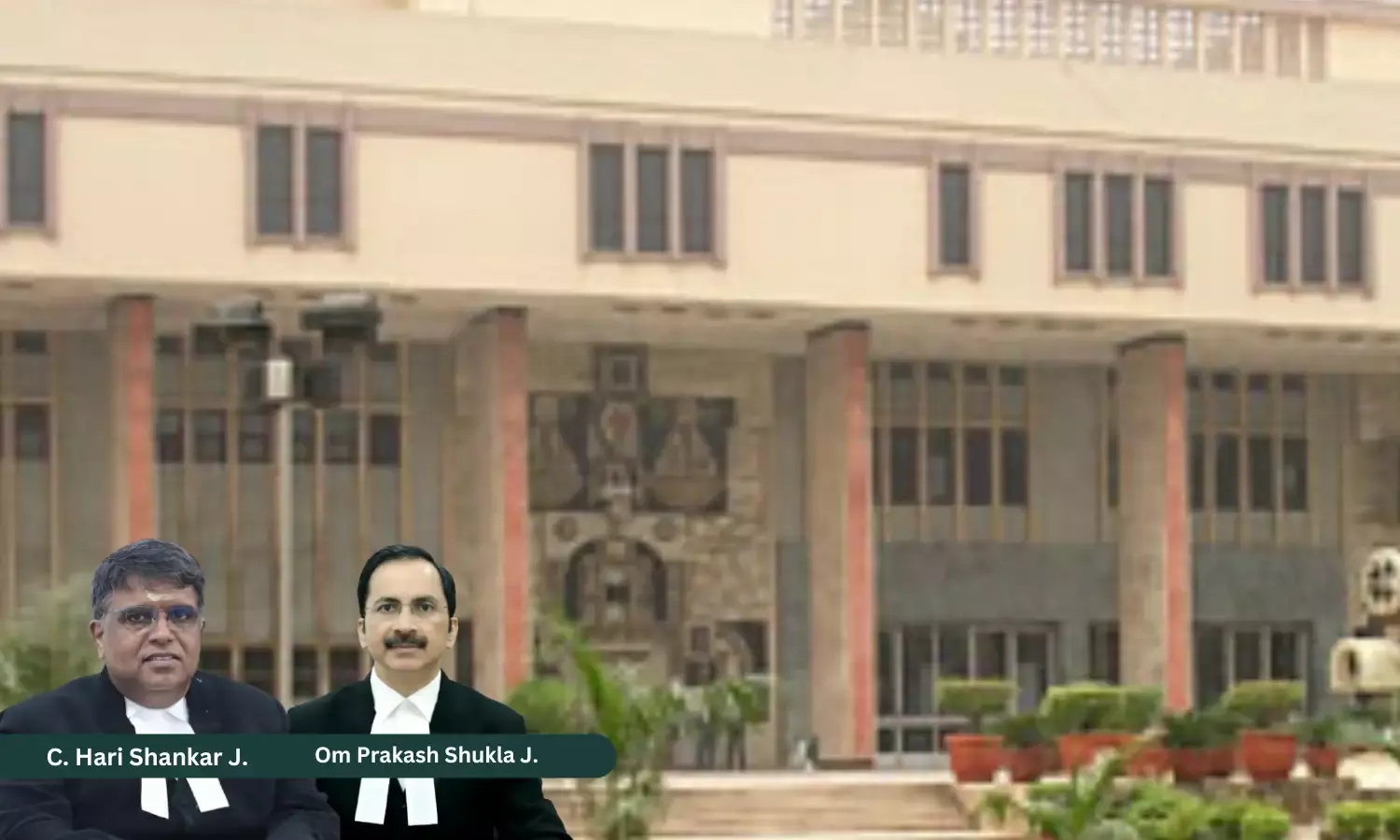
Justice C. Hari Shankar, Justice Om Prakash Shukla, Delhi High Court
The Delhi High Court has held that financial distress faced by a claimant does not, by itself, invalidate an unconditional “full and final” discharge voucher. The Court emphasised that the parties will be bound by the doctrine of accord and satisfaction and it cannot be diluted merely on account of economic hardship.
The Division Bench noted that the decision to sign an unconditional discharge voucher ultimately lies with the signatory. Therefore, it observed that merely being under financial strain does not automatically establish coercion, fraud, or undue influence.
Justice C. Hari Shankar and Justice Om Prakash Shukla observed, “It has to be borne in mind that the decision to sign an unconditional no claim discharge voucher is ultimately of the signatory. The mere fact that the signatory may feel financial pressure, and therefore decide to sign the discharge voucher, would not ipso facto render the voucher unenforceable on the ground of fraud, coercion, undue influence, or even compulsion. Absent any contribution to the financial distress, even remote, by the opposite party, the compulsion and duress, if any, arises out of the claimant’s own subjective decision, and the claimant cannot be permitted to take advantage thereof, to the prejudice of the opposite party. The principle of accord and satisfaction, which is a hallowed principle of contract jurisprudence, cannot be consigned to oblivion”.
Senior Advocate Sudhir Nandrajog appeared for the appellant and Advocate Saurav Agrawal appeared for the respondent.
The appellant company, in the matter, sought to reopen its insurance claim despite having executed discharge vouchers accepting a reduced amount as full settlement. The company argued that it had signed the vouchers under severe financial pressure following a devastating fire and mounting liabilities.
The Bench, therefore, relying on settled principles, noted, “An analysis of the afore-noted case law indicates that in almost every case, the test that has been applied by the Supreme Court is whether the discharge voucher was vitiated by fraud, coercion or undue influence. Where there was no sustainable material to indicate the existence of these elements, the Supreme Court has upheld the decision not to refer the dispute to arbitration. We have neither been shown nor have we come across, any decision in which absent at least any insistence by the insurer, an unconditional discharge voucher has been held not to discharge the claim by accord and satisfaction merely on the ground that the insurer was in financially distressed circumstances”.
The Court further noted that the appellant had multiple opportunities to raise objections or reserve its rights while accepting the payment but failed to do so. Instead, it executed not one but two discharge vouchers, including one countersigned by its banker, clearly indicating acceptance of the settlement without protest.
On the scope of interference under Section 34 of the Arbitration and Conciliation Act, 1996, the Bench noted, “Courts apply the law. The law is, therefore, distinct from its application. If, therefore, the arbitrator has understood the law correctly, but errs in applying it to the facts before him, that would not constitute a ground of challenge. However, if the arbitrator has misunderstood the law, in that he proceeds on a fundamentally incorrect legal principle, the award would be rendered vulnerable to interference… if the arbitrator has fundamentally erred in applying the law, as would amount to ‘patent illegality’, the Court must step in. The line is thin, but Courts are expected to possess the intellectual wherewithal to discern it, and walk the right side”.
Cause Title: Supermint Exports Pvt Ltd V. New India Assurance Co Ltd. & Ors. [Neutral Citation: 2026:DHC:2146-DB]
Appearances:
Appellant: Sudhir Nandrajog, Sr. Adv., Bhaskar Tiwari, Ramakant Shukla, Priscilla Kom, Advocates.
Respondent: Saurav Agrawal, Rajat Dasgupta, Sidhika Dwivedi, Anadi Mishra, Raadhika Chawla and Tushar Nair, Advocates.