

Delhi High Court: Mere Oral Assertions Of ‘Join Funds’ Unsupported By Contemporaneous Documentary Records Can’t Displace Registered Title Documents
The Delhi High Court reiterated that even if there is an existence of JHF (Joint Hindu Family), it does not ipso facto render all the properties as joint family properties.
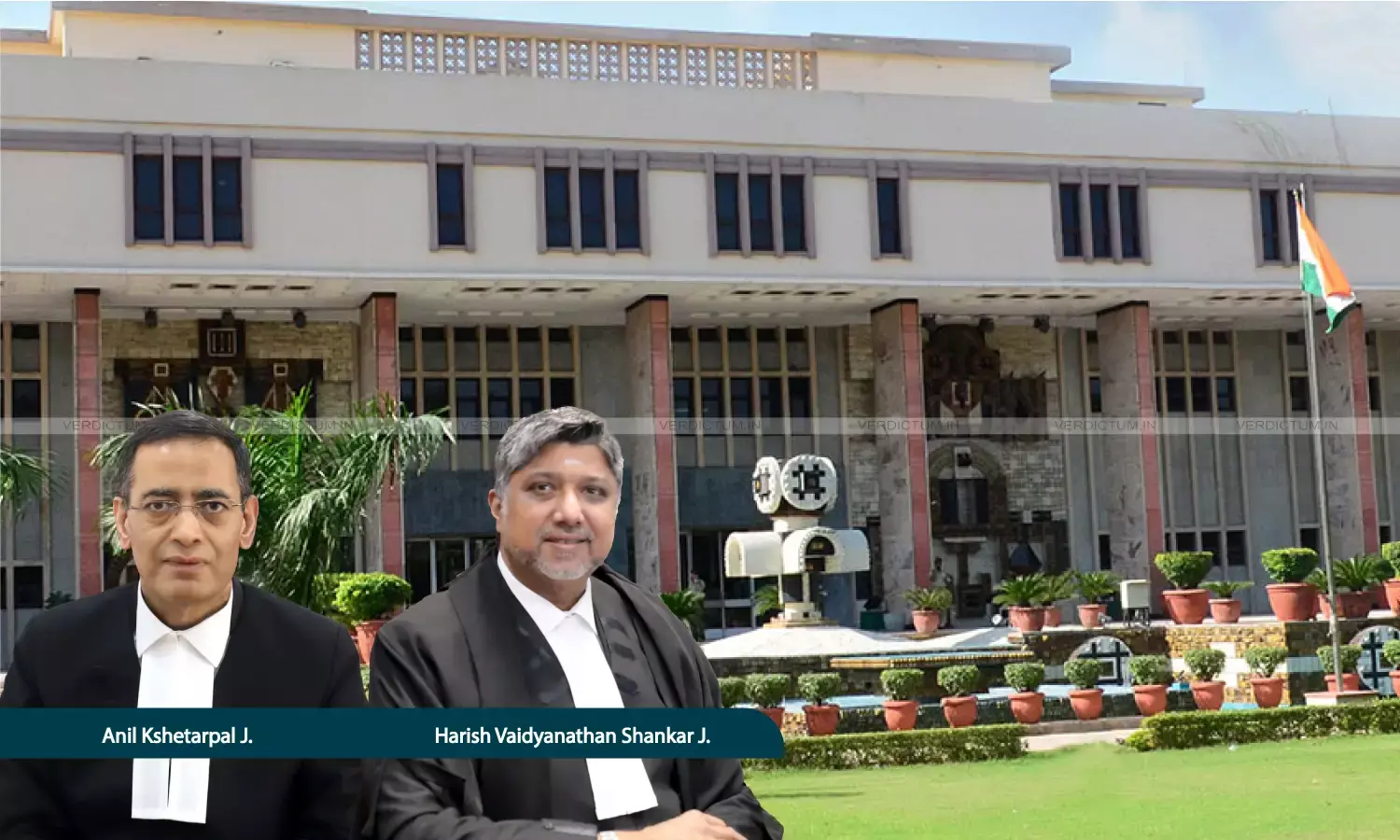
Justice Anil Kshetarpal, Justice Harish Vaidyanathan Shankar, Delhi High Court
The Delhi High Court held that mere oral assertions of ‘joint funds’, unsupported by contemporaneous documentary records, cannot displace registered title documents.
The Court was hearing a batch of Appeals challenging the Judgment of the Single Judge in a Suit.
A Division Bench of Justice Anil Kshetarpal and Justice Harish Vaidyanathan Shankar observed, “Even the passbook relied upon by the Defendant does not reflect any payment towards the auction consideration or construction costs. Mere oral assertions of “joint funds”, unsupported by contemporaneous documentary records, cannot displace registered title documents. … The mere existence of a JHF does not necessarily lead to existence of a JHF property. Once the existence of a JHF is not established, the presumption of a Joint Hindu Family Property does not arise.”
The Bench reiterated that even if there is an existence of JHF (Joint Hindu Family), it does not ipso facto render all the properties as joint family properties.
Senior Advocate Anil Sapra appeared for the Appellants, while Senior Advocate Ashish Mohan appeared for the Respondents.
Case Background
The Plaintiff’s suit was decreed by the Single Judge against the Defendants, directing them to handover the possession of the entire first floor and two rooms along with one bathroom on the second floor of the property within two months. The Counter Claim filed by the Defendant was dismissed. The Plaintiff was the registered owner of the said property, which was originally leased from the Municipal Corporation of Delhi (MCD) pursuant to a perpetual lease. The Plaintiff thereafter constructed a three-storey building on the said plot from his own funds and resources. The said property was subsequently converted into free-hold in favour of the Plaintiff vide a conveyance deed.
The Defendant, elder brother of the Plaintiff, was allowed to use and occupy the first floor, and two rooms along with one bathroom on the second floor of the property, purely out of natural love and affection. No consideration was ever charged from the Defendant for such use or occupation. As per the Plaintiff, the oral licence granted in favour of the Defendant was revoked in September 2006. Upon revocation, the Defendant sought 15 days’ time to shift, remove his belongings, and hand over the physical possession of the premises. However, despite such assurance, the Defendant failed to vacate the property. Hence, the suit was instituted by the Plaintiff.
Court’s Observations
The High Court after hearing the contentions of the counsel, noted, “… the claimant must establish that the property in question was acquired with the aid of the joint family funds, particularly by demonstrating the existence of a sufficient nucleus capable of supporting such acquisitions. It reinforces the importance of substantiating claims, regarding the nature of property within joint Hindu families. It is clear that without concrete evidence of a joint family nucleus, any presumption of a property as joint family-owned is legally impermissible.”
The Court reiterated that although a family settlement may be oral, its existence must be proved by cogent, reliable and convincing evidence demonstrating not only consensus ad idem but also acceptance and implementation by the parties.
“The Defendants, however, have failed on all counts. Moreover, the long and uninterrupted conduct of the parties, coupled with the absence of any mutation, change in possession, or assertion of rights in consonance with the alleged settlement, clearly negates the plea raised. An unsubstantiated oral family settlement cannot be permitted to defeat or override duly executed and subsisting title documents. Accordingly, the plea of family settlement remains a mere bald assertion, unsupported by evidence, and having remained unsubstantiated, was rightly rejected by the LSJ”, it added.
The Court remarked that the assertion that the ground floor was constructed from joint funds, whereas the first and second floors were allegedly constructed exclusively by the Defendants, is wholly unsupported by cogent and credible evidence.
“It is trite law that the burden of proving financial contribution towards construction squarely lies upon the party asserting such a claim. Mere assertions, uncorroborated by documentary evidence, do not discharge this burden. Conversely, the sanctioned building plans, electricity and water connections, as well as the municipal records, stand exclusively in the name of the Plaintiff, thereby clearly indicating both ownership and control over the property”, it said.
The Court observed that mere occupation, supervision of construction, or participation in management does not, in law, confer any proprietary or ownership rights in immovable property.
“In the absence of proof of title or demonstrable financial contribution leading to the creation of an enforceable interest, the Defendants‟ claim is legally untenable. The LSJ, therefore, rightly rejected the said plea, holding that possession or supervision, without more, cannot be elevated to a claim of ownership”, it held.
The Court was of the view that once the conveyance deed stands duly executed and registered solely in the name of the Plaintiff, a strong presumption of legality, title and exclusive financial contribution, arises in favour of the Plaintiff and mere denial or speculative assertions are insufficient to discharge such onus, particularly, in the absence of documentary evidence.
“Thus, the Defendants plea remains unsupported and legally untenable. … It is well settled that in the absence of material pleadings in the written statement, a plea of either an oral family settlement or of the case falling within the exception to Section 4 of the Benami Act is not legally tenable. Mere incantation of the words “trustee” or “fiduciary” cannot, by itself, attract the statutory exception. Notably, despite examining as many as twenty witnesses, the Defendants failed to elicit any credible evidence to substantiate the alleged family settlement, which forms the very bedrock of their defence. The entire defence, therefore, rests on conjecture and unsubstantiated assertions”, it added.
The Court further said that the Plaintiff cannot, by any stretch of imagination, be said to have been standing in a fiduciary capacity vis a-vis the Defendant, nor can the Plaintiff be construed as a trustee and even assuming such a plea is raised, the same is required to be established through specific and unambiguous pleadings and proof, both of which are conspicuously absent.
“However, the bar/prohibition under the Benami Act, cannot be circumvented merely by paying lip service to the concept of fiduciary capacity, as such an approach would defeat the very object and legislative intent of the statute. Permitting such defences, on the basis of bald and unsubstantiated pleas would amount to allowing statutory prohibitions to be rendered illusory, thereby subjecting the ostensible owner to prolonged and vexatious litigation at the instance of a person claiming to be the so called “real owner”. Such an outcome would not only undermine the sanctity of registered title but would also run counter to the express mandate of section 4 of the Benami Act”, it also noted.
Furthermore, the Court observed that in the absence of any foundational proof, the plea of adverse possession is legally untenable.
“The Defendant was a licensee, and he must be deemed to be always a licensee. It is not open to him, during the subsistence of the license or in the suit for recovery of possession of the property instituted after the revocation of the license to set up a title to the property in himself or anyone else”, it remarked.
Conclusion
The Court emphasised that the licensee’s obligation is to surrender possession upon termination of the license and, if so advised, to pursue any independent remedy for declaration of title through appropriate proceedings.
“In the present case, despite termination of the license though notice issued [Ex. PW1/15], and institution of the suit, the Defendants failed to surrender possession of the Suit property. The Plaintiff, therefore, became entitled, as a matter of law, to recover possession”, it held.
The Court elucidated that once the Defendants were held to be unauthorised occupants post revocation of licence, the liability to pay mesne profits followed as a necessary legal consequence.
“The defence set up by the Defendants is founded on conjectures, afterthoughts, and unsubstantiated allegations. In sharp contrast, the Plaintiff has established his case through registered title documents, statutory and municipal records, and consistent oral and documentary evidence”, it concluded.
Accordingly, the High Court dismissed the Appeals and upheld the impugned Judgment.
Cause Title- Sandeep Sethi & Anr. v. Rajinder Kumar Sethi deceased through LRs (Neutral Citation: 2026:DHC:152-DB)
Appearance:
Appellants: Senior Advocate Anil Sapra, Advocates Amrit Pal S. Gambhir, and Dalip Mehra.
Respondents: Senior Advocate Ashish Mohan and Advocate Manisha Singh.
