

Delhi High Court Sets Aside Patent Refusal Order, Remands Matter For Fresh Consideration Of Inventive Step
The High Court found that once clarity objections under Sections 10(4)(c) and 10(5) of the Patents Act were unsustainable, the objection under Section 2(1)(ja) required a fresh and reasoned analysis after granting the applicant an opportunity of hearing.
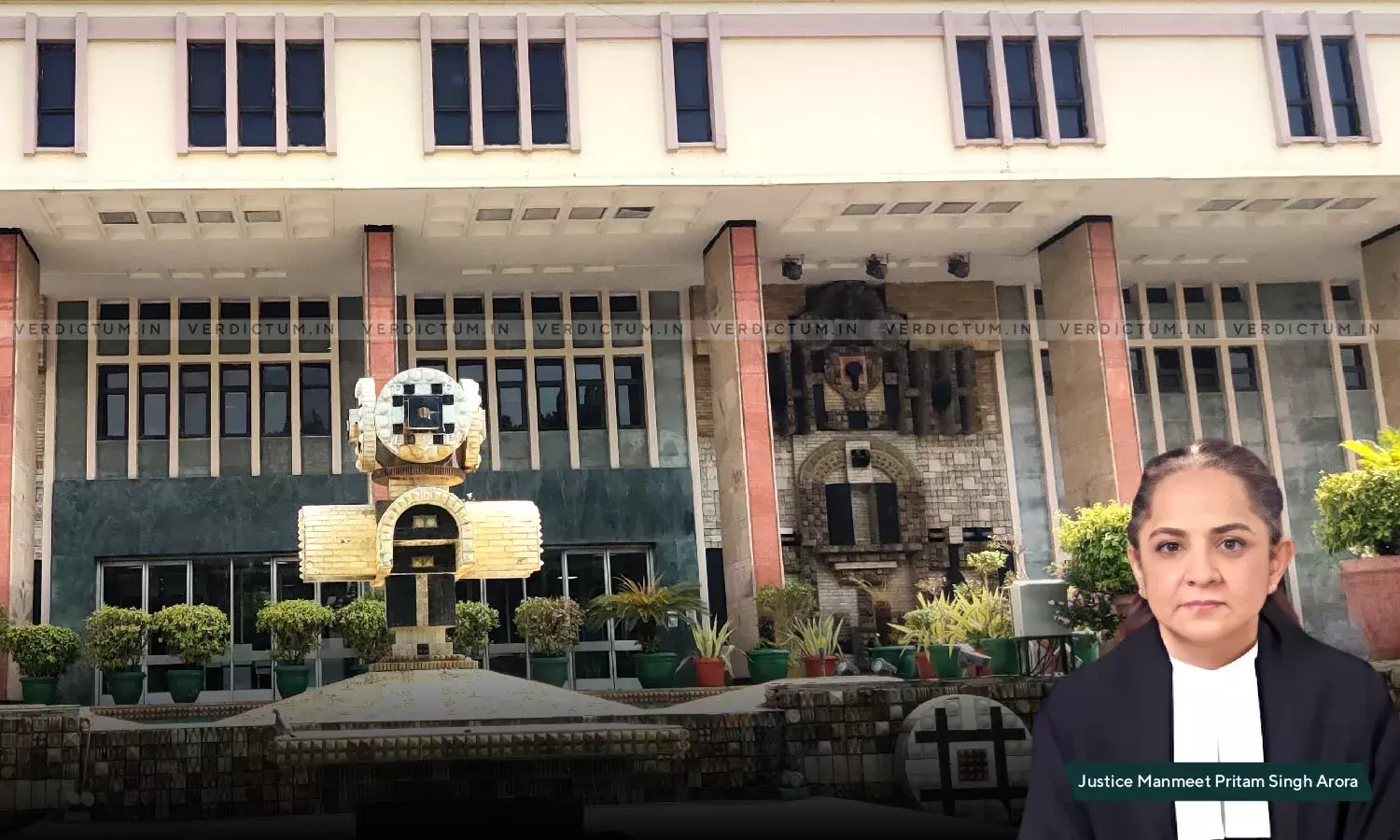
Justice Manmeet Pritam Singh Arora, Delhi High Court
The Delhi High Court has set aside an order passed by the Assistant Controller of Patents and Designs refusing a patent application, holding that the matter required fresh consideration on the question of inventive step under the Patents Act, 1970.
The Court found that the Controller’s conclusion that the claimed invention lacked inventive step was premised on findings which were themselves unsustainable, and that the impugned order suffered from a lack of reasoning and internal inconsistency.
The Court was hearing an appeal under Section 117A of the Patents Act challenging the refusal of a patent application relating to a device for folding or bending an article.
A Bench of Justice Manmeet Pritam Singh Arora, examined the validity of the refusal order passed under Section 15 of the Patents Act, held: “The unreasoned finding of the Controller that the features of the Claim 1 lacks any technical advancement in comparison with the prior arts D1 and D2 under Section 2(1)(ja) of the Patents Act also stands no merit and requires fresh analysis according to a five [5]-step test set out to determine the obviousness or lack of inventive step by the Division Bench of this Court in F. Hoffmann-La Roche Ltd. v. Cipla Ltd., which has also been recently reaffirmed by the Division Bench of this Court in Tapas Chatterjee v. Controller of Patents & Designs.”
Advocate Rajeshwari H. represented the petitioner, while Kangan Roda, SPC, represented the respondents.
Background
The appellant was the inventor and applicant of a domestic patent application filed in March 2020, which came to be refused by the Assistant Controller by an order dated 23 February 2023 under Section 15 of the Patents Act.
While the objection on lack of novelty raised in the First Examination Report had been withdrawn, objections relating to lack of clarity under Sections 10(4)(c) and 10(5), and lack of inventive step under Section 2(1)(ja), were reiterated at the hearing stage. The Controller ultimately refused the application holding that the claims were unclear, insufficiently defined, and did not disclose any technical advancement over the prior art.
A review petition filed by the appellant was dismissed on the ground of limitation, following which the present appeal was preferred before the High Court.
Court’s Observation
The Court first examined whether the claims of the subject patent application satisfied the requirements of Sections 10(4)(c) and 10(5) of the Patents Act. It noted that while the independent claim referred to an “input conveyor mechanism” and an “output mechanism”, these features were elaborately defined in the dependent claims and further clarified through the detailed description and drawings forming part of the complete specification.
Relying upon precedents of the Court, the High Court observed that claims cannot be read in isolation and that dependent claims and the complete specification must be considered together to determine whether the scope of the invention is sufficiently defined. Upon such reading, the Court held that the technical features objected to by the Controller were adequately explained and identifiable, and therefore the rejection under Sections 10(4)(c) and 10(5) could not be sustained.
Turning to the objection under Section 2(1)(ja), the Court found that while the Controller had asserted that the technical features of the invention were unclear, the same order went on to conclude that those very features lacked technical advancement over the prior art. The Court held that if the scope of the invention was allegedly indeterminate, it was unclear how a comparative assessment with prior art had been undertaken.
The Court observed that the finding of lack of inventive step was unreasoned, abrupt, and contradictory, and could not stand once the clarity objections were found to be untenable. It further noted that the Controller had failed to apply the settled tests for assessing inventive step and that the objection under Section 2(1)(ja) required a fresh evaluation in accordance with the law.
Conclusion
In view of the above findings, the Delhi High Court set aside the impugned order refusing the patent application and remanded the matter to the Patent Office for de novo consideration of the objection under Section 2(1)(ja) of the Patents Act.
The Court directed that the appellant be afforded a fresh opportunity of hearing and that any new material relied upon by the Patent Office be specifically put to the appellant through a hearing notice. It also permitted the appellant to file an amended set of claims and fresh written submissions.
With these directions, the appeal and the pending applications were disposed of.
Cause Title: Resham Priyadarshini v. Assistant Controller of Patents And Designs (Neutral Citation: 2025:DHC:12035)
Appearances
Appellant: Rajeshwari H., Garima Joshi and Swami Chothe, Advocates
Respondent: Kangan Roda, SPC with Tanishq Sharma, Advocate
