

Cut-Off Date In Middle Of Financial Year Deprives Them Of Rights Under Article 16: Delhi High Court Allows Pleas Of OBC Candidates
The Delhi High Court said that the OBC-NCL certificate shall be considered by an appointing/recruiting authority so long as its date of issuance falls within the same FY as that of the examination for which the candidate appears.
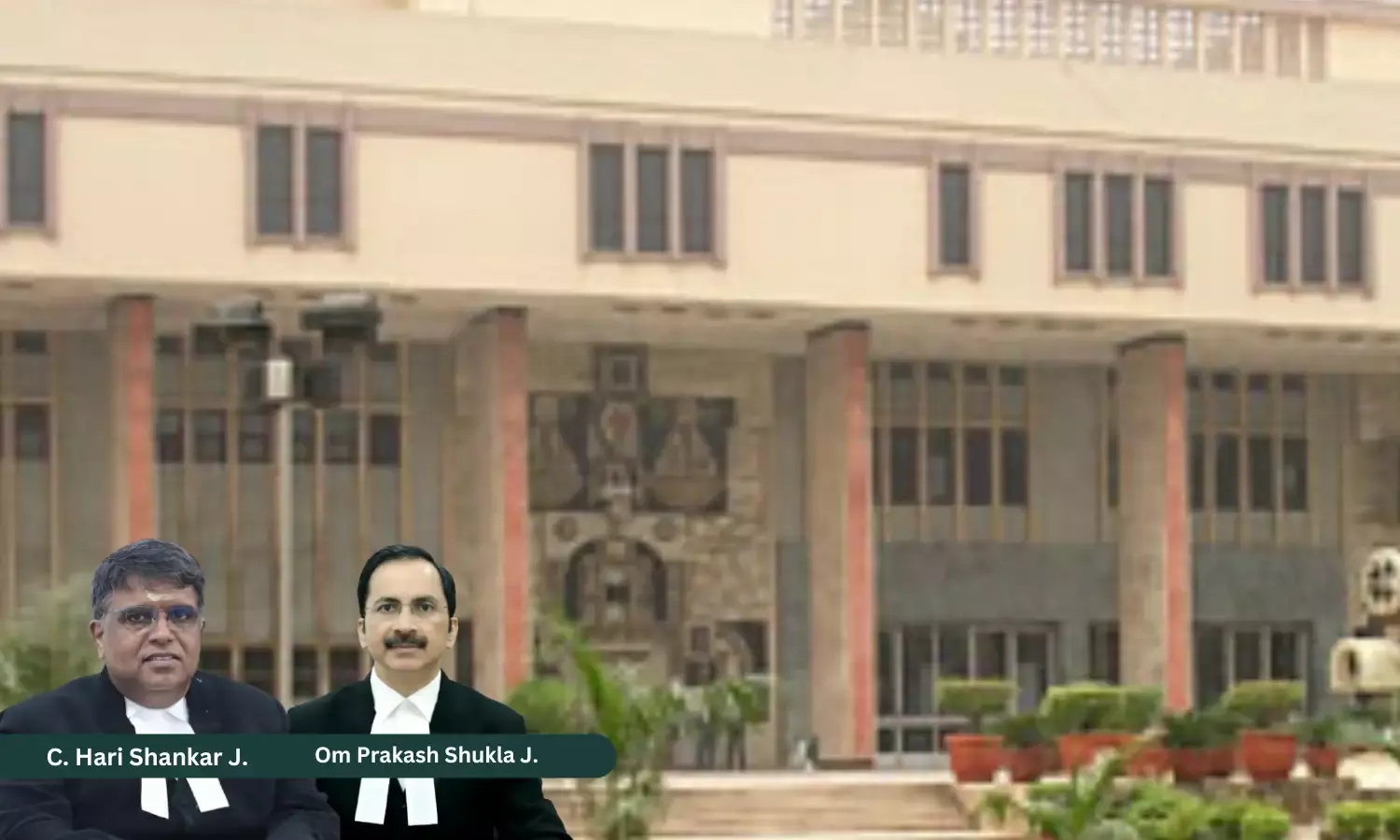
Justice C. Hari Shankar, Justice Om Prakash Shukla, Delhi High Court
The Delhi High Court held that the cut-off date in the middle of Financial Year (FY) deprives the persons of rights owed to them under Article 16 of the Constitution.
The Court allowed a batch of Writ Petitions filed by the persons belonging to the category of Other Backward Class (OBC) i.e., Non-Creamy Layer (NCL), aggrieved by the cancellation of their candidature for the Central Armed Police Forces (Assistant Commandant) Examination on the common ground that the OBC-NCL certificate submitted by them had not been issued and/or submitted by them within the prescribed cut-off period.
A Division Bench comprising Justice C. Hari Shankar and Justice Om Prakash Shukla observed, “The OBC-NCL certificates hold validity for a year, and the petitioners herein have furnished OBC-NCL certificates for the relevant year of examination. Though the stipulated cut-off date for issuance of OBC-NCL falls in between the FY, however, as held in Ravi Kumar (supra), the cut-off period must correspond to the FY. … The cut-off date in the middle of the FY deprives the petitioners of rights owed to them under Article 16 of the Constitution of India.”
The Bench said that the OBC-NCL certificate shall be considered by an appointing/recruiting authority so long as its date of issuance falls within the same FY as that of the examination for which the candidate appears.
Advocate Saaket Jain represented the Petitioners, while Senior Advocate Naresh Kaushik and CGSC Mukul Singh represented the Respondents.
Facts of the Case
The Petitioners applied for the CAPF (AC) Examination in the relevant years (i.e., either 2023 or 2024) and have cleared the written examination and were declared qualified to proceed to the subsequent stages, being, the Physical Efficiency Test/Physical Standard Test (PET/PST), Medical Standard Test (MST) and Personality Test (Interview). Since all the Petitioners fell under the OBC-NCL Category, they were mandated to furnish OBC NCL certificates issued within a prescribed timeframe for verification. This requirement of issuance of OBC-NCL certificate within a prescribed timeframe flowed from Rule 21.2 of the CAPF (AC) Examination Rules issued by the Ministry of Home Affairs vide Gazette Notifications and the said Rule was further reiterated in the examination prospectus issued by Union Public Service Commission (UPSC). Consequently, the Petitioners were afforded a 43 or 45-day window for obtaining the said OBC-NCL certificate.
The cut-off period began on 01.04.2023 for 2023 and 01.04.2024 for 2024. However, the Examination Rules by MHA (Ministry of Home Affairs) and the examination prospectus by UPSC which mandated this requirement were issued after the cut-off period had already begun, i.e., issued on 26th April 2023 and 24th April 2024. The Petitioners had submitted their respective OBC-NCL certificates, however, the primary issue faced by them was that the certificates were not issued within the stipulated window. Hence, their certificates were not considered by the Respondents. Due to the inability of the Petitioners to procure the certificates bearing a date within the cut-off stipulated window, the Respondents either cancelled the candidature or appointment or excluded their names from the interview or the Final Merit List or converted the Petitioner’s candidature to General/Unreserved category. Being aggrieved, the Petitioners approached the High Court.
Reasoning
The High Court in view of the facts and circumstances of the case, noted, “We further find that to cancel the candidature of otherwise eligible candidates, on sole grounds of issuance date, deprives the petitioners of their fundamental rights under Articles 14 and 16 of the Constitution of India and actually runs contrary to the object sought to be achieved by providing reservations in public employment as per the reasoning laid down in Ram Kumar Gijroya (supra), Anil Kumar (supra) and Pushpa (supra) discussed in the foregoing paragraphs.”
The Court was of the view that the present case is peculiar to the extent that the issuing authority itself has been negligent in communicating the recruitment rules and hence, the delay cannot be attributed to the Petitioners, as even though the Academic Calendar was issued a year ago, it only stipulates the date of notification/prospectus and the last date for submitting applications.
“… there is no reasonable justification by the respondents for a lapse of 24 days in 2024 and 26 days in 2023 in intimating the duration and the cutoff date for validity of the certificate. Accordingly, it cannot also be reasonably expected that the said certificate could have been issued by the competent authority within the remaining of twenty days in the cut-off period”, it remarked.
The Court reiterated that eligibility under OBC category cannot be equated to other technical/educational criteria for selection since it is not something one acquires later in life but is merely a confirmation of the status already possessed by an individual and the eligibility under the OBC category is by virtue of one’s birth and stems from our Constitution itself.
“… while there is no indefeasible right to be appointed in public employment, there is an inalienable right to be considered for such appointment and to be placed within the zone of consideration. … Procedural compliance cannot be an impediment in the broader pursuit of justice. Where a party is inherently entitled, delayed production of proof to that effect, cannot defeat or dilute the substantive rights owed to them”, it added.
The Court held that the Petitioner was effectively constrained to proceed in the selection process as a UR candidate and categorical and rigid stipulation of the issuance date for OBC-NCL certificates bears no rational nexus with the object sought through affirmative action of reservation in employment, i.e., equality in opportunity in public employment to reserved categories.
“… an administrative decision or action or cannot deprive an individual of the fundamental rights owed to them under Articles 14 and 16 of the Constitution of India, since there exists a legitimate expectation of reasonableness in administrative action, especially from constitutional and administrative bodies such as the respondents”, it further said.
The Court observed that caste certificates are reiteration of pre-existing facts and cannot be compared to other technical/educational criteria.
Conclusion
The Court also noted that the authority concerned has the power to stipulate cut-off periods, however, such cut-off period must be free from arbitrariness and/or unreasonableness and the concerned authority cannot exercise unfettered discretion.
“The power of stipulating such cut-off periods must be balanced with the rights owed to the candidates under Articles 14 and 16 of the Constitution of India. Administrative/ Regulatory/ Constitutional bodies cannot adopt an overly scrupulous and unyielding approach. … The candidates cannot negotiate recruitment rules and are required to adhere to them regardless of their impropriety. Hence, it is the duty of the concerned regulatory/constitutional/administrative bodies to act fairly, reasonably, and in consonance with the principles of natural justice”, it emphasised.
The Court, therefore, held that the cut-off period is arbitrary and hence, the prayer assailing Rule 21.2 of the Examination Rules issued by the MHA in 2023 and 2024 is allowed.
“The power to stipulate eligibility criteria is not unlimited and cannot be exercised in an arbitrary manner … The test under Article 14 of the Constitution of India is not satisfied, i.e., the cut-off date does not have any rational nexus with the object sought to be achieved by way of reservations in public employment”, it concluded.
Accordingly, the High Court allowed the Writ Petitions and directed the Respondents to consider the OBC-NCL certificates regardless of whether they were issued post the cut-off date as long as they are issued within the relevant FY.
Cause Title- Raghvendra Singh & Anr. v. Union Public Service Commission & Anr. (Neutral Citation: 2025:DHC:11105-DB)
Appearance:
Petitioners: Advocates Saaket Jain, Shivangi Anand, Sarthak Kumar Meena, and Parth Taran Singh.
Respondents: Senior Advocate Naresh Kaushik, CGSC Mukul Singh, Advocates Ravinder Agarwal, Manish Kumar Singh, Vasu Agarwal, Anand Singh, and Aryan Dhaka.
