

Supreme Court’s Mihir Rajesh Shah Judgment Operates Prospectively: Delhi Court On Written Communication Of Grounds Of Arrest Requirement
The Delhi High Court was considering a Petition filed under Articles 226 & 227 of the Constitution, read with Section 528 of Bharatiya Nagrik Suraksha Sanhita, whereby the petitioner sought a declaration that his arrest was unconstitutional.

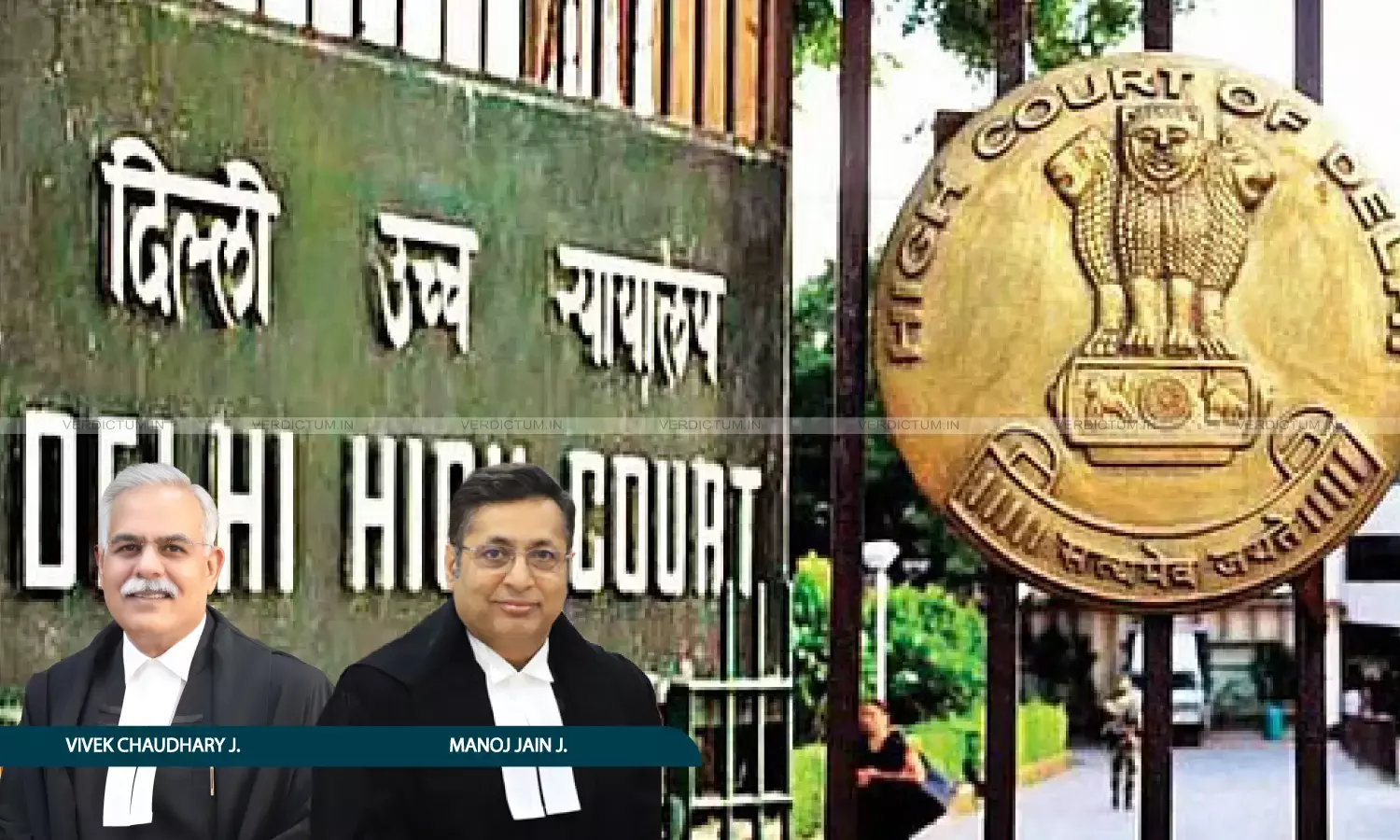
Justice Vivek Chaudhary, Justice Manoj Jain, Delhi High Court
While dismissing a petition filed by an accused challenging his arrest, the Delhi High Court held that the law laid down by the Supreme Court in Mihir Rajesh Shah v. State of Maharashtra (2025) mandating uniform written communication of grounds of arrest, operates prospectively.
The High Court was considering a Petition filed under Articles 226 & 227 of the Constitution, read with Section 528 of Bharatiya Nagrik Suraksha Sanhita, whereby the petitioner sought a declaration that his arrest was unconstitutional and in gross violation of Article 21, 22 (1) & Article 14 of the Constitution.
The Division Bench of Justice Vivek Chaudhary and Justice Manoj Jain held, “The law laid down in Mihir Rajesh Shah (supra), insofar as it mandates uniform written communication of grounds of arrest, operates prospectively.”
Advocate Chetan represented the Petitioner while Standing Counsel (Crl.) Sanjay Lao represented the Respondent.
Factual Background
The Petitioner was arrested in a case registered under Sections 302, 307, 34 of the Indian Penal Code, 1860. He filed an application seeking the grant of regular bail before the Trial Court, but the same was dismissed. The petitioner asserted that the grounds of arrest were never communicated to him till the filing of the chargesheet. The petitioner submitted that his co-accused had also moved an application seeking bail before the Trial Court, and while declaring his arrest as illegal, he was enlarged on bail.
Reasoning
The Bench explained that the legislative intent behind serving the grounds of arrest is to enable the arrested person to effectively secure legal representation and to promptly seek any appropriate legal remedies available, so that such remedies may be exercised without any delay. This requirement is designed to empower not only the arrestee but also those in a position to act on his behalf, thereby safeguarding the right to life and personal liberty guaranteed under Article 21 of the Constitution of India.
The Bench noted that the Apex Court in Mihir Rajesh Shah (supra) observed that in exceptional circumstances such as offences against body or property committed in flagrante delicto, where informing the grounds of arrest in writing on arrest is rendered impractical, it shall be sufficient for the police officer or other person arresting to orally convey the same to the person at the time of arrest. Later, a written copy of the grounds of arrest must be supplied to the arrested person within a reasonable time and in no event later than two hours prior to production of the arrestee before the magistrate for remand proceedings.
On a perusal of the facts of the case, the Bench noted that the petitioner had not come up with complete and true facts. As per the Bench, the grievance about the alleged procedural lapse was raised very belatedly i.e. after more than one year and nine months of the arrest. Moreover, there was no whisper of any prejudice being caused to the petitioner, who was represented by counsel from day one.
The Court found that the challenge to the arrest of the petitioner failed as the law laid down in Mihir Rajesh Shah (supra), insofar as it mandates uniform written communication of grounds of arrest, operates prospectively, and there was an absence of any demonstrated prejudice, coupled with the inordinate delay in raising the grievance. The Bench also took note of the petitioner’s evident contemporaneous awareness of the substance and basis of his arrest from the inception.
Thus, finding no merit in the petition, the Bench dismissed the same.
Cause Title: Karan Singh v. State NCT of Delhi (Neutral Citation: 2026:DHC:570-DB
Appearance
Petitioner: Advocates Chetan, Madhu Sharma
Respondent: Standing Counsel (Crl.) Sanjay Lao, Advocates Priyam Agarwal, Aryan Sachdeva, Insp. Gianender Singh, SI Vikram Singh